It is the era of longitudinal medicine, and you have blood-pressure readings taken monthly from hundreds of patients — but the repeated measurements on one patient are correlated, and a regression that treats every reading as an independent observation will drastically overstate its own certainty. Model the structure honestly: a population-level trend plus patient-specific random deviations, so each person can have their own baseline and slope drawn from a shared distribution. Get it wrong and you either pool everyone and erase real individual differences, or fit a separate line per patient and drown in noise — and, worst, you report confidence intervals far too narrow because you counted correlated readings as independent, and a treatment effect looks certain when it is not.
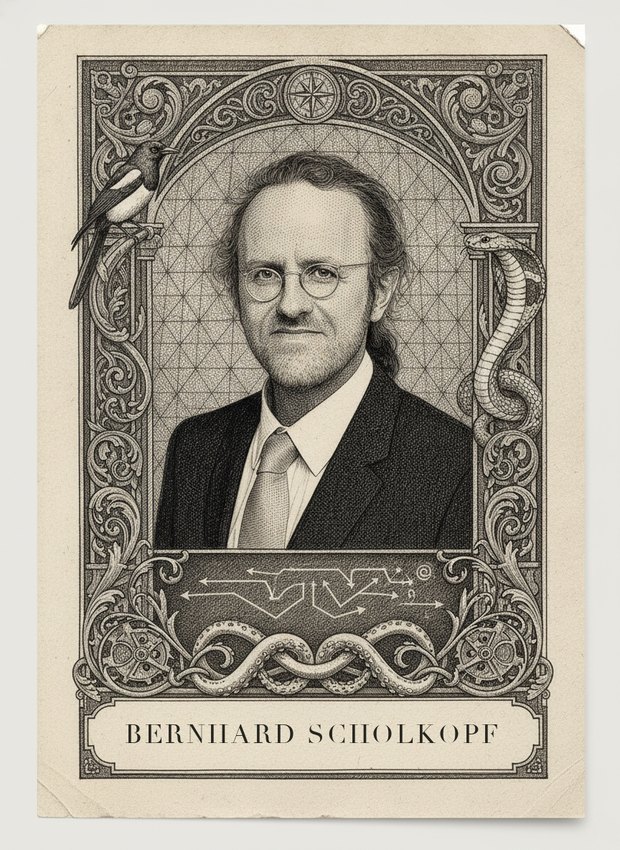
Chose The kernel two-sample and independence test — wrong. The kernel trick was the one that fit.
Scholkopf's systematization of kernel methods, including Gaussian process regression, offers a genuinely rigorous and mathematically related alternative to mixed-effects models — Gaussian processes and random-effects models share deep structural similarities in how they model correlated, patient-specific deviations from a population trend. His technical sophistication with covariance-structured estimation is directly relevant. But his substantive contributions target kernel-based machine learning developed from the 1990s onward, a later and differently framed approach than the classical random-effects mixed-model solution this repeated-measures problem's actual historical context requires. His kernel-methods program, systematized decades later, treats covariance-structured estimation as a foundational running theme throughout his most cited work. Nothing changes that. His actual career-defining work took shape in a machine-learning tradition quite separate from classical biostatistics.

The professor draws a single pooled regression line through six months of blood-pressure data from four hundred patients, is gently informed by a student that this is exactly the mistake the slide's own title warns against, and spends the next ten minutes explaining random intercepts while Andrew Gelman, seated in the front row, has already fit the correct hierarchical model on his laptop and is now checking his phone. His confidence interval for the treatment effect is, predictably, far too narrow, which is the specific and well-documented failure mode this entire scenario exists to test. He recovers by pointing out that at least he tried, which is true, generous, and not remotely the same as being right.
Battle #167 · 8/10/2026, 11:41:30 AM · this result is deterministic: the same two personas on this problem always resolve the same way.