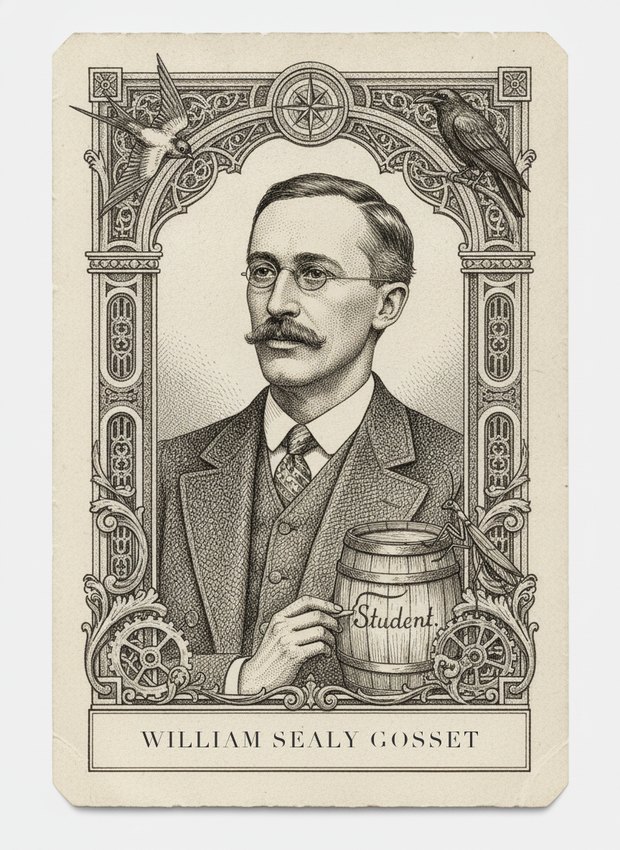
William Sealy Gosset
'Student' of the t-test; small-sample inference at Guinness
Strongest on
In the mind map
The same ideas, as concepts rather than history — in John's ML knowledge map.
Life and career
William Sealy Gosset is the only figure on this roster whose defining contribution was made because his employer would not let him put his name on it.
He was born in Canterbury in 1876, son of a Royal Engineers officer, educated at Winchester, and read chemistry and mathematics at New College, Oxford. In 1899 he joined Arthur Guinness, Son & Co. in Dublin as a brewer. This was not a sinecure; Guinness had begun recruiting scientifically trained young men to put brewing on a quantitative footing, and Gosset spent his whole career there, eventually becoming Head Brewer at the company's new London brewery at Park Royal shortly before his death in 1937.
The problem that made him a statistician was mundane and urgent. Brewing depends on inputs that vary — barley varieties, hop quality, yeast cell concentration in the pitching square — and on processes whose outcomes you can only sample. But the samples were tiny. You cannot run a thousand replicate brews. You get four field plots of a barley variety, or a handful of hemocytometer counts of yeast in a squared slide, and you have to decide whether one variety is genuinely better or whether you are looking at noise. The statistical theory available around 1900 was almost entirely large-sample: Pearson's methods assumed you knew, or could estimate accurately, the population standard deviation, and their distributional results held asymptotically. Gosset needed exact answers at n=4.
Guinness sent him for a year to Karl Pearson's Biometric Laboratory at University College London in 1906–07 to work on the problem. Pearson was helpful but, by Gosset's own account, did not fully appreciate why small samples required different theory rather than just wider error bars. Gosset worked it out largely himself, partly by an extraordinary empirical route: he took Macdonell's dataset of criminals' height and left-middle-finger measurements, wrote each subject's values on a card, shuffled the deck, dealt repeated samples of four, and computed the resulting statistic thousands of times to see what its distribution looked like. This is a Monte Carlo simulation, executed by hand with a card deck, used to verify a derivation. He published "The Probable Error of a Mean" in *Biometrika* in 1908 under the pseudonym **Student**, because Guinness forbade employees from publishing under their own names — a policy adopted after an earlier employee had leaked proprietary information. The company knew and permitted the work; it simply would not have its name or his attached.
Gosset's temperament was the opposite of his famous contemporaries'. He corresponded warmly and productively with both Ronald Fisher and Egon Pearson through the years when Fisher and Karl Pearson were at open war, and he seems to have been on good terms with everyone in a field notable for the reverse. Fisher, who was not generous by nature, called him the Faraday of statistics. Gosset's letters show a persistent practical bent: he cared about whether a method helped a brewer make a decision, and he argued with Fisher about randomization on exactly those grounds, preferring balanced systematic layouts in agricultural trials where Fisher insisted on randomization. He was largely wrong about that, and the disagreement was conducted without rancor on either side.
He died in 1937 at sixty-one, having spent thirty-eight years at Guinness.
Key contributions
**The t-distribution and the t-test.** The problem is this. To test whether a sample mean differs from a hypothesized value, you form (x̄ − μ)/(s/√n). If you knew the true σ this quantity would be standard normal. But you don't; you estimate it by s from the same small sample, and s is itself a random variable that is, in small samples, badly behaved — it underestimates on average and varies substantially. Substituting s for σ and pretending the ratio is normal produces confidence intervals that are too narrow and p-values that are too small, and the error is severe at small n.
Gosset derived the exact sampling distribution of that ratio under normality: what we now call Student's t with n−1 degrees of freedom. It is bell-shaped and symmetric like the normal but with heavier tails, converging to the normal as the degrees of freedom grow. The practical consequence is that the critical value for a two-sided test at n=5 is around 2.78 rather than 1.96 — the extra width is the honest price of not knowing σ. Fisher later supplied a rigorous geometric derivation and generalized the statistic to the regression and multi-parameter settings, giving the modern t-test for coefficients.
Three things about this deserve emphasis for a graduate audience. First, it is the first *exact small-sample* distributional result in statistics — not an asymptotic approximation but the true distribution for finite n. That shift, from "here is what happens as n → ∞" to "here is what happens at n = 4," is the conceptual break. Second, the mechanism is that the estimated variance in the denominator, being a chi-squared variate, inflates the tails; this same structure generates the F distribution, and the t/F/chi-squared family underlies ANOVA and essentially all classical linear-model inference. Third, the degrees-of-freedom correction encodes a genuine idea: you have spent one observation's worth of information estimating the mean, and the distribution knows it.
**Small-sample thinking as a discipline.** Beyond the specific distribution, Gosset's lasting contribution is a stance. He insisted that the right question is not "what does the estimate say" but "how much does the estimate vary given how little data I have," and that this must be built into the inference rather than acknowledged in a footnote. His work on correlation in small samples, on the Poisson distribution for yeast counts (the hemocytometer count problem is a canonical Poisson application and he treated it as one), and on the practical design of brewing and agricultural trials all follow the same logic.
**Empirical verification of a theoretical distribution.** The shuffled-card sampling experiment deserves note in its own right. Gosset did not have the tools to prove everything he wanted, so he simulated. Resampling as a method for interrogating a sampling distribution — later formalized as the bootstrap — has a genuine ancestor here.
In battle
Gosset's profile is one of the cleanest specializations on the roster: mean 37.3, median 35, but with nine problems above 80 and thirteen above 70, all of them clustered in a single regime. His small-sample category average is 71.7 across sixteen problems, and it is not close to anything else on his sheet.
The dominant problems are almost embarrassingly literal. "Counting yeast in the pitching square" is his best at 99 — his own workplace, his own problem, the reason the t-distribution exists at all. "Ten patients, one rare disease" (95) is inference from a handful of observations where variance must be estimated from the same handful. "The lady and her teacups" (93) and "The eight field plots" (92) are Fisher's problems, and Gosset scores just under Fisher on both because he was a genuine participant in that conversation — he corresponded with Fisher about agricultural trial design for years, though he lost the argument about randomization. "Two proportions, tiny cells" (91) is the small-count contingency table. "Count the fish you cannot see" (90) is capture-recapture with a small recapture sample. "The charge on a single drop" (88) is Millikan's oil-drop measurements: a small number of noisy physical readings where the uncertainty on the mean is the whole question. "The recombination fraction from a small cross" (86) is genetic linkage estimation from a limited cross. His testing average of 51.7 and experimental-design average of 42.3 round out the region.
His losses are a study in the opposite regime. "Train across a thousand GPUs" (5) is his floor, and the profile puts the contrast exactly: his method exists to reason honestly about scarcity, and this problem is about coordinating abundance. "Predict the next word" (6) is language modeling over enormous corpora, "A thousand categories, one bet" (8) is large-scale image classification, "Learning on the molecule graph" (6) is graph neural networks, and "Sequence the robot's actions" (6) is task planning. "Will it ever halt?" (5) is computability, which he never touched. His weak categories are systems 6.5, perception 8.0, search 8.0, networks 8.0, computability 8.0.
The pattern is unusually clean and worth stating as a lesson. Gosset does not fail because of era alone — he fails because his contribution is *specifically about the small-n regime*, and it becomes less necessary as n grows. At large n the t-distribution converges to the normal and his correction disappears into rounding error. He is the roster member whose advantage is largest exactly when data is scarcest and vanishes exactly when it is not. Play him on tiny samples, unknown variance, physical measurement, agricultural and biological trials, and any problem where the honest answer is "we have four observations." Do not play him on anything where the difficulty is scale, computation, or structure rather than scarcity.