small-sample
Counting yeast in the pitching square
It is 1906 at the Guinness brewery in Dublin, and the consistency of every batch of stout depends on pitching the right number of live yeast cells — but you cannot count a vat, only a few tiny squares under a hemocytometer, and the counts jump around alarmingly from square to square. From a handful of counts you must estimate the true cell density and state how uncertain that estimate is, using the law that governs rare countable events rather than pretending the fluctuation is measurement sloppiness. Get it wrong and batches are under- or over-pitched, fermentation stalls or runs wild, and a national product loses the uniformity its reputation rests on. Small counts are the whole difficulty.
Who this problem belongs to
The two figures whose methods fit it best, out of 47 in contention.
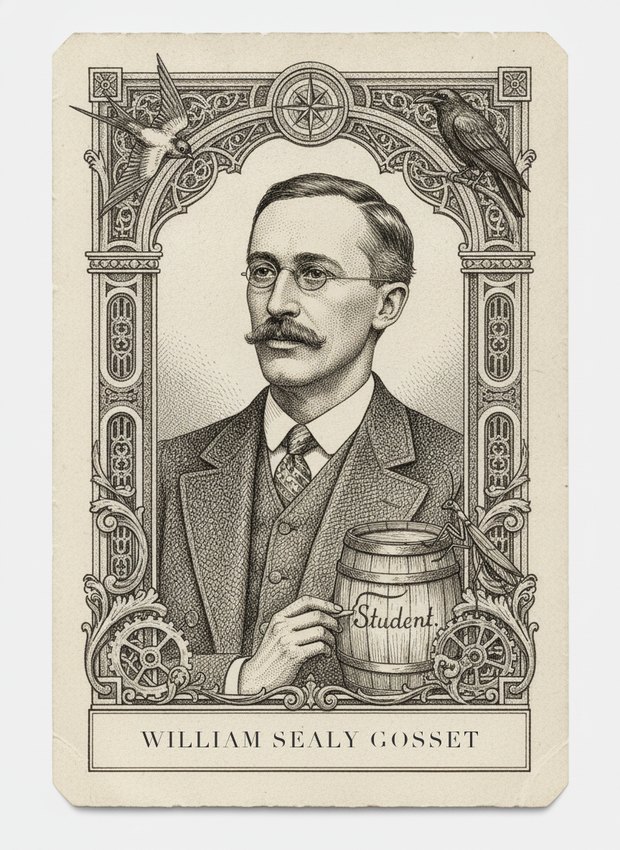
This is Gosset's own workplace and his own problem, not an analogy. Working as a brewer at Guinness in Dublin from 1899, he confronted precisely this: small hemocytometer counts of yeast cells with no large-sample theory to lean on, and Guinness's policy against publishing under employee names forced him to write as 'Student' (1908), inventing the t-distribution to handle exactly this small-n inference. His practical concern was batch consistency, the same stakes this problem names. No carrier has a closer match — he did not adapt a method to this problem, this problem is the reason his method exists.
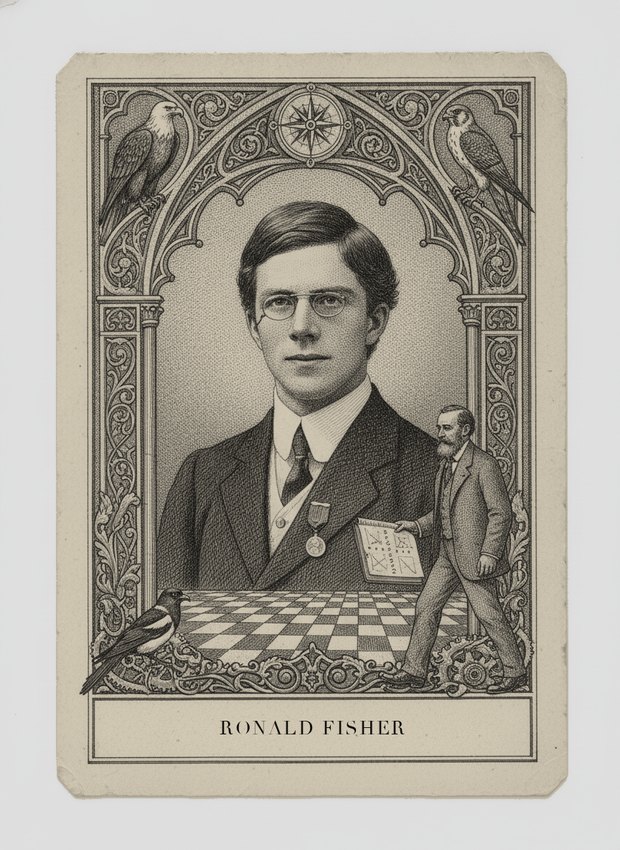
Fisher's maximum likelihood estimation and his development of the theory around counting processes (building directly on Gosset's small-sample work, which he championed and extended in the 1920s) give him the exact machinery for estimating a rate from sparse Poisson-like counts and attaching a rigorous likelihood-based uncertainty to it. His experimental-design instincts (replication, randomization) also speak to why counts vary across squares. He arrives slightly after Gosset's original brewery problem and generalizes it into the wider theory of estimation, making him an extremely strong but derivative second.
Fought here
In the mind map
The same ideas, as concepts rather than history — in John's ML knowledge map.
47 figures are scored on this problem. Draw it in a battle to see where you land.