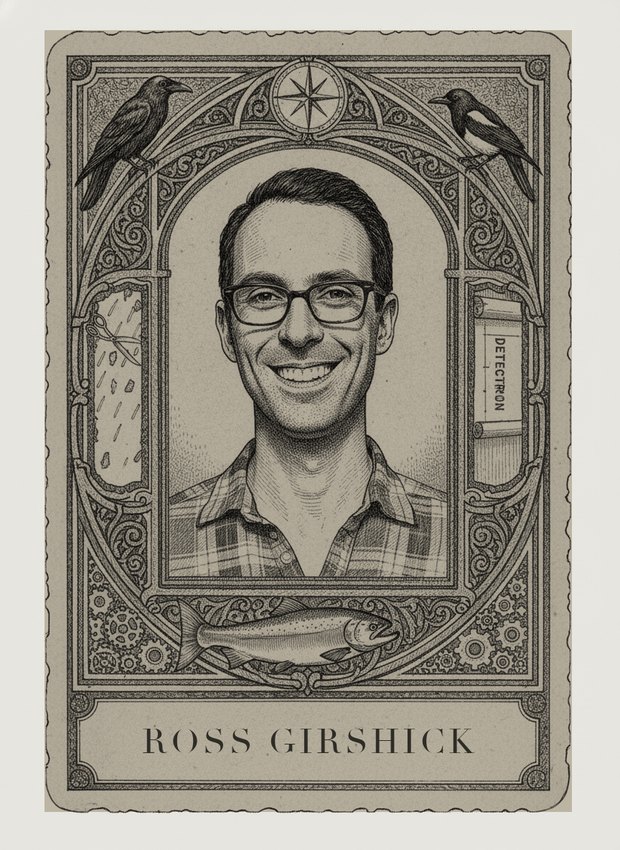
Ross Girshick
R-CNN lineage of object detection; Segment Anything
Played by Diogo · LinkedIn
Strongest on
Battles
Fill in the hidden variables W Dawn Song
The ruler that lies a little L Michael I. Jordan
The router's memory is smaller than its traffic L Michael I. Jordan
The grammar beneath the sentence L Grace Hopper
Is there a fast route through every city? L Aaron Clauset
The smooth curve, honestly
In the mind map
The same ideas, as concepts rather than history — in John's ML knowledge map.
Life and career
Object detection — putting a tight box around every object in an image and naming each one — was for a long time the least glamorous and most stubborn problem in computer vision. Classification had a clean formulation and a clean metric. Detection had a variable number of outputs, an enormous space of candidate locations and scales, an evaluation protocol nobody quite liked, and a decade of incremental progress. Ross Girshick is the researcher whose successive papers took detection from that condition to a solved-enough problem that it became a component other people build on without thinking about it.
He did his doctoral work at the University of Chicago with Pedro Felzenszwalb in the years just before deep learning arrived. That timing is important, because the system he helped build there — the deformable part model — was the reigning state of the art in detection for years and represented the high-water mark of the hand-designed approach. DPM detected objects by scoring a coarse root template plus a set of higher-resolution part filters, each allowed to shift relative to the root at a deformation cost, with the whole thing trained discriminatively using a latent-variable SVM where the unobserved part locations are inferred during training. It was elegant, it was carefully engineered, and it won the field's principal detection benchmark repeatedly. Knowing that Girshick came from *that* tradition explains a great deal about the papers that followed: he understood exactly what detection required, so when a new source of features appeared, he knew precisely where to put it.
He moved to Berkeley as a postdoctoral researcher with Jitendra Malik just as the ImageNet results demonstrated that convolutional networks learned dramatically better image features than anything hand-designed. The paper that resulted, R-CNN, is one of the most consequential in modern vision. He then spent time at Microsoft Research, where the architecture was refined into its fast and end-to-end forms, and afterward joined Facebook AI Research, where he spent years as one of the central figures in a group — alongside Kaiming He, Piotr Dollár, and others — that produced an extraordinary run of results in detection, segmentation, self-supervised learning, and eventually promptable segmentation. He has also been a principal force behind open detection software, whose successive releases made state-of-the-art detection reproducible by anyone rather than by the three labs that could reimplement it.
Key contributions
**R-CNN.** The 2014 paper answered a question the field was actively confused about: do the features learned by a convolutional network trained for whole-image classification transfer to *localization*? Girshick's answer was affirmative and the method was almost brutally direct. Generate a couple of thousand class-agnostic region proposals per image using an existing bottom-up segmentation method, warp each region to a fixed size, run it through a CNN pre-trained on ImageNet, and classify the resulting feature vector with per-class SVMs, followed by a learned bounding-box regressor to refine coordinates. It roughly doubled detection performance on the standard benchmark overnight. The paper's second contribution, arguably as important, was demonstrating **supervised pre-training followed by fine-tuning** on a small target dataset — the transfer learning recipe that became universal practice.
**Fast R-CNN.** R-CNN was slow and awkward: it ran the network separately on every proposal, and training was a multi-stage pipeline with features cached to disk. Fast R-CNN fixed both. Run the convolutional network *once* over the whole image, then for each proposal extract a fixed-size feature from the shared feature map using **RoI pooling**, which divides the projected region into a fixed grid and max-pools within each cell. Because RoI pooling is differentiable with respect to the feature map, the whole system trains end to end with a multi-task loss combining classification and box regression. Training time dropped by an order of magnitude, test time by two.
**Faster R-CNN.** The remaining bottleneck was the external region proposal step. With Shaoqing Ren, Kaiming He, and Jian Sun, Girshick replaced it with a **Region Proposal Network** — a small convolutional head sliding over the shared feature map, predicting objectness scores and box refinements relative to a set of predefined **anchors** at multiple scales and aspect ratios. Proposals now come from the same features used for detection, at almost no extra cost, and the entire detector is one network. Anchors have been the standard vocabulary of detection ever since.
**Mask R-CNN.** With He, Georgia Gkioxari, and Dollár, the extension to instance segmentation added a parallel branch predicting a binary mask per RoI. The key technical fix was **RoIAlign**: RoI pooling quantizes region boundaries to the feature grid, an error invisible for box prediction but destructive for pixel-accurate masks, so RoIAlign uses bilinear interpolation to sample at exact continuous locations. The other design decision worth noting is decoupling mask prediction from classification — predict one mask per class independently rather than a softmax over classes per pixel — which removed inter-class competition and improved results substantially.
**Focal loss and feature pyramids.** Two contributions addressing chronic detection problems. Feature pyramid networks build a multi-scale feature hierarchy with a top-down pathway and lateral connections, so that small objects are detected using high-resolution features that still carry semantic information. Focal loss addresses the extreme foreground–background imbalance in single-stage detectors by down-weighting the loss on easy, well-classified examples by a factor $(1-p_t)^\gamma$, so the enormous population of trivial background anchors stops drowning out the gradient from hard examples.
**Self-supervision and Segment Anything.** In the later FAIR period Girshick co-authored momentum contrast, a contrastive self-supervised method using a queue of negatives and a momentum-updated encoder, and masked autoencoders, which learn visual representations by reconstructing heavily masked image patches. Most recently he was a core author of Segment Anything, a promptable segmentation model trained on a vast mask dataset built through a model-in-the-loop annotation engine, capable of producing masks from point, box, or text-derived prompts and of returning multiple valid masks when the prompt is ambiguous.
In battle
Girshick has the narrowest card among his contemporaries: 100 problems, mean 21.4, median 12, and 69 problems at or below 20. But his ceiling is 97 and his `perception` category averages 41.4 across nineteen problems. He is a pure instrument.
**P071, "Segment anything"** (97) is his card and essentially unbeatable. He is a core author of the system itself, and the entire architectural lineage the problem depends on runs through his hands: R-CNN proving deep features transfer to localization, Fast and Faster R-CNN making it end-to-end and real-time, Mask R-CNN making high-quality per-object masks routine, and the model-in-the-loop annotation practices his group normalized. Prompt encoding, ambiguity-aware multiple mask outputs, and adapting transformer backbones to dense prediction are all design decisions his group made. The only deduction is that the result was a team's, not one person's.
The rest of his dominant band is detection in various guises. **P070, "Find every face"** (85) is detection specialized to faces. **P074, "Drive through the intersection"** (85) is autonomous driving perception, where his detectors are the literal components in most stacks — he sits just behind the people who shipped a fleet. **P029, "The tilted scan"** (83) is detection and localization under geometric variation. **P292, "Arrested by a false match"** (80) is facial recognition misidentification; he scores well because the underlying detection and recognition machinery is his, even though the accountability framing belongs to others.
Below that he falls off quickly. **P025, "Sixty thousand digits"** (72) is competent generic classification. **P148, "A thousand categories"** and **P233, "A thousand categories, one bet"** both score 55 — ImageNet-scale classification, where he is fluent but where the decisive contributions belong to the people who built and won that benchmark. That drop from 97 to 55 is the whole shape of his card: he owns detection and segmentation, and he is merely knowledgeable about everything adjacent.
His losses are among the most complete in the game, and they are worth reading as a lesson in specialization. **P221, "How much stock to hold"** (2) — inventory control by stochastic dynamic programming, a mid-century operations research problem — is his floor, with no structural overlap of any kind. **P122, "The lady and her teacups"** (3) is Fisher's exact test, **P151, "Three species of iris"** (3) is linear discriminant analysis on 150 samples, and **P215, "The therapy the trial reversed"** (3) is confounding in a clinical comparison. His `testing` average of 5.5 and `optimization` average of 6.0 are the lowest figures on his sheet. **P176, "Cut through the interior"** (4) is interior-point methods; **P249, "The shopping cart that must not vanish"** (4) is distributed systems.
There is a real pattern here. Girshick's career is defined by making one class of supervised visual task work extremely well at scale, and that skill has essentially no transfer to problems whose difficulty is inferential, economic, or infrastructural. His `high-dim` average of 13.2 across fifteen problems is a good illustration — he works with high-dimensional data constantly, but the mathematical questions about high-dimensional geometry are not his questions.
Play Girshick on anything involving finding, boxing, or masking objects in an image. Anywhere else, he is close to a wasted turn.