It is 1956, and two audiences with nothing else in common need the same theorem. Linguists want to know what kind of machine a human grammar is; the first compiler writers want to know what kind of grammar a machine can parse. Characterize which sentence structures a finite device can recognize — build the hierarchy of grammars and automata, prove the separations between its levels, and locate where natural language sits: beyond the reach of finite-state devices, as the center-embedded sentences suggest. The results must be theorems, not taxonomy. Get it right and both linguistics and programming-language design inherit their mathematical foundations from one construction; get it wrong and the study of language stays a catalogue of examples with no notion of what is possible.
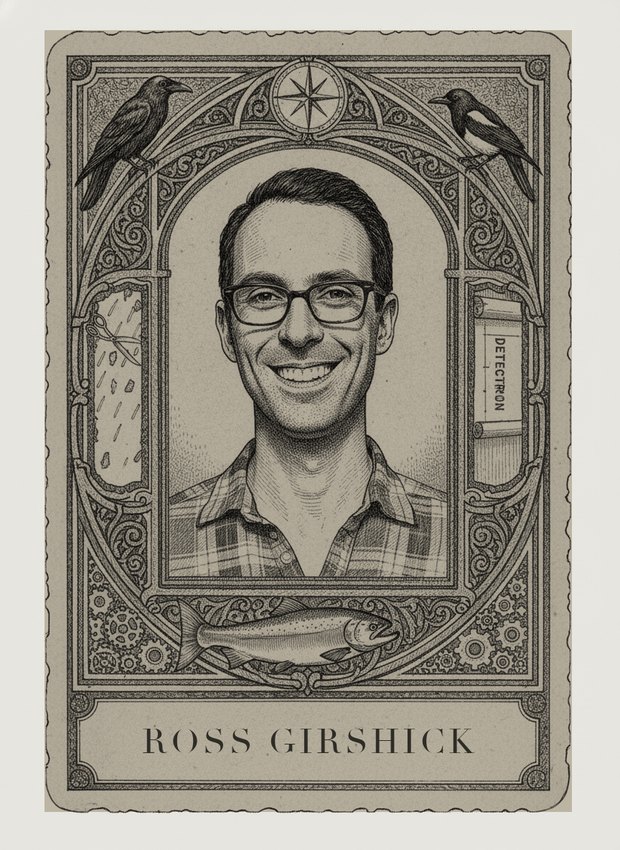
Girshick's R-CNN lineage of object detection, beginning with his 2014 paper at Berkeley and UC Berkeley's vision group, and his later contribution to Meta's Segment Anything model, address computer-vision architecture for localizing and segmenting objects in images -- work built on convolutional networks and region proposals, entirely disconnected from formal language theory, automata hierarchies, or the theorem-proving standard this 1956 problem demands. His career begins six decades after this problem's setting, in a research tradition concerned with pixels and learned visual features rather than symbolic grammar and parsing. His specialty shares no meaningful overlap with grammars, parsing theory, or the Chomsky hierarchy this brief specifically requires be proven, leaving essentially no transferable relevance.
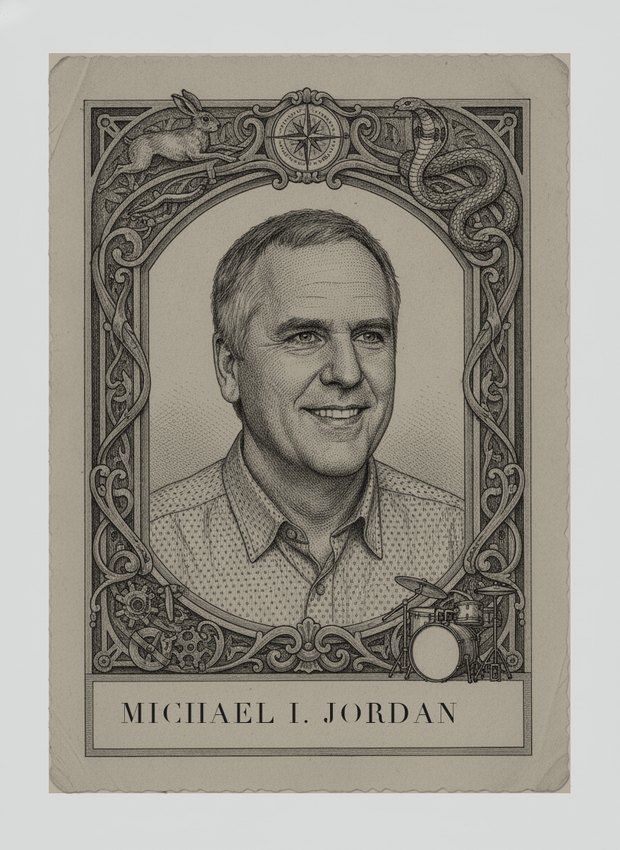
Jordan's career, from his Berkeley PhD work in the 1980s through his later synthesis of graphical models and modern statistical machine learning, demonstrates exactly the mathematician's instinct this problem rewards: unifying disparate formalisms -- Bayesian networks, variational methods, exponential families -- under one rigorous framework. That meta-skill is genuinely relevant to building a hierarchy spanning linguistics and computation. But his actual technical contributions concern probabilistic inference and statistical learning under uncertainty, not formal language theory, automata, or grammar classes, and his career begins three decades after 1956, missing the actual construction entirely. He would recognize and admire the Chomsky hierarchy as a unifying theorem the moment he saw it, but nothing in his own toolkit -- graphical models, EM, variational inference -- proves separations between regular, context-free, and unrestricted grammars.
Battle #53 · 8/9/2026, 8:42:01 PM · this result is deterministic: the same two personas on this problem always resolve the same way.