It is the era of data too big to fit in memory, and you are handed a matrix so enormous it cannot be held all at once, let alone factored by classical methods that assume random access to every entry. You still need its dominant structure — the top singular vectors that capture most of its action. Approximate them using a few randomized passes, multiplying by random test matrices to sketch the range, with provable guarantees on the error. Randomness buys scale that exactness cannot. Get it wrong and either the computation is simply infeasible and the analysis never happens, or your sketch silently loses the structure you needed and every downstream result is corrupted — randomized methods are what make linear algebra possible when the matrix dwarfs the machine.
Chose The logical clock — wrong. The quorum consensus was the one that fit.
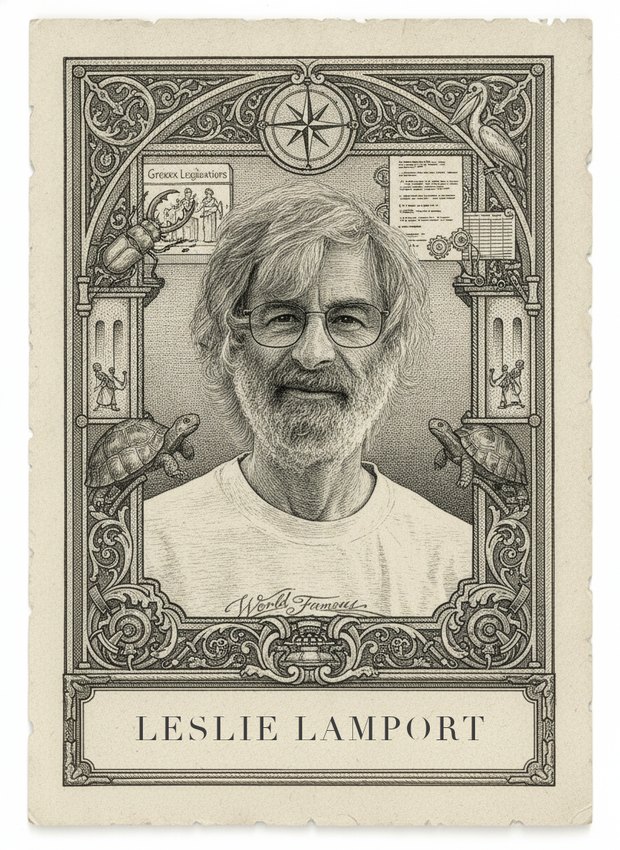
Lamport's science concerns time, ordering, and agreement in distributed systems — Paxos, logical clocks, Byzantine fault tolerance — with proofs (TLA+) about safety and liveness of protocols. An out-of-core sketching computation distributed across machines would happily run atop infrastructure his ideas secure, and his insistence on specifying what a system guarantees before trusting it is good hygiene for a pipeline whose failure mode is silent corruption. There is even an early-career curiosity: his 1970s work included a paper on parallel execution of sequential programs touching matrix computation styles. But his guarantees are about consistency and fault tolerance, not approximation error; probability enters his world as adversarial failure, not as an analytic resource; and singular subspaces, random projections, and spectral bounds are wholly outside his corpus. Infrastructure-adjacent, mathematically disjoint.

Song's field — systems security and adversarial machine learning — makes her professionally suspicious of exactly this problem's failure mode: a computation that silently returns corrupted structure. Her adversarial-ML work (from the mid-2010s) studies how small, targeted perturbations destroy learned representations, and her program-analysis background gives real systems competence with large-scale computation. There is even a genuine niche connection: verifiable computation and integrity of outsourced numerical work, which her security community studies, overlaps with certifying a factorization you cannot recompute. But she has no contributions to numerical linear algebra, randomized or otherwise; sketching, subspace embeddings, and spectral perturbation theory appear nowhere in her record, and her guarantees concern attacker models, not approximation error. She would audit the pipeline's integrity while someone else designed its mathematics.
Battle #110 · 8/10/2026, 11:38:27 AM · this result is deterministic: the same two personas on this problem always resolve the same way.