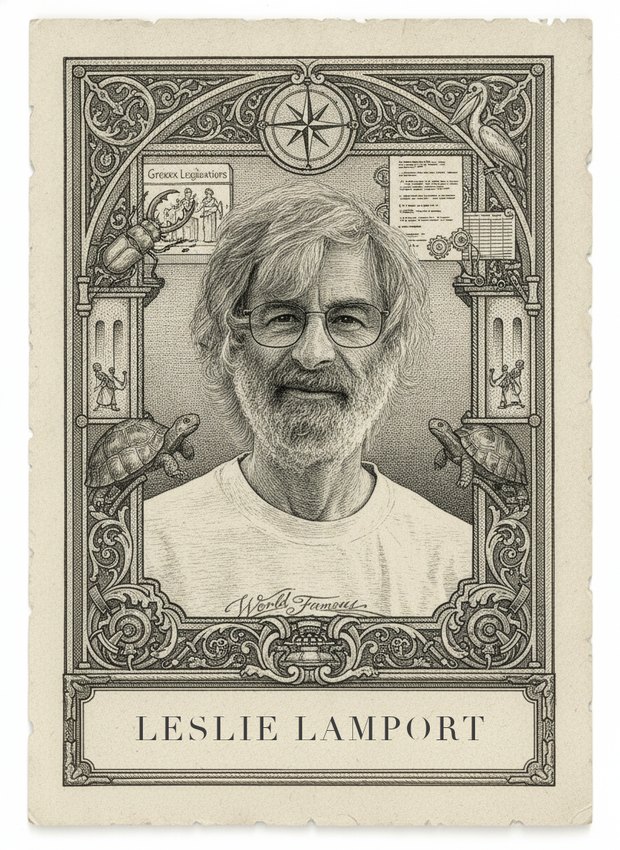
Leslie Lamport
Time in distributed systems; Paxos; LaTeX
Played by Daniel Alvarez
Strongest on
Battles
The model is five percent of the system L Dawn Song
Sketch the enormous matrix W Carlos Guestrin
Relax, then round L Carlos Guestrin
Optimize across the datacenter
Life and career
Leslie Lamport was born in New York City in 1941. He studied mathematics at MIT and took his master's and doctorate at Brandeis, completing a PhD in 1972 on analytic partial differential equations — a thesis with no obvious connection to computing. He arrived at computer science sideways, through jobs at Massachusetts Computer Associates and then at SRI International, and later spent many years at Digital Equipment Corporation's Systems Research Center and its successors, ending at Microsoft Research, where he worked from 2001.
The mathematical training is the key to everything he did afterward. Lamport approached distributed computing as a mathematician confronted with a domain where practitioners were reasoning informally about phenomena that defeat intuition. His consistent complaint over five decades has been that programmers do not know how to think precisely about concurrency, and his consistent remedy has been to insist on specifications and proofs. He has said, more or less, that if you are thinking without writing you only think you are thinking.
His 1978 paper "Time, Clocks, and the Ordering of Events in a Distributed System" is among the most cited papers in computer science, and its origin story is characteristic: he read a paper on replicated databases, believed it was wrong, and in working out why, discovered that the underlying issue was that "the time an event happened" is not a well-defined notion in a distributed system. He has remarked that the insight came from special relativity, which had taught him that simultaneity is observer-dependent.
Through the 1980s and 1990s he produced the results that define the field — the Byzantine Generals formulation with Robert Shostak and Marshall Pease, the bakery algorithm for mutual exclusion, sequential consistency as a memory model, and Paxos. The Paxos story is famous: he presented the algorithm as an archaeological account of the parliamentary procedures of the fictional Greek island of Paxos, complete with legislators wandering in and out of the chamber. Reviewers found the conceit distracting and the paper went unpublished for roughly nine years, appearing in 1998 as "The Part-Time Parliament." He eventually wrote a plainer version, "Paxos Made Simple," whose abstract consists of a single deadpan sentence to the effect that the algorithm is straightforward.
Alongside all this he wrote **LaTeX**, the document preparation system layered over Donald Knuth's TeX, which became and remains the standard for writing mathematics. It is, by a wide margin, the piece of his work that the largest number of people touch daily.
He received the ACM Turing Award in 2013 for fundamental contributions to the theory and practice of distributed and concurrent systems, notably the invention of concepts such as causality and logical clocks, safety and liveness, replicated state machines, and sequential consistency. He also holds the Dijkstra Prize (multiple times), the IEEE John von Neumann Medal, and membership in the National Academy of Engineering and National Academy of Sciences.
Key contributions
**Logical clocks and the happened-before relation.** The 1978 paper's central move is to abandon physical time. Define a partial order $\to$ on events: $a \to b$ if they occur in the same process with $a$ first, or if $a$ is the sending of a message and $b$ its receipt, plus transitivity. Two events unrelated by $\to$ are *concurrent* — and crucially, no observer can meaningfully say which came first. Lamport then gave a clock condition: assign each event a counter such that $a \to b$ implies $C(a) < C(b)$, implemented by incrementing a local counter on each event and, on receiving a message, taking the max of the local counter and the message's timestamp. Breaking ties by process ID yields a total order consistent with causality, which is enough to build a distributed mutual-exclusion algorithm — and, more importantly, to build a **replicated state machine**: if all replicas apply the same deterministic operations in the same order, they stay identical. That construction is the foundation of essentially all fault-tolerant service replication. Vector clocks, version vectors, and the causal-consistency machinery in modern distributed databases are all descendants.
**The Byzantine Generals Problem.** With Shostak and Pease (1982), Lamport posed the problem of reaching agreement when some participants may fail arbitrarily — crashing, sending contradictory messages, actively lying. The core results are sharp: with oral (unauthenticated) messages, agreement among $n$ generals tolerating $m$ traitors is possible if and only if $n \geq 3m + 1$; with unforgeable signed messages, any number of traitors can be tolerated. The naming was deliberate — he chose "Byzantine" partly to avoid slighting any actual nation — and the framing gave the field a permanent vocabulary. Byzantine fault tolerance underpins aerospace flight-control redundancy, and in the last fifteen years it has become the theoretical backbone of blockchain consensus.
**Paxos.** Paxos solves consensus in an asynchronous system with crash failures: a set of processes must agree on a single value, with **safety always** — never two different decided values, even under arbitrary message loss, delay, and reordering — and **liveness when the network behaves**. The protocol proceeds in numbered ballots with a two-phase structure: a proposer asks acceptors to promise not to accept lower-numbered proposals and to report any value they have already accepted, then proposes a value (constrained to any previously accepted one) and gathers acceptance from a majority. Quorum intersection does the work: any two majorities share a member, so no two ballots can decide differently. The FLP impossibility result means no such protocol can guarantee termination in a fully asynchronous system, which is exactly why Paxos separates safety from liveness. Multi-Paxos, running the protocol repeatedly to agree on a log, is what actually runs in production. Google's Chubby, Spanner, and ZooKeeper's ZAB descend from it, and Raft was designed explicitly as a more teachable equivalent.
**Safety and liveness; TLA+.** Lamport formalized the distinction between safety properties (nothing bad ever happens — violated by a finite prefix) and liveness properties (something good eventually happens — violated only by infinite behaviors), a decomposition now standard in verification. He then built **TLA+**, the Temporal Logic of Actions, a specification language in which a system is a set of behaviors and correctness is a formula, checkable by the TLC model checker. TLA+ has been used in production at Amazon Web Services, Microsoft, and elsewhere to find deep design bugs in distributed protocols before implementation — bugs that testing would never have surfaced because they require specific interleavings.
**LaTeX, the bakery algorithm, sequential consistency.** The bakery algorithm gives mutual exclusion without atomic read-modify-write operations, using only safe registers — a striking result about what is achievable with minimal hardware support. Sequential consistency, defined in 1979, remains the reference memory model against which weaker ones are described. And LaTeX made typeset mathematics accessible to everyone.
In battle
Lamport's computed profile shows a heavyweight specialist with meaningfully broader reach than the other systems figures here. He carries 100 problems at a mean of **27.8**, median 16, with **seven** dominant problems — the most of any systems figure in this set — and a range from 3 to 99. His top categories are **systems** at 55.9 across eighteen problems, **games** at 49.0, **computability** at 37.8, **search** at 37.0, and **networks** at 36.5.
He has two problems at 99. **P078, "Agreement among the unreliable"** is consensus — Paxos and Byzantine Generals together, with the safety-always/liveness-when-possible framing the problem states. The game's explanation notes that no other carrier owns both the historical protocol and the proof discipline this completely. **P247, "What happened first?"** is the logical-clocks paper, literally the question the happened-before relation was invented to dissolve. **P048, "Prove the program correct"** (93) is TLA+ and the safety/liveness decomposition. **P249, "The shopping cart that must not vanish"** (88) is durable replicated state, which is Paxos in commercial dress. **P204, "Solve the game, completely"** (83) is a surprising strength that his `games` average of 49.0 corroborates — exhaustive state-space search rewards the same appetite for enumerating all behaviors that model checking requires. **P076, "Index the entire web"** (82) is large-scale distributed systems. **P248, "The machine that overdosed"** (80) is Therac-25, whose failures were concurrency race conditions — precisely the class of bug Lamport built a career arguing can only be prevented by formal reasoning. **P080, "The software that may not fail"** (75) places him strong but behind Hamilton's 99.
The losses are uniformly statistical. **P285, "Test the many with the blood of few"** (3) is combinatorial group testing; **P184, "Fill in the hidden variables"** (3) is EM; **P183, "Cool it slowly"** (3) is simulated annealing; **P114, "Eleven factors, twelve runs"** (3) is fractional factorial design; **P182, "The corner that sparsity loves"** (4) is the lasso; **P135, "The probability of default"** (4) is credit-risk modeling. His `causality` and `regression` averages are both 5.0, `small-sample` 6.0, and `classification` 6.7. Fifty-five of his hundred problems fall at or below 20.
The strategic read: Lamport is the strongest systems pick here on breadth as well as peak, and the only figure who reliably wins *both* the consensus problems and the formal-verification problems. Anything involving multiple machines that must agree, order events, or survive failure is his. His stated battle identity is exactly right about the failure mode — he loses patience with sloppy informal reasoning, which means he loses whenever the correct answer is an empirical estimate rather than a proof.