systems
Agreement among the unreliable
It is 1989, and distributed systems keep working in the demo and diverging in production: two replicas each convinced they hold the true ledger. Five servers must agree on a value — a committed transaction, a configuration change — though any may crash mid-protocol, messages may be delayed indefinitely, and a crashed machine may recover with old state and strong opinions. Prove your protocol correct: not tested, proved, because the interleavings that kill consensus protocols occur once a month at scale and never in the lab. Impossibility results fence the terrain: safety must hold always, progress whenever the network permits. Banks, databases, and eventually every cloud service will stake correctness on this. An unproved consensus protocol is a distributed bug with a delay timer.
Who this problem belongs to
The two figures whose methods fit it best, out of 40 in contention.
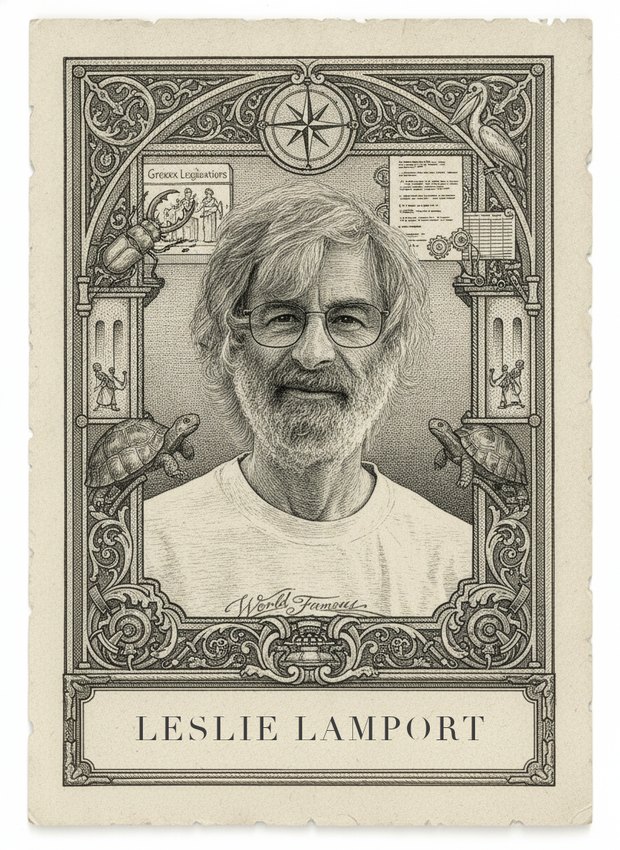
This is Lamport's field at exactly this moment: his Paxos protocol (developed around this 1989 setting, though published later after reviewers found it too playful) and his earlier Byzantine Generals work with Shostak and Pease (1982) formalize precisely this problem — a set of processes that must agree on a value despite crashes, delayed messages, and recovered machines with stale state. Lamport's papers are proofs, not demos, addressing exactly the safety-always/progress-when-possible framing the problem states. No other carrier owns both the historical protocol and the proof discipline this completely; this is as close to a perfect match as the roster contains. Even granting the era gap, Lamport's standing on time in distributed systems; paxos; latex is close enough to this problem's actual demands that a graduate student would expect a real, defensible showing rather than a token one.

Liskov's Byzantine fault tolerant replication work (PBFT, with Castro, building on distributed-systems foundations she had worked in since the 1970s and 80s) directly addresses consensus among processes that may not just crash but behave arbitrarily — a strictly harder and more general version of this problem's crash-fault model. Her substitution-principle rigor around correct abstraction also reflects the proof-oriented discipline the problem demands. Slightly behind Lamport because her most directly on-point protocol work is somewhat later than 1989, but the technical and methodological fit is exceptionally close. Even granting the era gap, Liskov's standing on data abstraction; the substitution principle is close enough to this problem's actual demands that a graduate student would expect a real, defensible showing rather than a token one.
40 figures are scored on this problem. Draw it in a battle to see where you land.