systems
What happened first?
It is 1978, and distributed systems have a metaphysical bug: two machines timestamp their events with two clocks, and the clocks disagree — not by error but by physics, because there is no master clock and messages take time. A replicated database applies updates in different orders on different replicas and diverges. Define what "before" even means across machines that share no clock: an ordering built from causality — message sends and receipts — rather than wall time, and a construction that lets every replica process the same requests in the same order. Get it wrong and every distributed ledger, file system, and reservation system on earth inherits a subtle disease: replicas that are each locally consistent and collectively contradictory, with no one able to say which history really happened.
Who this problem belongs to
The two figures whose methods fit it best, out of 33 in contention.
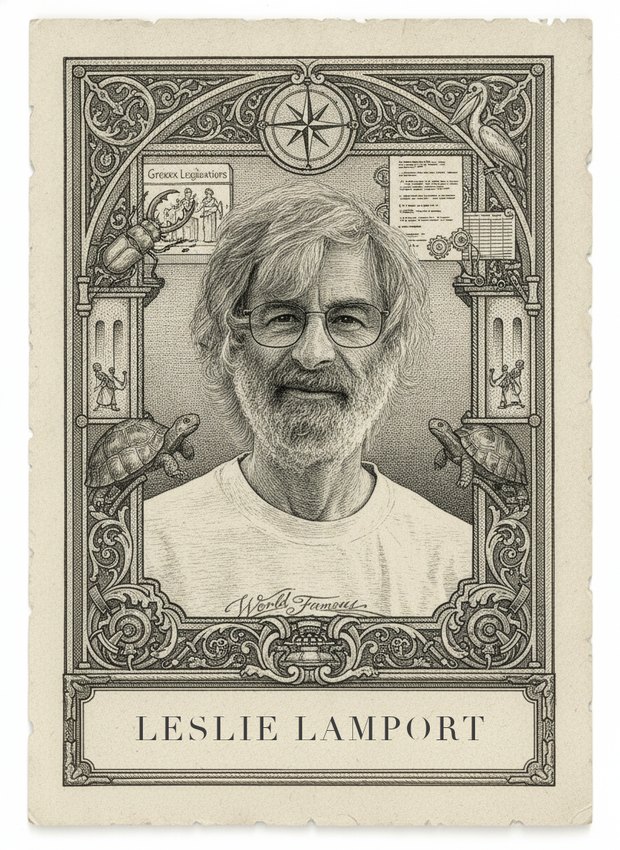
This is not a hypothetical for Lamport; it is his own 1978 paper, 'Time, Clocks, and the Ordering of Events in a Distributed System,' which is the founding document of the exact problem this scenario poses. He showed that without a shared master clock, 'before' cannot be defined by wall-clock time alone, and instead constructed a logical ordering from causality itself: if a message is sent before it is received, the send happens-before the receive, and this relation, together with each process's own local sequence of events, generates a partial order sufficient to timestamp events consistently across machines. His logical clocks and his broader construction for how replicas can agree on a consistent total order of requests are precisely the tools this problem's 'define what before even means' demands. Few problems on this roster have a more exact single-author match.
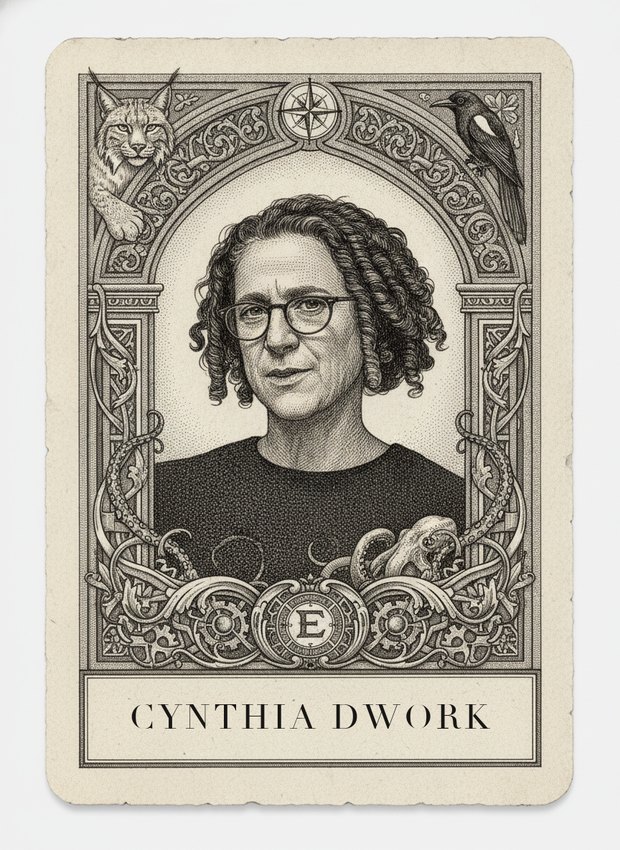
Dwork's 1988 paper with Lynch and Stockmeyer, 'Consensus in the Presence of Partial Synchrony,' tackles the direct sibling of this problem's challenge: how replicas in a distributed system can agree on a consistent history of events when no shared clock exists and message delays are unpredictable, establishing rigorous conditions under which consensus is achievable despite the impossibility results that haunt fully asynchronous systems. That work sits in the same research lineage as Lamport's causal-ordering construction, tackling agreement rather than ordering per se, which is why her score sits just below Lamport's rather than matching it. Her later differential-privacy career moved into a different subfield, but this specific 1988 contribution is squarely, directly on point for this problem's distributed-consensus stakes.
Fought here
33 figures are scored on this problem. Draw it in a battle to see where you land.