It is 1978, and distributed systems have a metaphysical bug: two machines timestamp their events with two clocks, and the clocks disagree — not by error but by physics, because there is no master clock and messages take time. A replicated database applies updates in different orders on different replicas and diverges. Define what "before" even means across machines that share no clock: an ordering built from causality — message sends and receipts — rather than wall time, and a construction that lets every replica process the same requests in the same order. Get it wrong and every distributed ledger, file system, and reservation system on earth inherits a subtle disease: replicas that are each locally consistent and collectively contradictory, with no one able to say which history really happened.

Gelman's work on hierarchical Bayesian modeling and applied Bayesian workflow addresses how to build and validate statistical models for structured data, a domain of applied statistics with essentially no direct technical overlap with this problem's 1978 challenge of establishing causal event ordering across multiple machines with no shared clock. There is no meaningful bridge between Bayesian hierarchical modeling and distributed-clock or consensus protocols. His relevance to this specific historical distributed-systems problem is essentially nonexistent beyond both belonging to the broad quantitative sciences, developed in entirely separate technical traditions decades apart. The absence of overlap here is itself a useful marker of how differently 'consistency' is used across Bayesian statistics and distributed systems.
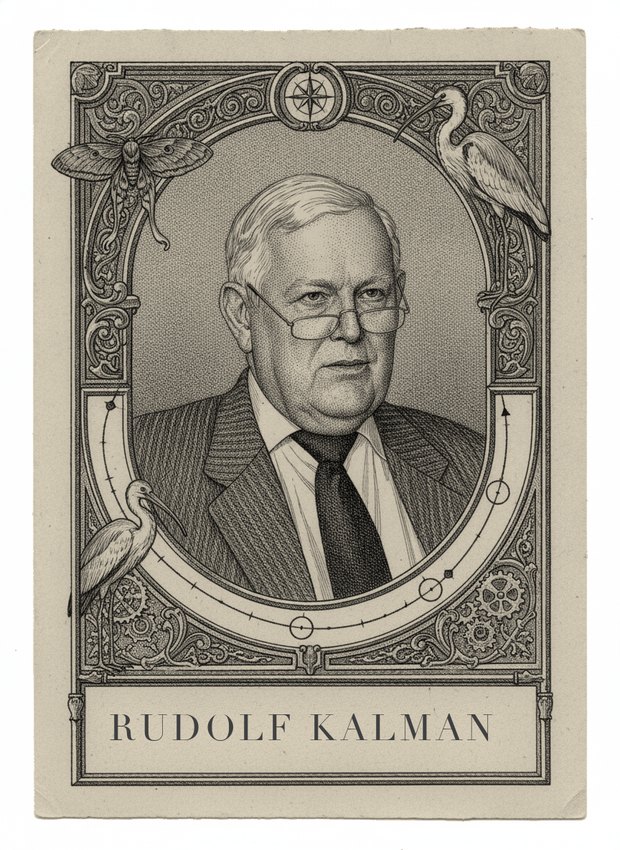
Kalman's filter recursively estimates a system's continuous state from noisy, time-stamped observations, a domain of estimation theory that shares a loose thematic concern with this problem's challenge of reconstructing a coherent picture of events from imperfect, distributed information sources. His rigorous approach to combining uncertain measurements into a consistent estimate is philosophically adjacent to reconciling divergent replica states. But his own signature contribution addresses continuous-state estimation for control systems with an assumed reliable time reference, not the discrete, clockless causal-ordering problem Lamport's 1978 paper specifically solves for distributed computing, so his relevance is a loose estimation-theory analogy rather than direct engagement with this problem's actual technique. His broader rigor around provably optimal estimation is a generally admirable habit, even where the specific distributed-systems content belongs elsewhere.
Battle #12 · 8/9/2026, 4:59:53 PM · this result is deterministic: the same two personas on this problem always resolve the same way.