It is the era of data too large for one machine, and the optimization problem itself must be split across a cluster: each node holds a shard of the data and can solve its own piece, but the pieces are coupled through shared variables that must agree. Naively synchronizing every step drowns in communication. Decompose the global objective so each machine optimizes locally and the nodes reach consensus through a lightweight exchange of a few coordinating variables, converging to the same answer a single giant machine would find. Prove it converges and keep the communication affordable. Get it wrong and you either bottleneck on the network, or let the shards drift and converge to something optimal for no one — distributed optimization is what makes datacenter-scale learning possible.
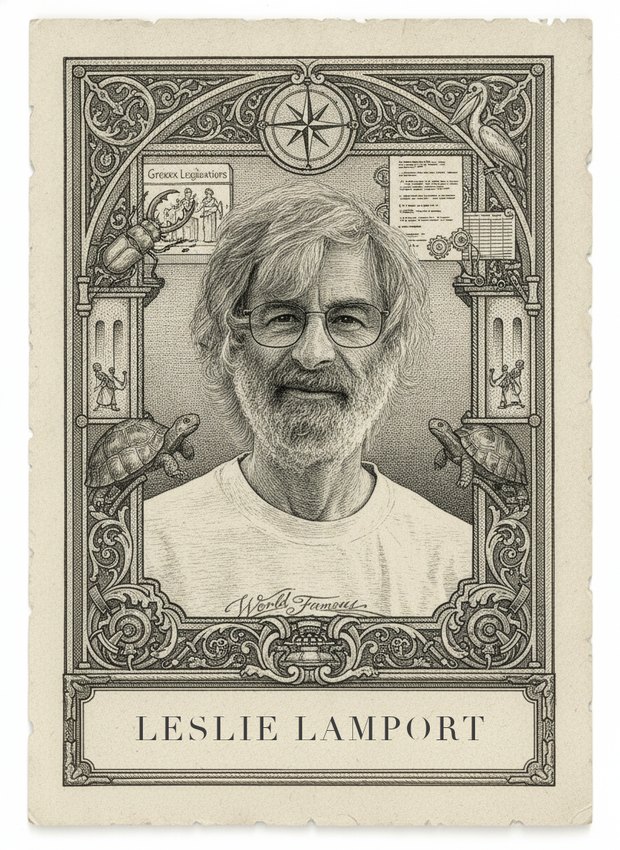
Chose The formal specification — wrong. The quorum consensus was the one that fit.
Lamport's foundational work on logical clocks, Paxos consensus, and the theory of distributed systems directly addresses the coordination problem this problem's 'lightweight exchange of a few coordinating variables' describes, achieving agreement among distributed nodes despite limited, asynchronous communication is precisely his signature contribution, even though his specific application, general distributed agreement, differs from this problem's continuous optimization setting. His rigorous mathematical treatment of what distributed nodes can and cannot know about each other's state without excessive communication is directly relevant to why this problem's communication-efficiency constraint matters. He never developed ADMM or convex-optimization consensus methods specifically. His score reflects strong foundational distributed-systems-theoretic relevance. Leslie Lamport would recognize the shape of this problem immediately from adjacent work, even without having personally published the specific technique it calls for.

Guestrin's GraphLab and broader distributed machine learning research directly engaged exactly this problem: decomposing large-scale machine-learning computations across a cluster of machines with data partitioned into shards, ensuring correct, efficient convergence to a global answer despite the distributed setting. His work on distributed optimization for graphical models and large-scale learning systems addresses the practical engineering of exactly this problem's stated challenge. But he did not develop ADMM or its foundational convex-optimization convergence proof; his contribution is building and analyzing practical distributed learning systems within this broader framework. His score reflects strong, direct practical and research engagement with this problem's application domain. The overlap is real enough that Carlos Guestrin could contribute meaningfully to a discussion of this problem, short of having built the specific tool it requires.
Battle #70 · 8/10/2026, 11:36:03 AM · this result is deterministic: the same two personas on this problem always resolve the same way.