It is 2011 at MIT, and the gap is embarrassing: state-of-the-art learning systems need thousands of labeled examples to recognize a category, while a three-year-old down the hall at the daycare sees three examples of a new word — "that's a wug, there's another wug" — and generalizes correctly, immediately, including to cases she has never seen. Model this one-shot concept learning as Bayesian program induction: structured priors over how concepts are built, likelihoods that explain why three examples suffice, inference that lands where the child lands. The stakes run in both directions — a computational account of human concept learning for cognitive science, and an existence proof that data-hungry statistics is not the only path, which the deep-learning era badly needs to hear.
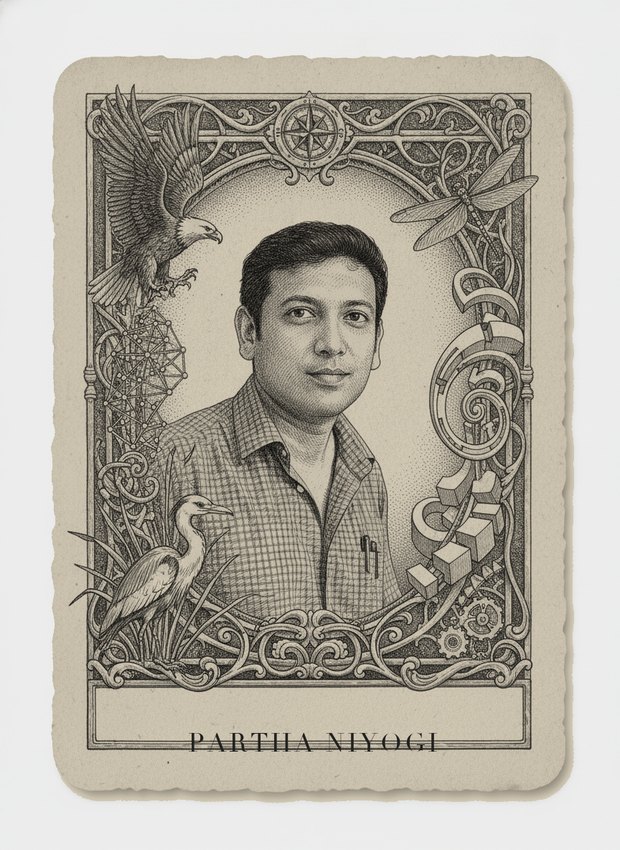
Chose The Laplacian eigenmap — wrong. The learnability analysis was the one that fit.
Niyogi worked this problem's home terrain: the learning theory of language acquisition. His work with Berwick in the 1990s formalized how children converge on grammars from limited evidence — treating acquisition as inference in a constrained hypothesis space, the same logic as structured priors over concepts — and The Computational Nature of Language Learning and Evolution (2006) is a sustained treatment of learnability from sparse data. His manifold-learning line (Laplacian eigenmaps with Belkin, 2003) is a second, different formalization of how structure tames data hunger: unlabeled data reveals geometry that makes few labels suffice, semi-supervised learning's answer to the wug. He died in 2010, just before this problem's moment. His frameworks were parameter-setting and spectral rather than program-induction, and he modeled populations more than individual children — but few carriers genuinely studied why children need so little data; he did.
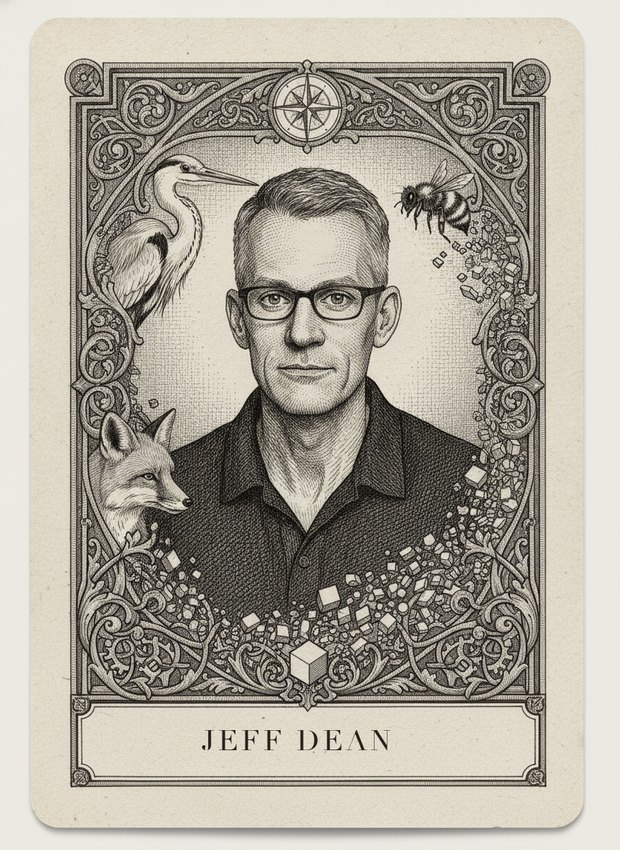
Dean's genius is systems leverage: MapReduce and Bigtable (2004-2006) let Google compute over planetary data, and in 2011 he was standing up Google Brain, whose founding demonstration — thousands of cores learning a cat detector from ten million YouTube frames — is this problem's designated villain, the state-of-the-art system needing orders of magnitude more data than the daycare child. His later TensorFlow made large-scale gradient descent a commodity. None of this machinery addresses structured priors, program induction, or cognitive modeling; his optimization is of throughput, not of hypothesis spaces. The one honest connection is that Dean's infrastructure eventually powered everyone's inference engines, including probabilistic-programming backends. But the problem is explicitly a rebuke of scale-first learning, and Dean is scale-first learning's chief engineer.
Battle #114 · 8/10/2026, 11:38:40 AM · this result is deterministic: the same two personas on this problem always resolve the same way.