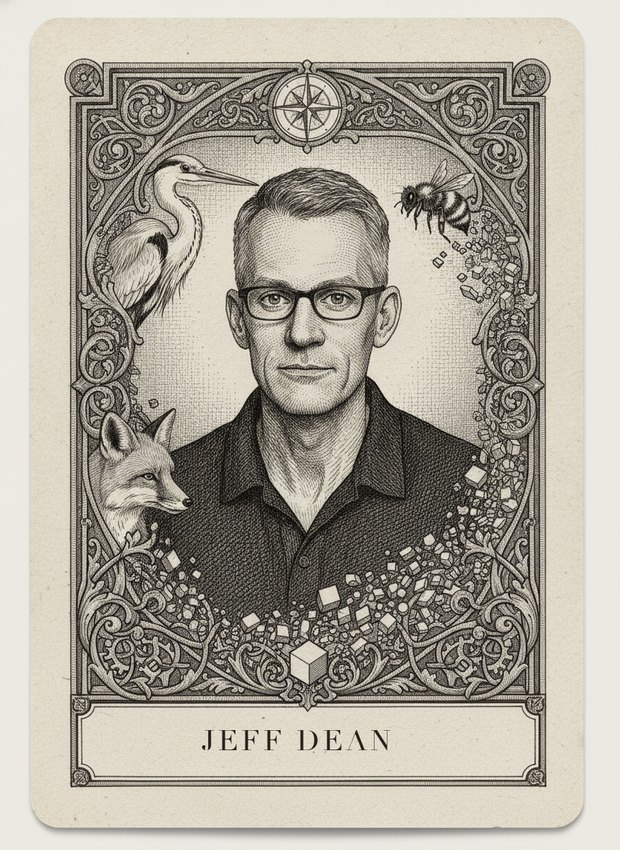
Jeff Dean
MapReduce, Bigtable, TensorFlow; large-scale ML systems
Played by Anushka
Strongest on
Battles
The shopping cart that must not vanish L Partha Niyogi
The million-parameter valley L Partha Niyogi
The heuristic that never lies W Partha Niyogi
Concepts from three examples L Partha Niyogi
Squash the dimensions, keep the distances W Partha Niyogi
Beat the world champion L Michael I. Jordan
Tune the un-differentiable W Grace Hopper
The parallel text is the teacher
In the mind map
The same ideas, as concepts rather than history — in John's ML knowledge map.
Life and career
Jeffrey Adam Dean was born in Hawaii in 1968 and had an unusually itinerant childhood — his father was a tropical disease epidemiologist and his mother a medical anthropologist, and the family lived in several countries as the work moved. He has said that he wrote software for his father's public-health work while still a teenager, including a statistical analysis package for epidemiological data that saw real use in the field. That origin is worth remembering, because it establishes early the pattern of his career: build the tool that lets other people do their work at a scale they could not otherwise reach.
He took an undergraduate degree in computer science and economics at the University of Minnesota, writing an undergraduate thesis on parallel training of neural networks — in 1990, which is to say a full two decades before that became the central problem in computing. He then did a PhD at the University of Washington under Craig Chambers, working on compiler optimization for object-oriented languages, particularly whole-program analysis and dynamic dispatch optimization. After finishing he joined **DEC's Western Research Laboratory** in Palo Alto, where he worked on profiling tools and compilers and where a remarkable concentration of systems talent was assembled — much of which would shortly relocate to a startup down the road.
He joined **Google** in mid-1999, when the company was still small and the crawler was struggling. Over the following two decades he was involved in an implausible fraction of Google's core infrastructure: the crawling and indexing system, the serving system, the ad-serving system, MapReduce, BigTable, Spanner, LevelDB, protocol buffers, the distributed neural-net training project that became Google Brain, TensorFlow, and the TPU program. He was named a Google Senior Fellow and eventually became head of Google AI, and later Chief Scientist at Google and Google DeepMind.
The "Jeff Dean facts" phenomenon — a set of jokes in the style of Chuck Norris facts, circulated internally at Google and then publicly — is an odd artifact but a genuine cultural signal. Engineers made them up because the productivity was hard to account for by normal means. Dean himself has been consistently gracious about the whole thing and quick to credit collaborators, especially Sanjay Ghemawat, with whom he has worked so closely and for so long that they are routinely discussed as a single unit. The pairing is one of the most productive documented collaborations in software engineering.
He is a member of the National Academy of Engineering, a Fellow of the ACM and AAAS, and shared the 2012 ACM–Infosys Foundation Award (now the ACM Prize in Computing) with Ghemawat for their work on large-scale distributed systems.
Key contributions
**MapReduce.** The 2004 paper by Dean and Ghemawat solved a problem that was, in a sense, purely one of abstraction. Google needed to run computations over petabytes of data on thousands of commodity machines that fail routinely. The individual computations — count occurrences, invert an index, sort — were trivial. The hard parts were partitioning the data, scheduling work, handling machine failures, dealing with stragglers, and shuffling intermediate results. MapReduce let a programmer write two ordinary functions, `map(k1,v1) -> list(k2,v2)` and `reduce(k2, list(v2)) -> list(v2)`, and hand everything else to the framework: parallelization, fault tolerance through re-execution of failed tasks, locality-aware scheduling that moves computation to the data, and **backup tasks** that speculatively re-run stragglers.
The intellectual content is the recognition that fault tolerance can be *free* if the computation is expressed in a restricted functional form. Because map and reduce tasks are deterministic and side-effect-free, a failed task can simply be re-run. The restriction is the price; the payoff is that ordinary engineers, with no distributed-systems training, could write jobs that ran on ten thousand machines. Hadoop was a direct open-source reimplementation, and Spark, Flink, Dataflow, and the entire big-data ecosystem descend from the idea even where they have moved past the specific API.
**The Google storage stack.** With Ghemawat and others, Dean built the layers beneath MapReduce. **GFS** (with Ghemawat and Gobioff) assumed commodity disks fail constantly and provided a distributed file system with large chunks, replication, and relaxed consistency tuned for append-heavy workloads. **BigTable** provided a sparse, distributed, sorted multidimensional map — rows, column families, and timestamps — with strong single-row consistency, giving structure without the cost of a full relational database at that scale; it is the direct ancestor of HBase, Cassandra's data model, and much of the NoSQL movement. **Spanner** went further, offering globally distributed transactions with external consistency, achieved through the **TrueTime** API: rather than pretending clocks are synchronized, TrueTime exposes a bounded *uncertainty interval* over the current time using GPS and atomic clocks, and Spanner simply waits out the uncertainty before committing. This is a beautiful engineering move — it converts an unsolvable distributed-systems problem into a latency cost you can pay.
**Large-scale machine learning.** Dean co-founded **Google Brain** with Andrew Ng and Greg Corrado. **DistBelief**, described in the 2012 "Large Scale Distributed Deep Networks" paper, introduced practical model parallelism and data parallelism with asynchronous SGD across a parameter server — training networks far larger than a single machine could hold, at a moment when the field still largely believed that was infeasible. **TensorFlow**, released open-source in 2015, generalized the approach into a dataflow-graph framework that could target CPUs, GPUs, TPUs, and mobile devices from the same program, and it dominated the ML tooling landscape for several years before PyTorch's eager-execution model won back much of the research community.
**TPUs and hardware co-design.** Dean was central to Google's decision to build custom accelerators. The Tensor Processing Unit trades general-purpose flexibility for enormous throughput on low-precision matrix multiplication, and the first-generation paper's argument — that inference workloads at Google's scale justified custom silicon — reset industry expectations about who builds chips. He has also written and spoken influentially about the **"numbers everyone should know"**: the latency of an L1 cache reference versus a disk seek versus a round trip across the Atlantic, a mental model that shapes how a generation of engineers reasons about system design.
In battle
Dean's computed profile is the strongest systems card in this set by a wide margin. He carries 100 problems at a mean of **34.8** with a median of 27, **eight** dominant problems, **fifteen** at 70 or above, and only 38 at or below 20 — dramatically fewer weak problems than Ritchie (77), Thompson (68), or Hamilton (71). His range is 3 to 98. Crucially, his strength is not confined to `systems` (53.3): he leads on **high-dim** (75.0), **perception** (60.4 across five problems), and **rl** (48.8), and posts respectable numbers in `fairness` (38.8) and `classification` (38.7). He is the only figure in this group who is genuinely competitive on machine-learning problems.
His ceiling problems come in a cluster of three 98s. **P076, "Index the entire web"** is MapReduce and GFS in their original 2003–2004 setting, solving literally the problem they were built for. **P081, "Train across a thousand GPUs"** is DistBelief and TensorFlow — distributed training, parameter servers, and the practical engineering of asynchronous SGD at scale. **P253, "The model is five percent of the system"** is the ML-infrastructure thesis he has articulated repeatedly: the model is a small component in a system dominated by data pipelines, serving, monitoring, and versioning. **P250, "The cluster that iterates"** (92) is iterative distributed computation, where MapReduce's limitations and their successors are his own territory. **P237, "Replace the acoustic model"** (90) is the deep-learning displacement of GMM-HMM speech systems, which Google Brain drove. **P293, "Train on the phones, keep the secrets"** (85) is federated learning, developed at Google under his organization. **P227, "Cool the datacenter"** (80) rewards actual datacenter operations experience. **P287, "The router's memory is smaller than its traffic"** (80) is streaming and sketching at scale — engineering-side rather than Yao's lower-bound side, and note that Yao scores 95 there while Dean scores 80; the two approach the same problem from opposite ends.
His losses are precisely the whiteboard problems. **P113, "The first randomized trial"** (3) is the streptomycin trial and the logic of randomized assignment. **P083, "The grammar beneath the sentence"** (4) is formal syntax and parsing theory — a striking loss for someone at the center of modern NLP systems, and a clean illustration that building the infrastructure for language models is not the same as understanding linguistic structure. **P177, "The certificate of optimality"** (5) is LP duality; **P176, "Cut through the interior"** (6) is interior-point methods; **P183, "Cool it slowly"** (6) is simulated annealing; **P174, "The floor no estimator beats"** (6) is the Cramér–Rao bound. His `small-sample` average is 7.5 and `testing` is 11.5.
The strategic read is exactly his stated identity: he wins anything that must run on ten thousand machines, and loses problems a whiteboard rather than a datacenter must solve. Note the specific shape of that: his optimization average is only 30.0 despite seventeen problems in the category, because classical optimization theory — duality, convex analysis, certificates — is mathematics, not engineering. Dean is the best all-around systems pick here and a viable generalist, but the moment a problem asks for a proof rather than a deployment, he is beatable by any of the theorists.