It is 1990 at IBM's Yorktown labs, and a group of speech researchers is committing linguistic sacrilege: translate French to English with no grammar rules at all, treating translation as a noisy channel — the English sentence garbled into French — and learning everything from millions of sentence pairs of Canadian parliamentary proceedings. Build the statistical translation system: word-alignment models learned from unaligned sentence pairs, a language model to keep the output English, and a decoder to search the space of translations. Then defend the heresy with numbers against linguists who call it barbarism. Get it wrong and translation stays hand-built and brittle for decades; get it right and the data-over-rules argument wins its second great victory — the one language technology never walks back.

Dean's large-scale systems work, arriving nearly two decades after this problem's 1990 setting, would eventually make statistical and later neural machine translation possible at a scale this problem's IBM team could not have imagined, training on far larger corpora with far more computational power. His MapReduce and TensorFlow infrastructure directly descends from the same data-driven, empirical philosophy this problem's team pioneered, just applied at a scale that required entirely different engineering. But Dean's direct engagement with this problem's actual 1990 moment, its specific alignment models, or its immediate defense against linguistic critics is nonexistent; his relevance is a downstream, much later continuation of the paradigm rather than a contemporaneous contribution.
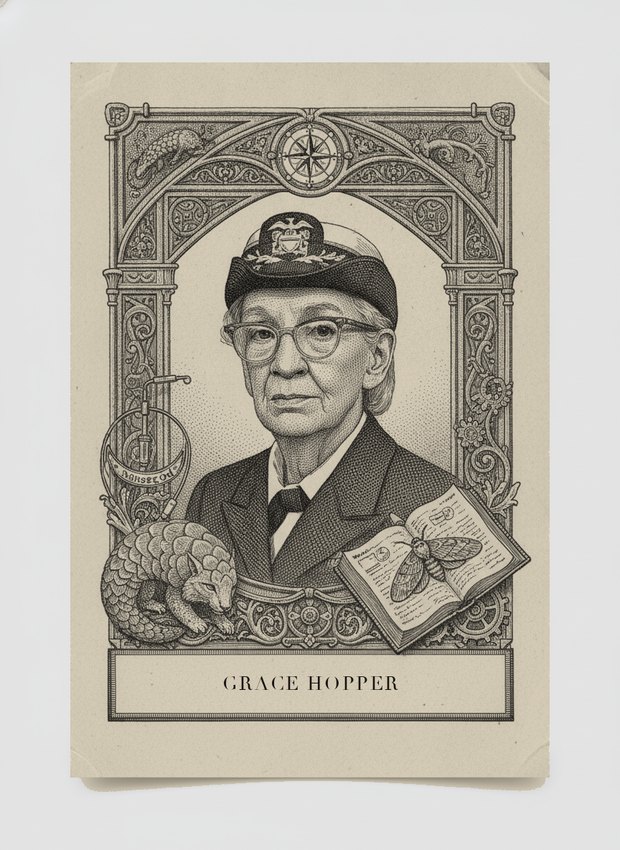
Hopper's compiler work and her advocacy for accessible, higher-level programming, spanning the 1950s and 1960s, gave the field an early template for machine-independent computation, a domain with essentially no direct connection to the word-alignment, noisy-channel, or statistical-language-modeling questions this 1990 problem poses. She never engaged with translation, corpora, or statistical natural language processing at any point in her career, which ended before this problem's setting. Her relevance to this specific historical problem is essentially nonexistent beyond the loosest, most generic sense of shared computing-history ancestry and a general value of making computation more accessible to non-specialists. That gap in both era and subject matter is exactly why her relevance to this specific 1990 problem remains essentially nonexistent, beyond general accessibility values.
Battle #60 · 8/10/2026, 11:35:02 AM · this result is deterministic: the same two personas on this problem always resolve the same way.