nlp
The parallel text is the teacher
It is 1990 at IBM's Yorktown labs, and a group of speech researchers is committing linguistic sacrilege: translate French to English with no grammar rules at all, treating translation as a noisy channel — the English sentence garbled into French — and learning everything from millions of sentence pairs of Canadian parliamentary proceedings. Build the statistical translation system: word-alignment models learned from unaligned sentence pairs, a language model to keep the output English, and a decoder to search the space of translations. Then defend the heresy with numbers against linguists who call it barbarism. Get it wrong and translation stays hand-built and brittle for decades; get it right and the data-over-rules argument wins its second great victory — the one language technology never walks back.
Who this problem belongs to
The two figures whose methods fit it best, out of 52 in contention.

This is Jelinek's own group at IBM's Yorktown Heights lab in 1990, not a hypothetical. He led the speech-recognition team that turned to Canadian Hansard parliamentary transcripts and treated translation as a noisy-channel problem, training word-alignment and language models from millions of sentence pairs with no hand-built grammar rules at all, culminating in the Brown, Della Pietra, and colleagues 1990 and 1993 IBM alignment-model papers. His maxim, 'every time I fire a linguist, the performance of the speech recognizer improves,' is the literal defense of the heresy this problem describes, delivered by the person who built and defended it against linguists who called it barbarism. No one on this roster stood closer to this exact desk, in this exact building, in this exact year. Score: maximal, by definition.
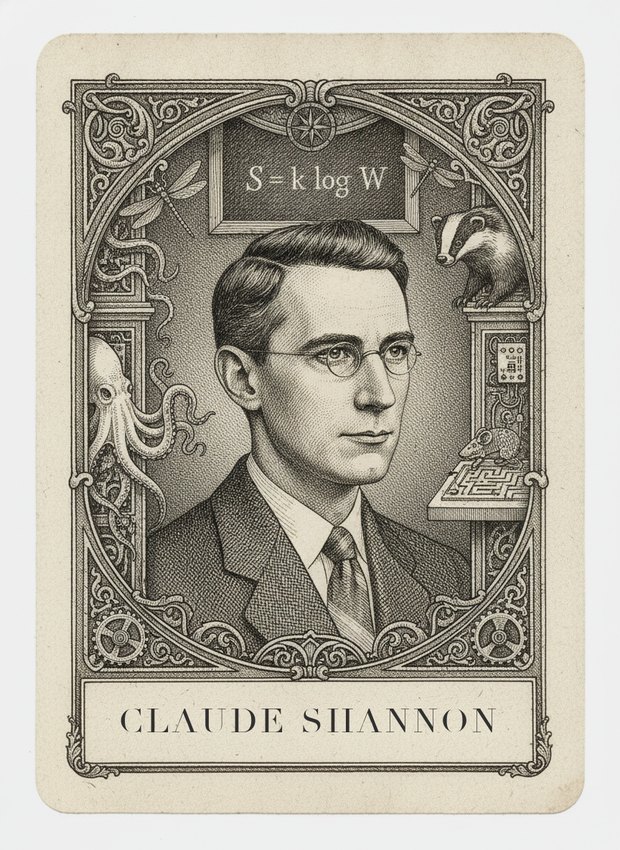
Shannon's 1948 mathematical theory of communication supplied the entire conceptual architecture this problem's IBM team borrowed wholesale: a noisy channel through which a message is corrupted and must be recovered by a decoder that knows the channel's statistics and the source's redundancy. Treating French-to-English translation as English 'garbled into French' by a noisy channel, exactly as this problem states, is a direct, almost unmodified transplant of Shannon's framework from telecommunications to language. His entropy and redundancy measures for English also underlie the language-modeling half of the system, which must judge whether a candidate translation sounds like fluent English. He predates this problem's 1990 setting by four decades, which is the only reason he scores below Jelinek's team, who actually built the system on Shannon's foundation.
Fought here
In the mind map
The same ideas, as concepts rather than history — in John's ML knowledge map.
52 figures are scored on this problem. Draw it in a battle to see where you land.