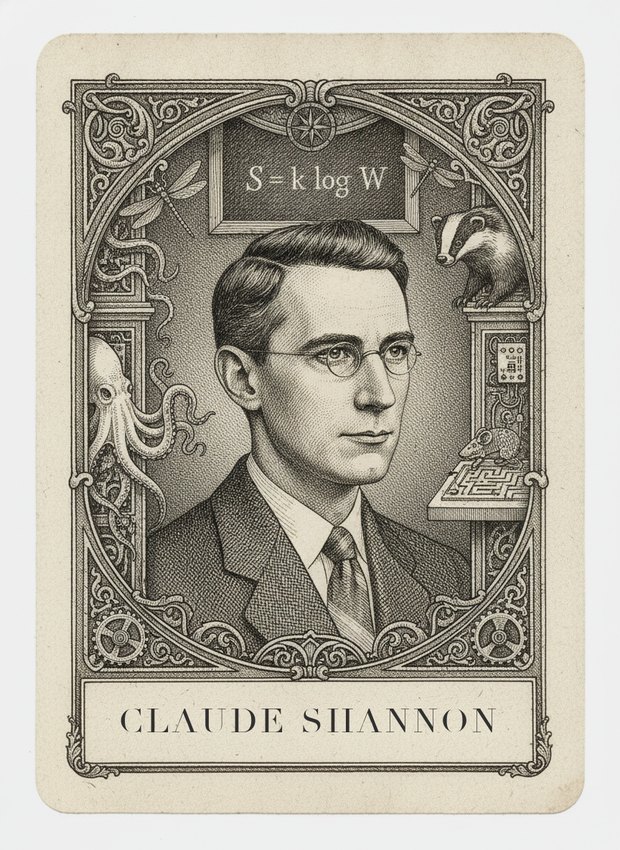
Claude Shannon
Information theory; channel capacity; digital circuit design
Strongest on
In the mind map
The same ideas, as concepts rather than history — in John's ML knowledge map.
Life and career
Claude Elwood Shannon wrote two documents that each, independently, founded a field. He was twenty-one when he wrote the first and thirty-two when he published the second, and he spent much of the rest of his life building juggling machines, riding a unicycle down the corridors of Bell Labs, and declining to write the follow-up that everyone wanted.
He was born in Gaylord, Michigan, in 1916. His father was a businessman and probate judge, his mother a language teacher and school principal, and his boyhood was spent building things: model planes, a radio-controlled boat, a barbed-wire telegraph line to a friend's house half a mile away. He admired Edison, to whom he turned out to be distantly related. He took a double degree at the University of Michigan in electrical engineering and mathematics, which is exactly the combination his career required.
In 1936 he went to MIT as a graduate student and got a job operating Vannevar Bush's differential analyzer — a room-sized mechanical analog computer whose control circuits were built from telephone relays. Shannon had taken an undergraduate course in Boolean algebra, an obscure branch of nineteenth-century logic with no known application. Looking at the relay circuits, he noticed that a switch is a proposition: open or closed, true or false; series connection is AND, parallel is OR, a normally-closed contact is NOT. His 1937 master's thesis, "A Symbolic Analysis of Relay and Switching Circuits," made the correspondence explicit and showed that any circuit could be designed and — crucially — *simplified* algebraically rather than by intuition. It has a decent claim to being the most important master's thesis ever written; every digital circuit since is designed on its premise.
His doctorate, completed in 1940 under Bush's urging, was on an entirely different subject: an algebra for theoretical genetics. He essentially abandoned it and it went largely unread for decades.
He joined Bell Labs in 1941. His war work was on fire control — the same anti-aircraft problem Wiener was attacking — and, more significantly, on cryptography. He worked on the SIGSALY secure speech system that carried Roosevelt–Churchill conversations, and he was at Bell Labs during Turing's 1943 visit on cryptanalytic liaison; the two men took tea together and discussed machine intelligence, though not, by both accounts, classified work. Shannon's classified 1945 memorandum "A Mathematical Theory of Cryptography," declassified and published in 1949 as "Communication Theory of Secrecy Systems," contains the proof that the one-time pad is unbreakable and the concepts of confusion and diffusion that still organize block cipher design.
Then, in 1948, the *Bell System Technical Journal* published "A Mathematical Theory of Communication" in two parts, and communication became a mathematical science. Warren Weaver's popularizing essay accompanied the book version the following year, which is why the book is titled *The* rather than *A*. The reception was immediate and slightly overwhelming; "information theory" became a fashion, applied enthusiastically to psychology, linguistics, biology, and economics, to the point that Shannon published a short, dry 1956 editorial titled "The Bandwagon" asking people to stop.
He moved to MIT in 1956 as a professor, keeping a Bell Labs affiliation, and taught and supervised there for over a decade, though he published progressively less. He built things instead: Theseus, a relay-driven mechanical mouse that learned a maze and is one of the first machine-learning devices; a chess-playing machine; a calculator that worked in Roman numerals; a juggling robot; a rocket-powered frisbee; a machine whose only function was, when switched on, to extend a mechanical hand that switched it off. He was a serious and successful investor, applying an analytical approach to stocks, and with Ed Thorp built a small wearable device for predicting roulette outcomes, arguably the first wearable computer. He developed Alzheimer's disease in his later years and died in 2001.
Key contributions
**Entropy and the bit.** Shannon asked how much *choice* a source exercises, and derived — from three natural axioms about continuity, monotonicity, and decomposability — that the only satisfactory measure is $H(X) = -\sum_i p_i \log p_i$. Measured in base two, the unit is the bit, a term Shannon credits to John Tukey. The formal identity with Boltzmann's entropy is not a coincidence but it is not a physical claim either; it is the same functional answering the same combinatorial question about the number of typical configurations.
**Source coding theorem.** A source of entropy $H$ can be compressed to $H$ bits per symbol and no fewer. The proof introduces the *asymptotic equipartition property*: for long i.i.d. sequences, essentially all the probability mass concentrates on roughly $2^{nH}$ "typical" sequences of nearly equal probability, so you need $nH$ bits to index them and the rest can be discarded. This is the entire conceptual basis of data compression. The Kraft–McMillan inequality, $\sum_i 2^{-\ell_i} \le 1$, characterizes exactly which sets of codeword lengths a uniquely decodable prefix code can have; Huffman's algorithm, produced by a student in Robert Fano's course rather than by Shannon, gives the optimal lengths, with Shannon–Fano coding as the earlier near-optimal version.
**Noisy channel coding theorem.** This is the result that surprised everyone. Define channel capacity $C = \max_{p(x)} I(X;Y)$, the maximum mutual information between input and output. Shannon proved that for any rate $R < C$ there exist codes with error probability approaching zero as block length grows, and that no code can do this for $R > C$. Before 1948 the engineering intuition was that reliability could only be bought by slowing down or raising power without limit; Shannon showed there is a hard threshold below which arbitrarily reliable communication is free. For the binary symmetric channel with crossover $p$, $C = 1 - H(p)$.
The proof technique is as important as the theorem: *random coding*. Draw a codebook at random, show the average error probability over codebooks is small, conclude that a good codebook exists. It is a probabilistic-method existence proof, and it left a seventy-year engineering programme of actually finding the codes — a programme that ran through Hamming, Reed–Solomon, convolutional codes, turbo codes, LDPC, and finally polar codes, which provably achieve capacity constructively.
**Rate–distortion theory.** For lossy compression, Shannon defined $R(D)$, the minimum rate needed to reproduce a source within average distortion $D$, as a constrained mutual-information minimization. Every lossy codec — JPEG, MP3, and by extension the modern neural compression and VAE literature, where the ELBO is a rate–distortion Lagrangian — lives on this curve.
**Perfect secrecy.** In the secrecy paper, Shannon proved that a cipher achieves perfect secrecy — ciphertext statistically independent of plaintext — if and only if the key entropy is at least the message entropy, which forces the one-time pad and makes key management the whole problem.
**Language modelling.** The 1948 paper models English as a Markov source and generates text from $n$-gram approximations of increasing order, showing the output becoming progressively more English-like. His 1951 paper "Prediction and Entropy of Printed English" used human subjects guessing successive letters to bound English's entropy at roughly one bit per character. This is the direct ancestor of statistical language modelling and of perplexity as an evaluation metric.
**Chess.** "Programming a Computer for Playing Chess" (1950) predates working machines and lays out board representation, an evaluation function combining material and positional terms, minimax search, and the Type A (fixed-depth exhaustive) versus Type B (selective, quiescence-aware) distinction that still organizes the subject.
In battle
Shannon has the strongest overall profile in this set: 100 problems, mean 49.2, twenty-three dominant cells, twenty-eight at 70 or above, and only ten at 20 or below. He is both deeper and broader than most of the roster.
His categories are led by **high-dim** (90.5), **information** (87.8 across sixteen problems — the single most dominant large-count category anywhere in these sixteen profiles), **games** (79.7), **search** (66.5), and **testing** (61.5).
The ceiling cells are his own papers. **P035 — The noisy channel's limit** (99): the matrix notes the problem is his theorem, at his institution, in his notation. **P175 — What is a bit, exactly?** (99) is the axiomatic derivation of entropy. **P173 — Can these codeword lengths even exist?** (99) is Kraft–McMillan. **P170 — The message no eavesdropper can read** (99) is perfect secrecy and the one-time pad. **P198 — Program chess before the computer exists** (99) is the 1950 chess paper, literally its title. **P037 — Compress the English novel** (98) is source coding plus his own entropy-of-English experiments. **P165 — The optimal codebook** (97) is Huffman coding, which came out of his framework and his colleague's classroom. **P167 — How few bits for a good-enough picture** (96) is rate–distortion.
The unusual thing about Shannon relative to his contemporaries is how well the mid-range holds. **nlp** at 42.7 across eighteen problems is high for a 1948 figure, because $n$-gram language models and entropy-of-text are genuinely his. **computability** at 47.1 across ten reflects real engagement with logic and machines. **perception** at 35.5 across fifteen picks up sampling theory and quantization. He is rarely useless.
The losses concentrate in exactly one place: **causality** at 12.5, his lowest category by a factor of two. His floor cells are **P214 — The paradox in the admissions data** (10), **P059 — The confounder you can't measure** (15), and **P299 — The proxy that rationed care** (20). The matrix's explanation of the first is the important lesson: Shannon's general facility with formalizing messy problems mathematically *would* transfer somewhat, and that is explicitly not enough to score. Mutual information is a symmetric measure of statistical dependence, and the entire content of causal inference is that dependence is not direction and that unmeasured common causes are invisible to any function of the joint distribution. Shannon's framework is, definitionally, blind to precisely the thing those problems turn on.
The other losses are more ordinary era gaps: **P176 — Cut through the interior** (16, interior-point LP), **P072 — The subspaces of moving objects** (14, structure from motion), **P074 — Drive through the intersection** (12, autonomous driving). His **optimization** at 28.0 and **classification** at 20.0 confirm the shape — he built the theory of the channel, not of the estimator or the decision rule.
Play Shannon on anything measured in bits, on limits and impossibility results, on compression, secrecy, coding, and on text as a stochastic process. He will lose to almost anyone on a question about what caused what.