games
Program chess before the computer exists
It is 1949 at Bell Labs, and Claude Shannon is writing the paper that will found computer chess before any machine can run it. Sketch a complete design: represent the board, define an evaluation function from material and mobility, and choose between searching every line to fixed depth or selectively following plausible moves — the brute-force and intuition strategies, named and costed decades before hardware can test either. The arithmetic is brutal: the game tree holds more positions than atoms, so the design must argue from principle, not experiment. Get the framing wrong and the field inherits a dead end for its first canonical problem; get it right and fifty years of machines climb the ladder this one paper builds.
Who this problem belongs to
The two figures whose methods fit it best, out of 53 in contention.
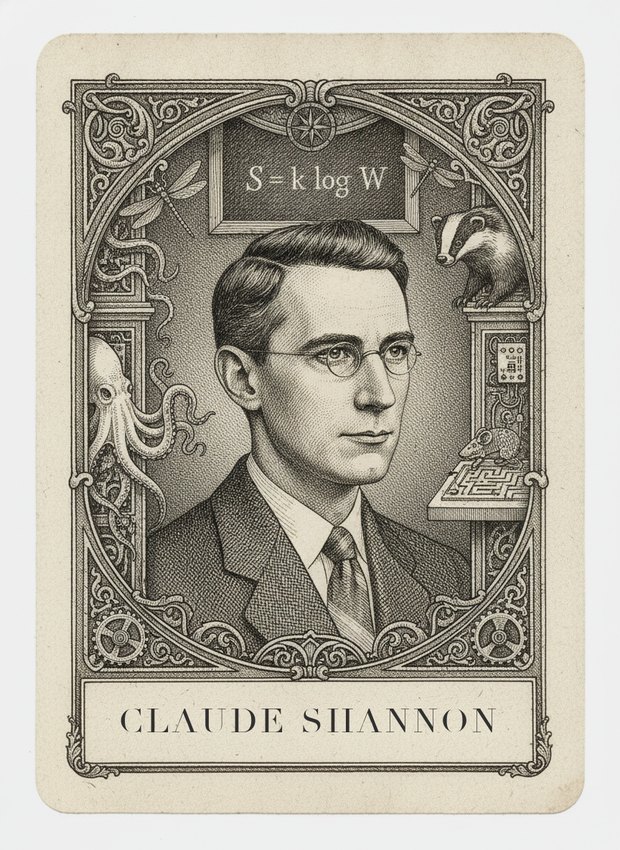
This problem is not a hypothetical for Shannon; it is his actual 1949–1950 project at Bell Labs. His paper 'Programming a Computer for Playing Chess' laid out exactly what the problem asks: a board representation, an evaluation function built from material and mobility, and the explicit choice between 'Type A' brute-force search to fixed depth and 'Type B' selective search following only plausible moves — named and costed years before any machine could test either. He argued from combinatorics alone, correctly noting the game tree dwarfs the number of atoms in the observable universe, so any design had to reason from principle rather than experiment. Every subsequent chess program, from NSS through Deep Blue, is answering the design questions he posed first. No one else on this roster owns this problem more completely.
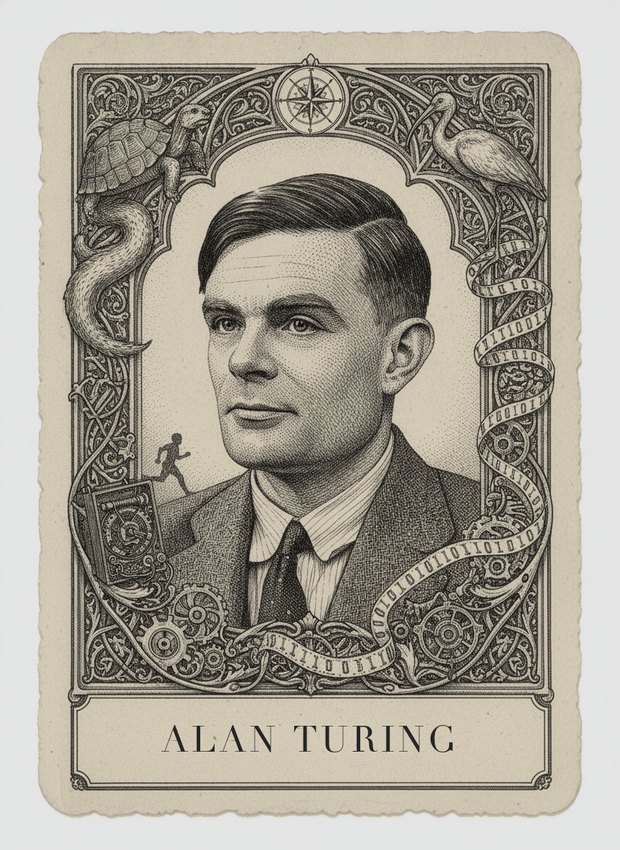
Turing, working with David Champernowne around 1948, designed 'Turochamp,' a complete set of chess rules including a rudimentary evaluation function and depth-limited look-ahead, executed by hand since no machine of the era could run it — making him, alongside Shannon, one of the two people who actually did this problem as history rather than hypothesis. His scheme was simpler than Shannon's, without the explicit Type A versus Type B framing or formal cost analysis, and he never implemented or refined it computationally. His deeper theoretical contributions — computability and the universal machine — also establish the ceiling on what any such design can eventually compute. Between the two founding figures, Shannon's paper is more complete and more influential, but Turing's Turochamp is the other genuine, contemporaneous answer to this exact problem.
Fought here
In the mind map
The same ideas, as concepts rather than history — in John's ML knowledge map.
53 figures are scored on this problem. Draw it in a battle to see where you land.