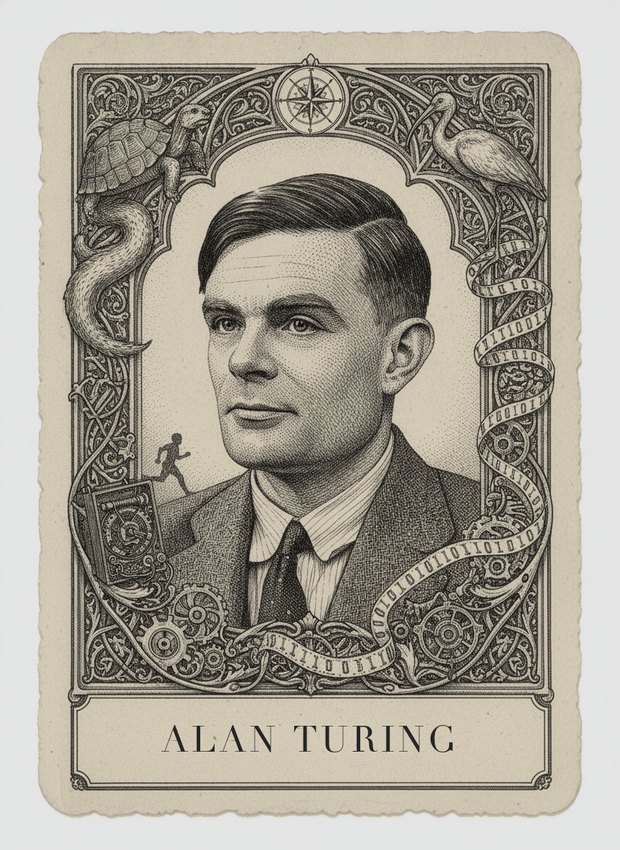
Alan Turing
Computability, the universal machine, the imitation game, codebreaking
Strongest on
In the mind map
The same ideas, as concepts rather than history — in John's ML knowledge map.
Life and career
In 1936, a 24-year-old fellow of King's College, Cambridge, published a paper answering a question David Hilbert had posed about the foundations of mathematics. To answer it, he had to first invent a definition of what it means to compute something. The definition he chose — a machine with a tape, a read/write head, and a finite table of states — was so obviously right that it has never been improved upon, and everything the rest of this roster does runs on it.
Alan Mathison Turing was born in London in 1912 to a family in the Indian Civil Service; he and his brother were largely raised by others in England while their parents were abroad. At Sherborne School he was an indifferent student in subjects that bored him and a formidable one in mathematics and science, a pattern that persisted. The defining relationship of his adolescence was with Christopher Morcom, a fellow pupil of extraordinary promise who died suddenly in 1930. Biographers consistently link that loss to Turing's later preoccupation with mind, matter, and whether thought could survive its physical substrate.
He went up to King's College, Cambridge, in 1931, was elected a fellow at 22 on the strength of a dissertation proving a version of the central limit theorem (not knowing it had already been proved by Lindeberg), and then encountered Max Newman's lectures on the Entscheidungsproblem — Hilbert's question of whether there exists a mechanical procedure to determine the truth of any first-order statement. "On Computable Numbers, with an Application to the Entscheidungsproblem" was the answer, and it is one of a small handful of papers that founded a field outright. Alonzo Church had reached the same conclusion months earlier by a different route, and Turing spent 1936–38 at Princeton taking a doctorate under Church, producing along the way the theory of ordinal logics and the concept of an *oracle* machine — the germ of relative computability and the arithmetical hierarchy.
He returned to England, and in September 1939 reported to Bletchley Park. What he did there is the most consequential applied work of his life. Building on Polish cryptanalytic work by Rejewski and colleagues, Turing and Gordon Welchman designed the Bombe, an electromechanical machine that tested Enigma rotor configurations by exploiting *cribs* — guessed plaintext — and propagating logical contradictions to eliminate settings en masse. Turing led Hut 8, responsible for German naval Enigma, the hardest and highest-stakes traffic, and developed the sequential statistical method he called Banburismus to rank candidate rotor orders before committing scarce Bombe time. His measure of evidence, in units he named the *ban*, is a log-likelihood ratio accumulated sequentially — Bayesian statistics done under wartime secrecy, years before Wald published sequential analysis openly, and known publicly only decades later through I. J. Good's writing.
After the war he designed the Automatic Computing Engine at the National Physical Laboratory — a strikingly modern design, with a small instruction set and an emphasis on programming complexity into software rather than hardware — but institutional delay frustrated him, and he moved to Manchester to work with Newman on the Manchester machine. There he wrote about machine intelligence, including the 1950 *Mind* paper "Computing Machinery and Intelligence," and turned to mathematical biology, publishing in 1952 "The Chemical Basis of Morphogenesis."
In 1952 Turing reported a burglary to the police and, in the course of the investigation, was open about a sexual relationship with another man. Homosexual acts were criminal in Britain. He was prosecuted for gross indecency, convicted, and — to avoid prison — accepted a court-mandated regime of synthetic oestrogen intended as chemical castration. He lost his security clearance and was barred from further cryptographic consultancy at a moment when his knowledge made him, in the state's eyes, a liability. He died at his home in Wilmslow in June 1954, aged 41, of cyanide poisoning; the inquest recorded suicide, and while some, including his mother, disputed that reading, it remains the finding of record. The British government issued an apology in 2009 and a posthumous royal pardon in 2013, and the subsequent legislation extending pardons to others convicted under the same laws is informally known as the Alan Turing law.
Key contributions
**The Turing machine and undecidability (1936).** A Turing machine is a finite control operating on an unbounded tape. The paper's decisive move is the *universal* machine: a single machine $U$ that, given an encoding $\langle M, x\rangle$, simulates $M$ on $x$. Universality makes computation a *datum* — programs are data — and it is what makes self-reference bite. Turing then ran a diagonal argument over machine descriptions to show that no machine can decide, for arbitrary $\langle M, x\rangle$, whether $M$ halts on $x$; the Entscheidungsproblem falls immediately. Church's lambda calculus reached the same limit, and the equivalence of the two models is the empirical core of the Church–Turing thesis. Rice's theorem later generalized the result: *every* non-trivial semantic property of programs is undecidable.
**Oracles and relative computability.** His Princeton thesis introduced machines with access to an oracle for some (possibly uncomputable) set, which is how one defines Turing reducibility, degrees of unsolvability, and — much later, with resource bounds — the polynomial hierarchy and relativized complexity.
**Sequential Bayesian evidence.** Banburismus accumulates the log-odds of hypotheses about rotor settings from repeated weak evidence, stopping when a threshold is crossed. The *ban* is a decimal log-likelihood unit; the deciban, a tenth of one, was chosen as roughly the smallest change in belief a human could perceive. This is a fully worked sequential likelihood-ratio test, applied at scale, in 1940.
**Machine intelligence and the imitation game.** The 1950 paper proposes replacing the unanswerable "can machines think?" with an operational test: an interrogator communicating by teleprinter with a human and a machine tries to tell which is which. The paper's real substance is the systematic rebuttal of nine objections — theological, mathematical (including the Gödelian objection), consciousness-based, Lady Lovelace's — and, notably, its proposal that the practical route to machine intelligence is to build a *child machine* and educate it, complete with a suggestion of learning by reward and punishment. That is a research program, not a thought experiment.
**Morphogenesis.** The 1952 paper asks how a chemically uniform embryo develops spatial structure, and shows that a system of reacting and diffusing chemicals — an activator and a faster-diffusing inhibitor — can be stable to uniform perturbation but unstable to a particular spatial wavelength, spontaneously producing stripes and spots. Diffusion, normally a smoothing force, *causes* the instability. Turing patterns are now standard in developmental biology and nonlinear dynamics, and the paper is essentially the founding of mathematical biology as a quantitative field.
In battle
Turing's profile is that of a foundational theorist on a board that contains a great deal of engineering: 100 problems, mean 42.1, median 33, fourteen dominant cells and twenty-four at 20 or below. The spread is wide because his contributions are extremely deep in a narrow band.
His top categories are **testing** (77.0), **nlp** (75.7), and **computability** (74.8 across 16 problems) — the last being the most sustained categorical dominance anyone in this set shows over a large problem count. The nlp number is not about language modelling; it reflects the imitation game and the machine-intelligence problems being filed there.
The ceiling cells are, essentially, his own papers read back to him. **P030 — Will it ever halt?** (99) is the 1936 paper, with the matrix noting it is a ceiling case by construction. **P259 — The imitation game, scored** (99) is the 1950 paper. **P163 — The fastest-growing function** (98, the busy beaver / non-computable growth), **P156 — Every interesting property is undecidable** (96, Rice's theorem), and **P162 — More time, strictly more power** (97, the time hierarchy theorem) are all diagonalization arguments over machine descriptions, which the matrix correctly calls his native move — he did not prove the hierarchy theorem himself, but the entire technique and the machine model are his. **P155 — Three machines, one class** (98) is the equivalence of computational models, i.e. the Church–Turing thesis. **P127 — Weight of evidence at Bletchley** (98) is Banburismus, literally his wartime work. **P033 — The shortest description** (90) is Kolmogorov complexity, which is defined over universal Turing machines and is inconceivable without them.
The losses are the interesting part, because they are not era gaps in every case. **Regression** at 13.0, **causality** at 13.5, **classification** at 17.5, and **small-sample** at 20.5 are all genuinely low for a man who proved a central limit theorem as a student and did world-class sequential inference at Bletchley. His floor cells are **P108 — Estimating many means at once** (6, Stein shrinkage), **P215 — The therapy the trial reversed** (7, confounded clinical trials), **P151 — Three species of iris** (10, Fisher's discriminant), **P174 — The floor no estimator beats** (12, Cramér–Rao), and **P139 — Regression when the outcome is censored** (12). The pattern: Turing used probability as a *tool* for a specific decision problem, but never built estimation theory, never engaged with confounding or study design, and published essentially nothing in statistics because what he did do was classified for thirty years. The matrix scores the documented record, not the counterfactual.
The other loss is honest era distance. **P081 — Train across a thousand GPUs** sits at 3, and the explanation says plainly that this is a marked era gap, not a doubt about his importance: his universal machine guarantees such a computation is possible in principle and offers nothing whatsoever about partitioning a hundred-billion-parameter model across failure-prone hardware. His **systems** average of 24.3 across 18 problems is the same story repeated — he specified what computation *is* and died before anyone had to run it at scale.
The practical read: Turing is close to unbeatable on any question of the form *can this be computed at all*, *is this decidable*, *what is the right model of computation*, or *how do we know if a machine is thinking*. Bring him to a problem about fitting, estimating, confounding, or deploying, and much smaller figures will take the cell.