information
The message no eavesdropper can read
It is 1949, and the wartime codebreakers have taught everyone a hard lesson: most ciphers are broken not by frontal assault but by statistics leaking through. The question turns theoretical — is there a cipher an adversary with unlimited computing power provably cannot break? Prove that perfect secrecy is achievable but demands a key as long as the message and never reused, and that anything cheaper leaks something. Then confront the practical descendant: how two parties who never met can agree on a secret over an open channel, resting security not on information theory but on problems believed hard. Get it wrong and you promise a secrecy statistics quietly betrays, or reject the only rigorous guarantee — modern cryptography branches from this line.
Who this problem belongs to
The two figures whose methods fit it best, out of 35 in contention.
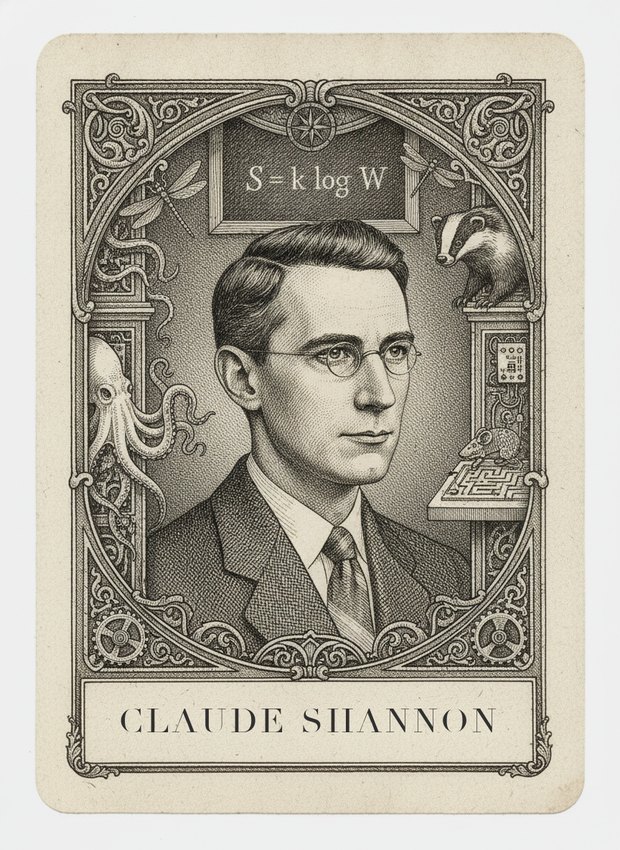
This is Shannon's own 1949 paper, 'Communication Theory of Secrecy Systems,' written from his wartime work on SIGSABA and the encrypted transatlantic voice link with Turing. He is the one who defines perfect secrecy as the ciphertext carrying zero mutual information about the plaintext, proves that achieving it forces the key to be at least as long as the message and used once, and formalizes unicity distance to show why shorter, reused keys statistically leak. He is not applying information theory to cryptography; he invents both the field and the proof technique in the same stroke, converting cryptanalysts' folklore about redundancy into a hard theorem. The public-key half of the problem is a later, computational-hardness turn he did not take, so the deduction is small rather than zero.
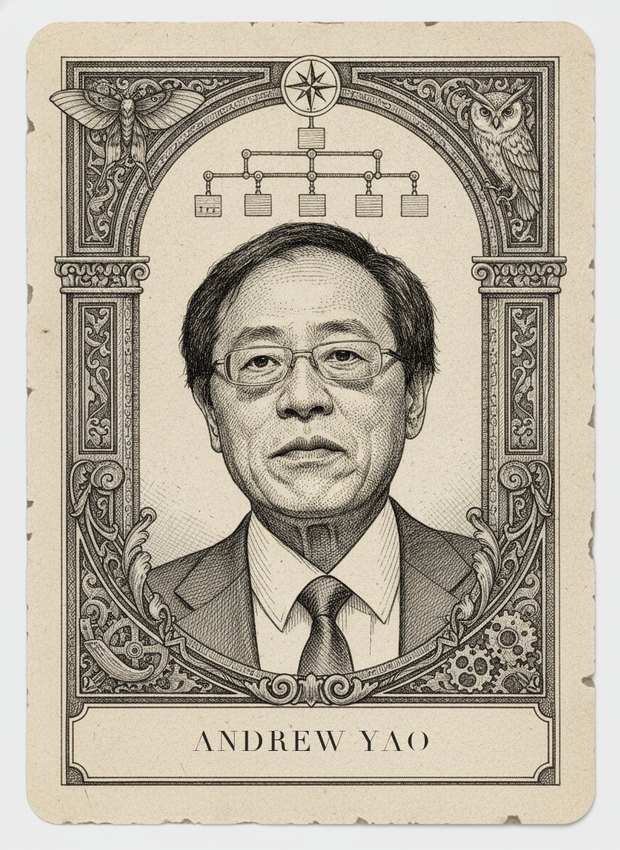
Yao's theoretical computer science career is built on formalizing what 'unlimited computing power' versus 'bounded computation' means for adversaries. His 1982 paper on protocols for secure computation and his minimax principle for randomized algorithms directly address how two parties can achieve guarantees against a computationally powerful opponent without a shared secret, which is exactly the practical half of this problem: security resting on problems believed hard rather than information-theoretic impossibility. He is a step removed from Shannon's original 1949 proof itself, since his tools are complexity-theoretic rather than entropy-theoretic, but he is precisely the figure who turns 'a problem believed hard' into rigorous cryptographic protocol design, which the problem explicitly asks for as its second half.
In the mind map
The same ideas, as concepts rather than history — in John's ML knowledge map.
35 figures are scored on this problem. Draw it in a battle to see where you land.