It is the era when heuristic search meets puzzles whose state spaces dwarf any road map — the sliding-tile puzzle, the Rubik's cube, with billions of configurations — and the quality of the answer hinges entirely on the guidance. A good heuristic estimates the distance remaining to the goal and prunes vast regions, but it must never overestimate, or the search returns a suboptimal solution while believing it optimal. Construct powerful admissible heuristics automatically: solve relaxed subproblems, tabulate their costs into pattern databases, and combine them into an estimate both tight and provably a lower bound. Get it wrong and a weak heuristic leaves the search grinding forever, while an inadmissible one returns the wrong answer — the heuristic that never lies makes hard search both fast and correct.

Chose The fault-tolerant batch pipeline — right call.
Dean's large-scale systems work at Google, MapReduce and distributed infrastructure, shows genuine competence at making computationally expensive search algorithms run at massive scale, relevant to constructing and querying enormous pattern databases for hard puzzle instances like Rubik's cube. But Dean did not develop A*, admissibility theory, or pattern databases himself; his relevance is in making an already-proven algorithm scale to enormous problem sizes, a valuable but implementation-side contribution rather than the specific heuristic-construction technique this problem is fundamentally asking a solver to execute. His large-scale systems work shows the disposition, though not the specific algorithm, needed to scale a puzzle solver efficiently. That scaling competence is valuable engineering, not the admissibility theory this problem actually tests.
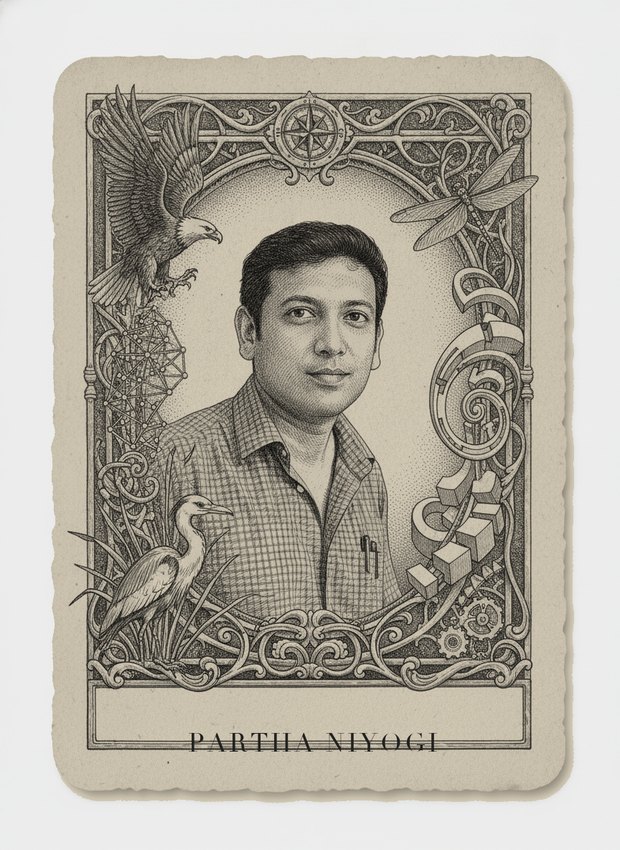
Niyogi's manifold learning and Laplacian eigenmaps work is fundamentally about finding a small set of coordinates that capture almost all the structure of a much higher-dimensional space, a loose conceptual cousin of how a pattern database captures most of the relevant cost information from a much larger, relaxed subproblem. But his methods are continuous, spectral, and graph-Laplacian based rather than the discrete symbolic admissibility theory this problem requires, so the resonance is thematic and geometric rather than a directly transferable proof technique for A* search or pattern-database construction specifically. His semi-supervised learning theory on graphs shows a career-long comfort with turning an intractable-looking space into a provably manageable one. That resonance remains geometric and thematic rather than a directly transferable admissibility proof technique.
Battle #116 · 8/10/2026, 11:38:41 AM · this result is deterministic: the same two personas on this problem always resolve the same way.