search
The heuristic that never lies
It is the era when heuristic search meets puzzles whose state spaces dwarf any road map — the sliding-tile puzzle, the Rubik's cube, with billions of configurations — and the quality of the answer hinges entirely on the guidance. A good heuristic estimates the distance remaining to the goal and prunes vast regions, but it must never overestimate, or the search returns a suboptimal solution while believing it optimal. Construct powerful admissible heuristics automatically: solve relaxed subproblems, tabulate their costs into pattern databases, and combine them into an estimate both tight and provably a lower bound. Get it wrong and a weak heuristic leaves the search grinding forever, while an inadmissible one returns the wrong answer — the heuristic that never lies makes hard search both fast and correct.
Who this problem belongs to
The two figures whose methods fit it best, out of 65 in contention.
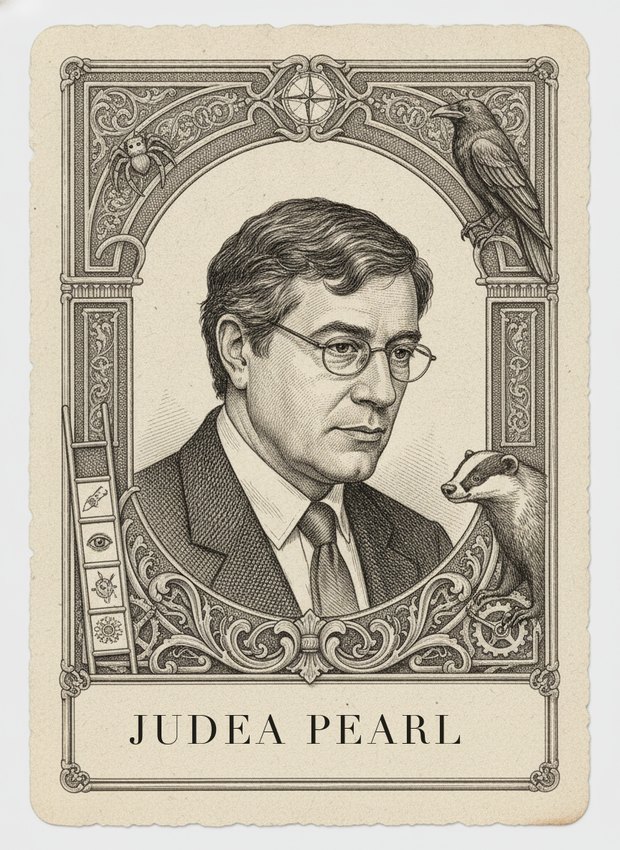
Pearl's 1984 book Heuristics: Intelligent Search Strategies for Computer Problem Solving is the definitive systematic treatment of exactly this problem: what makes a heuristic admissible (never overestimating true cost), how admissibility guarantees A*-style search returns a provably optimal solution, and how to compare heuristics by their informedness, the precise theoretical apparatus this problem's sliding-tile and Rubik's cube examples require. His analysis of when a search algorithm is complete and optimal under an admissible heuristic remains the standard reference cited by every subsequent pattern-database paper. He did not personally invent pattern databases (developed later by Culberson, Schaeffer, and others), which is the only reason his score is not an outright maximum, but the theoretical foundation this problem rests on is substantially his.
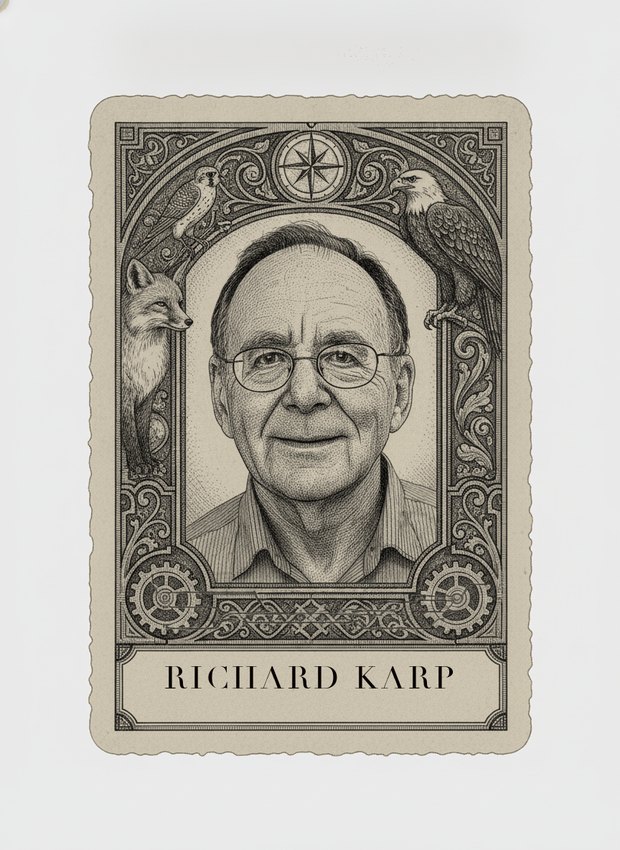
Karp's foundational work on NP-completeness and algorithmic efficiency explains precisely why exhaustive search over billions of Rubik's cube or sliding-tile configurations is intractable, giving deep theoretical grounding for why a good heuristic is not a convenience but a necessity. His subsequent decades of algorithm design, including work on approximation and randomized methods, show real comfort with the tradeoff between guaranteed optimality and practical tractability this problem's admissibility requirement embodies. But the specific construction of admissible heuristics via relaxed subproblems and pattern databases is a distinct, more applied search-and-AI lineage he did not develop himself, so his relevance is strong complexity-theoretic grounding rather than direct authorship of this problem's heuristic-construction techniques.
Fought here
In the mind map
The same ideas, as concepts rather than history — in John's ML knowledge map.
65 figures are scored on this problem. Draw it in a battle to see where you land.