It is the era when planning problems refuse to bend to continuous math: you cannot build half a warehouse, dispatch a third of a truck, or assign a crew to two-and-a-half flights. The decisions are discrete, and the moment you require variables to be integers the smooth geometry that made linear programming easy shatters — the problem turns NP-hard. Solve it anyway in practice: relax the integrality, solve the easy continuous problem for a bound, branch on a fractional variable and bound each subproblem, pruning whole subtrees that cannot beat the best so far, and tighten with cutting planes. Get it wrong and you brute-force a combinatorial explosion, or round a solution into something infeasible — branch-and-bound is how the discrete decisions of real logistics get made.
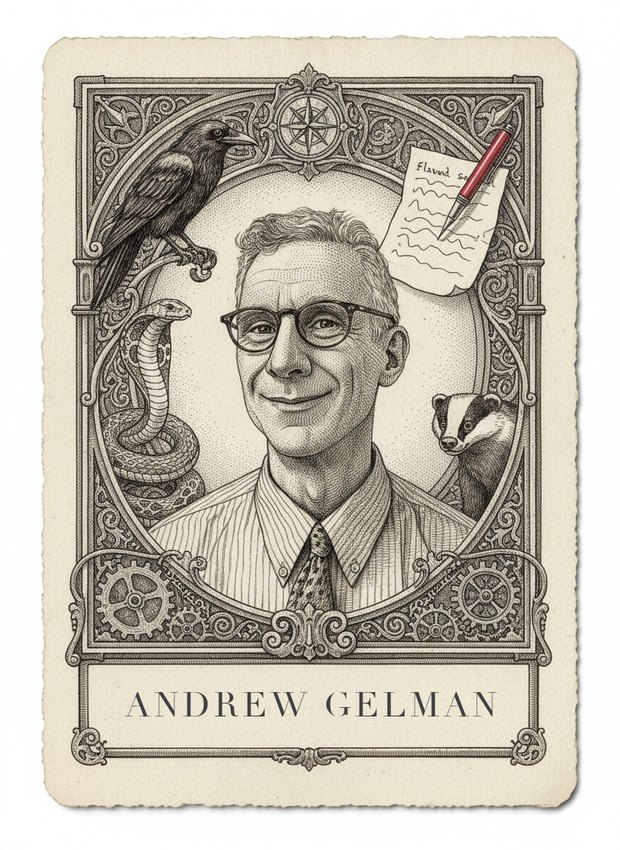
Gelman's contributions to hierarchical Bayesian modeling and the Stan probabilistic programming language address uncertainty quantification and inference from data, a statistical toolkit built on continuous probability distributions and Markov chain Monte Carlo sampling, with no connection to the discrete, deterministic combinatorial search this problem requires. His applied Bayesian workflow addresses model checking and posterior inference, not resource-constrained planning under integrality restrictions. Nothing in his published work touches branch-and-bound, LP relaxation, or NP-hardness. His score reflects that Bayesian statistics and integer programming, despite both being mathematical optimization-adjacent fields, solve entirely different problems with entirely different tools, leaving essentially no historical or methodological overlap to draw on. His applied Bayesian workflow does occasionally confront discrete model-choice questions, which model structure to select, but resolves them through posterior predictive checks rather than combinatorial search with certified bounds.
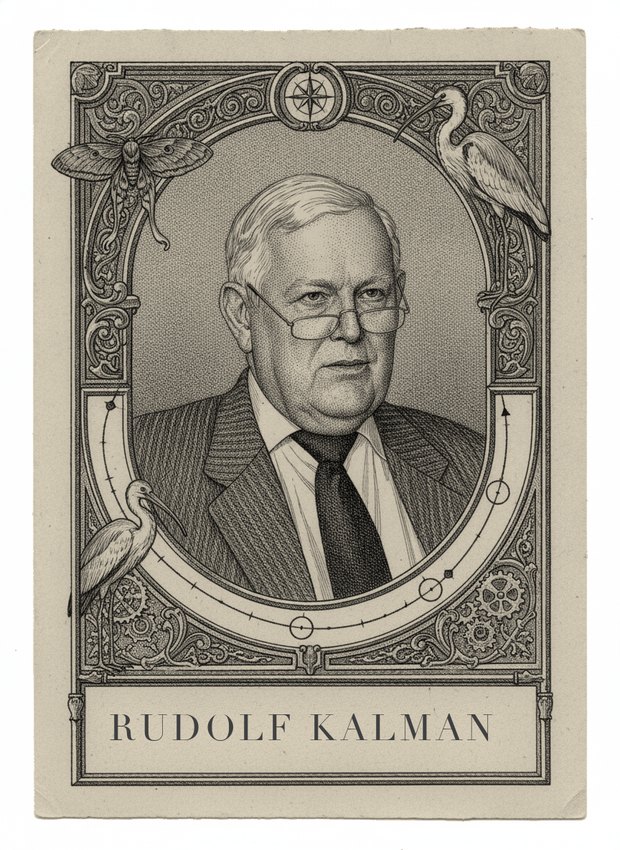
Kalman's filter, developed in 1960 for continuous and linear state estimation aboard the Apollo guidance computer, is optimal recursive estimation under uncertainty, a fundamentally different problem from discrete combinatorial search over integer feasible regions. The two fields share the word 'optimal' and both emerged from the same mid-century systems-and-control milieu that also produced Bellman's dynamic programming, giving Kalman passing intellectual proximity to Bellman-style recursive optimization. But Kalman's filter assumes continuous, Gaussian, linear dynamics, the opposite of the discrete integrality this problem centers on. His score reflects only that shared control-theory ancestry, with no direct contribution to branch-and-bound, relaxation, or cutting-plane methods. His later work on controllability and observability did engage discrete-time systems theory, a thin bridge toward the discrete decision variables this problem centers on, though never combinatorial optimization directly.
Battle #15 · 8/9/2026, 5:03:18 PM · this result is deterministic: the same two personas on this problem always resolve the same way.