It is 1801, and the astronomer Piazzi has tracked a new body — Ceres — for forty-one nights before it slipped behind the glare of the sun, and now all of Europe's telescopes have lost it. Whether it is ever seen again depends on you: from a mere handful of noisy angular observations you must predict where along the sky Ceres will re-emerge months from now, with the celestial mechanics exact and the measurement errors unforgiving. There is no second chance; if your prediction is off, the telescopes point at empty sky and the planet is lost, perhaps for years. Fit the orbit, tame the observational error, and stake the reappearance on your arithmetic. Small data, exact physics, no do-overs.
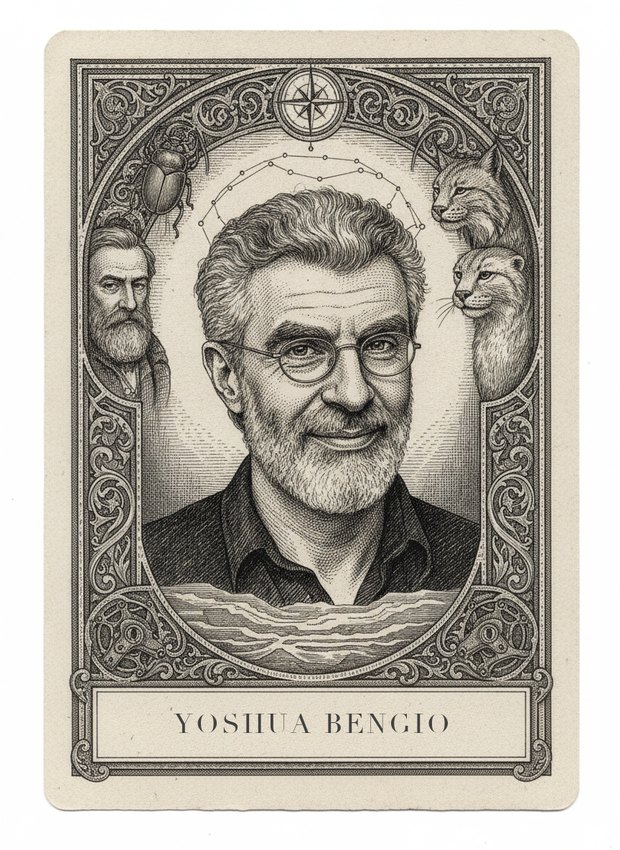
Bengio's lineage — neural language models (2003), representation learning, deep-learning theory, later causal and system-2 research — is devoted to learning distributed representations from large corpora so that structure emerges from data. Ceres inverts every premise: the structure (Newtonian mechanics) is fully known, the data is forty-one points, and the required operation is exact extrapolation, the regime where learned representations are least trustworthy. A neural model fit to the arc would interpolate plausibly and extrapolate fatally — the precise catastrophe the problem punishes with a lost planet. His theoretical work on why depth helps concerns function classes this task must avoid, and his causal interests, while epistemically sympathetic to mechanism, have produced no tool that fits orbits. Frank era-gap verdict: two centuries of method development in the wrong direction for this particular sky. Floor-adjacent, with his deep-modern peers.
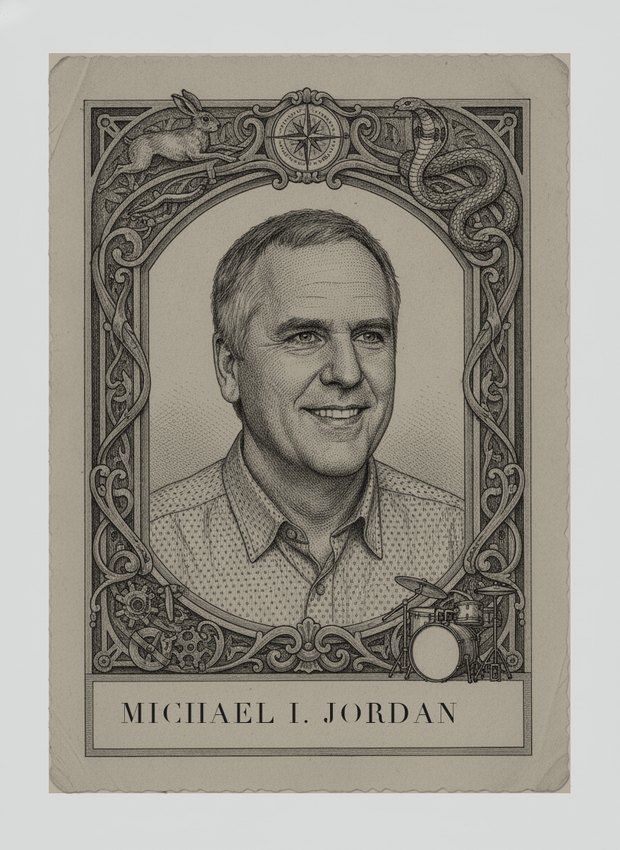
Jordan's unifying view — graphical models as the common language of statistics and computation, variational inference, the bridge he personally built between the ML and statistics communities — means he sees instantly what this problem is: posterior inference over the latent state of a chain-structured dynamical model, i.e., filtering and smoothing. His pedagogical lineage (many of this roster's moderns trained under him) includes exactly the state-space machinery required. But seeing the structure and having personally built tools for this regime are different things: his own research ran toward mixtures of experts, variational methods for intractable models, and later optimization and decision-making at scale — none load-bearing for a six-parameter exact-physics fit. He would orchestrate the right solution competently, borrowing Kalman's filter and Gauss's error model, adding characteristic clarity and no new leverage. The consummate synthesizer, out-specialized on classical turf.
Battle #39 · 8/9/2026, 7:13:29 PM · this result is deterministic: the same two personas on this problem always resolve the same way.