regression
Find the lost planet
It is 1801, and the astronomer Piazzi has tracked a new body — Ceres — for forty-one nights before it slipped behind the glare of the sun, and now all of Europe's telescopes have lost it. Whether it is ever seen again depends on you: from a mere handful of noisy angular observations you must predict where along the sky Ceres will re-emerge months from now, with the celestial mechanics exact and the measurement errors unforgiving. There is no second chance; if your prediction is off, the telescopes point at empty sky and the planet is lost, perhaps for years. Fit the orbit, tame the observational error, and stake the reappearance on your arithmetic. Small data, exact physics, no do-overs.
Who this problem belongs to
The two figures whose methods fit it best, out of 62 in contention.
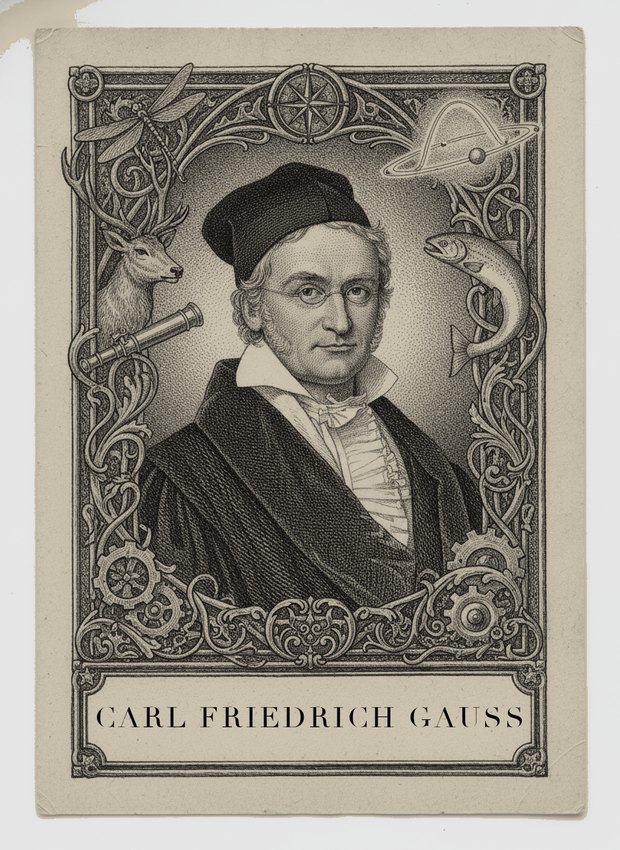
This is not an analogy; it is the event. In autumn 1801 the twenty-four-year-old Gauss took Piazzi's forty-one nights of Ceres observations and did precisely what the problem demands: fit the orbit with the celestial mechanics exact, tame the measurement error — inventing the method of least squares and grounding it in the normal error law along the way — and predicted the reappearance point. In December 1801, Zach and then Olbers recovered Ceres almost exactly where Gauss said it would be, and his reputation was made overnight. His Theoria Motus (1809) codified the orbit-determination machinery astronomers used for a century. Every later tool on this roster — maximum likelihood, Kalman filtering, Bayesian orbit posteriors — descends from what he built for this exact task. The two points withheld are ceremonial.
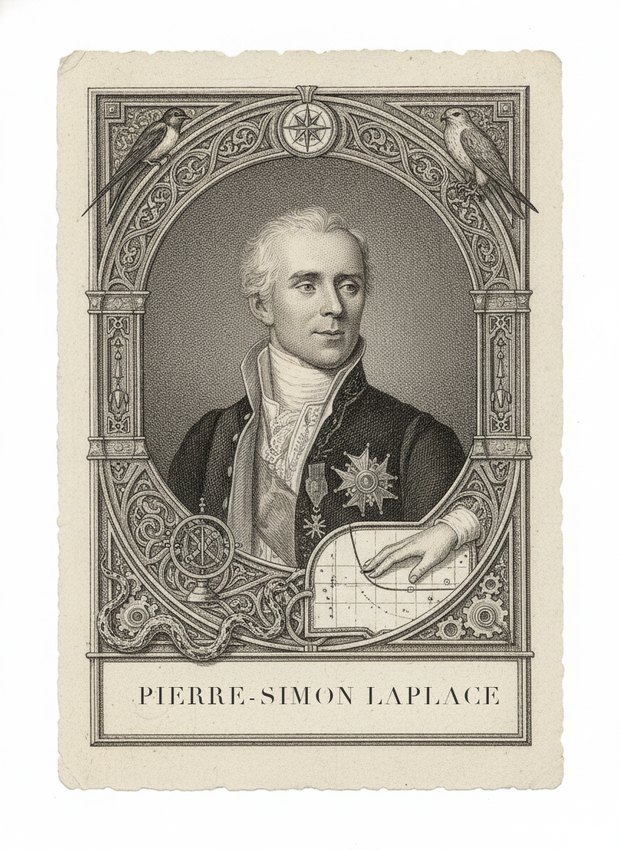
Laplace stands one step behind Gauss on Gauss's greatest stage, which still places him ahead of nearly everyone. Celestial mechanics was his life's work: the Mecanique Celeste systematized planetary perturbation theory, he analyzed cometary orbits, and he possessed every dynamical tool the problem needs. On the error side he was equally armed — his Bayesian inversion of probability weighed causes from effects, and his 1810 central limit theorem underwrote the very error law that justifies least squares (he immediately connected it to Gauss's method). Given Piazzi's forty-one nights, Laplace produces a sound orbit and a defensible reappearance window by his own methods. What he lacked in 1801 was the specific least-squares machinery Gauss invented for the occasion — the decisive edge in taming the observational error. The master of the domain, outdone once, by the one problem's namesake.
Fought here
In the mind map
The same ideas, as concepts rather than history — in John's ML knowledge map.
62 figures are scored on this problem. Draw it in a battle to see where you land.