It is 1990, and Bayesian statistics has a paradox for a heart: the framework is coherent, the priors are chosen, and the posterior — the entire answer — is a high-dimensional integral nobody can compute. Closed forms exist only for toy conjugate models; real models with hundreds of parameters have been unreachable for two centuries. Unlock them: construct a Markov chain whose stationary distribution is the posterior itself, wander it by computer, and treat the visited states as samples. Then face the hard practical question — how do you know the chain has converged, rather than stalled in one mode while another holds half the probability? Get it wrong and the revival of Bayesian inference ships confident intervals sampled from the wrong distribution entirely.
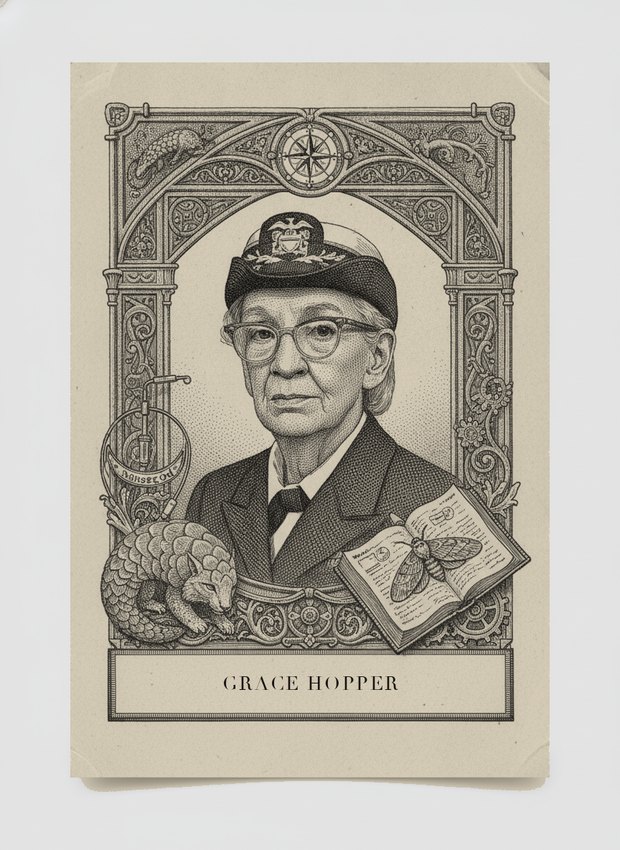
Hopper's foundational work on compilers and the COBOL programming language, developed from the 1950s onward, gave computer science machine-independent programming and made software development accessible beyond specialists working directly in machine code, an important infrastructural contribution to computing broadly. But this work addresses compiler design and business-oriented programming languages, with essentially no technical connection to the statistical mathematics of constructing a Markov chain to sample from a Bayesian posterior. Hopper's career, centered on naval computing and software engineering from the 1950s through the 1980s, never engaged Bayesian statistics, probabilistic inference, or the specific convergence-diagnostic problems the 1990 computational Bayes revival addressed, leaving this connection essentially absent beyond shared reliance on computers.

Jordan's career, spanning graphical models, variational methods, and mentoring a generation of Bayesian machine learning researchers from the 1990s at Berkeley, sits directly inside the computational Bayes revival the problem describes; his work formalized how complex probabilistic models with hundreds of latent variables could be represented and reasoned about systematically, and his students and collaborators built much of the practical MCMC and variational-inference toolkit that made unlocking these models routine. His own preference leaned toward variational approximations as a faster alternative to sampling, but his deep technical fluency with the exact convergence and computational tradeoffs the problem raises, when does approximate beat exact, how do you know either has converged, is exactly on point. The gap is that his major contributions arrived slightly after 1990 and matured through the 1990s and 2000s.
Battle #56 · 8/10/2026, 11:34:06 AM · this result is deterministic: the same two personas on this problem always resolve the same way.