causality
Sample from the impossible posterior
It is 1990, and Bayesian statistics has a paradox for a heart: the framework is coherent, the priors are chosen, and the posterior — the entire answer — is a high-dimensional integral nobody can compute. Closed forms exist only for toy conjugate models; real models with hundreds of parameters have been unreachable for two centuries. Unlock them: construct a Markov chain whose stationary distribution is the posterior itself, wander it by computer, and treat the visited states as samples. Then face the hard practical question — how do you know the chain has converged, rather than stalled in one mode while another holds half the probability? Get it wrong and the revival of Bayesian inference ships confident intervals sampled from the wrong distribution entirely.
Who this problem belongs to
The two figures whose methods fit it best, out of 67 in contention.
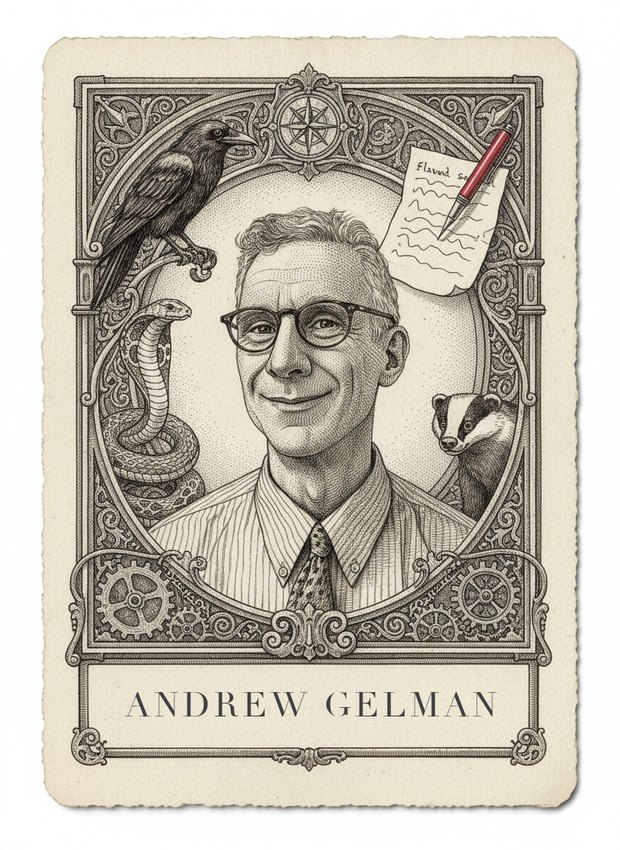
Gelman is one of the two people who literally solved this exact problem. His 1992 paper with Donald Rubin, Inference from Iterative Simulation Using Multiple Sequences, gave the field its standard convergence diagnostic, running multiple chains from overdispersed starting points and comparing within-chain to between-chain variance to detect exactly the stuck-in-one-mode failure the problem describes. His subsequent decades building Stan and codifying an applied Bayesian workflow, build a model, sample it, check the diagnostics, revise, turned MCMC from a research technique into standard scientific practice for models with hundreds of parameters. This is not adjacent expertise transferred sideways into the problem; it is the actual named contribution the problem is describing, computational Bayes as a functioning field, which is why the score sits at the ceiling alongside his direct collaborator.
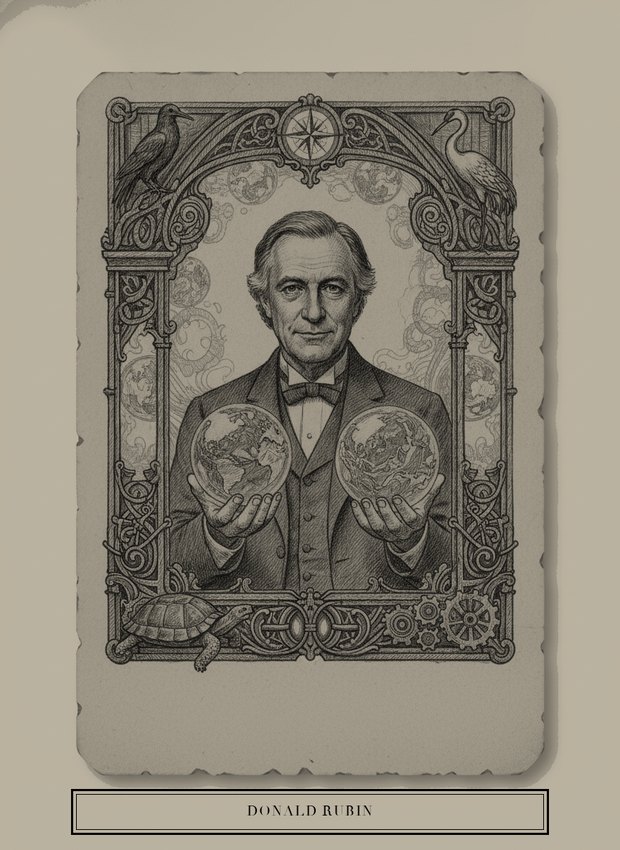
Rubin co-authored the 1992 Gelman-Rubin convergence diagnostic, the field-standard answer to the problem's central hard question, how do you know the chain has converged rather than stalled in one mode while another holds half the probability, by comparing multiple independently started chains rather than trusting a single run. His EM algorithm, developed with Dempster and Laird in 1977, already gave statistics a rigorous iterative method for handling exactly the kind of intractable, high-dimensional likelihood that motivated MCMC's revival of Bayesian inference in the first place. His broader career-long comfort treating missing or unobserved structure as something to be filled in probabilistically rather than assumed away is precisely the intellectual disposition MCMC formalizes. The score sits just below Gelman only because Gelman's subsequent decades built the surrounding applied-workflow infrastructure Rubin's 1992 paper made possible.
Fought here
In the mind map
The same ideas, as concepts rather than history — in John's ML knowledge map.
67 figures are scored on this problem. Draw it in a battle to see where you land.