It is the 1990s, and a startling theoretical question has just been answered yes: can a bunch of rules that are each only slightly better than a coin flip be combined into a single strong, accurate classifier? You hold exactly such weak learners. Combine hundreds of them into one powerful predictor — and, crucially, explain with theory why the combination keeps improving on test data even after it has driven training error to zero, defying the naive expectation that it must overfit. The margin explanation is the deep part. Get it wrong and you either dismiss weak rules as useless, or trust an ensemble you cannot justify — boosting's legacy is that it worked, spectacularly, for reasons that demanded new theory to understand.

Koller's signature science — probabilistic graphical models through the 1990s and 2000s, culminating in the 2009 textbook with Friedman — represents the era's other major learning paradigm: encode structure explicitly, learn parameters, reason by inference. Combining weak learners sits outside that program; boosting is aggressively non-generative, and its margin theory belongs to the computational learning community she overlapped with socially but not methodologically. Her strengths do partially transfer: she was a rigorous 1990s machine-learning researcher who could implement AdaBoost immediately, design honest experiments, and discuss bias-variance tradeoffs fluently, and Bayesian model averaging gives her a principled — though incorrect for this phenomenon — first story about why combination helps. But the specific deep answer, margins over the convex hull of hypotheses, is not something her actual methods generate.
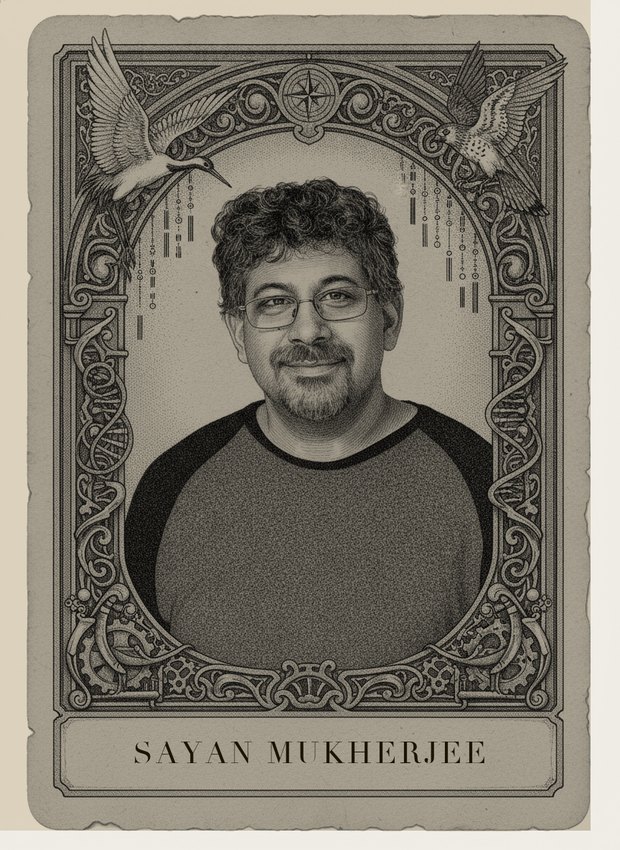
Mukherjee worked squarely inside the generalization-theory culture this problem's deep part inhabits: with Poggio, Rifkin, and Niyogi in the early 2000s he helped develop the stability approach to generalization — showing learnability can be characterized by algorithmic stability rather than uniform convergence alone — which is a genuine alternative lens on why procedures that fit training data still generalize. He commands VC theory, regularization, and empirical-process tools, and could reconstruct the margin bounds and critique them from the stability side, a distinctive and legitimate contribution to the demanded explanation. The discounts: his work slightly postdates the 1990s setting; boosting itself is famously awkward for stability analysis (AdaBoost is not uniformly stable), so his signature tool grips the phenomenon imperfectly; and the ensemble algorithms and margin theorems are others' results. A real theorist of the right question, one framework over.
Battle #61 · 8/10/2026, 11:35:17 AM · this result is deterministic: the same two personas on this problem always resolve the same way.