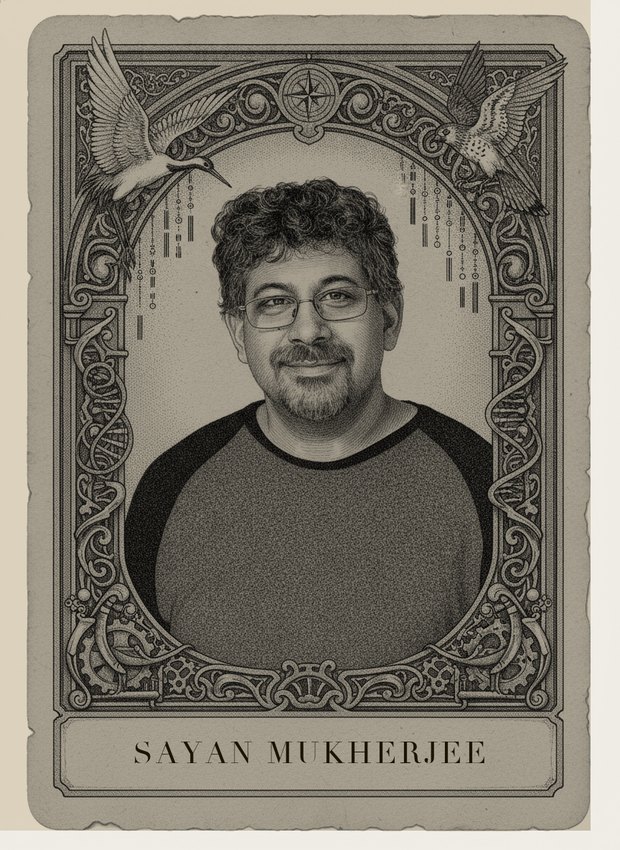
Sayan Mukherjee
Learning theory; topology and geometry of data; Bayesian ML
Strongest on
Battles
Two voices, two microphones L Michael I. Jordan
A committee of weak learners W Daphne Koller
A committee of weak learners
In the mind map
The same ideas, as concepts rather than history — in John's ML knowledge map.
Life and career
Sayan Mukherjee's career sits at an intersection that barely existed when he entered it: the place where learning theory, differential and algebraic geometry, Bayesian statistics, and genomics all have something to say about the same dataset. He is one of the people who made that intersection habitable.
He did his doctoral work at MIT in the Center for Biological and Computational Learning, in Tomaso Poggio's group — the same intellectual household that produced Partha Niyogi a few years earlier, and with the same formative commitment: that learning should be understood as an ill-posed inverse problem, tamed by regularization, and analyzed with the tools of approximation theory and functional analysis rather than with benchmark tables.
What distinguished his time at MIT was the proximity to genomics. The late 1990s and early 2000s were the moment when microarray technology suddenly made it possible to measure thousands of gene expression levels at once, and the statistical situation this created was unprecedented and awful: a few dozen samples, ten thousand variables, and biologists who wanted to know which genes mattered. Mukherjee worked with the Whitehead Institute and Broad-affiliated groups on exactly this problem, applying support vector machines and related methods to molecular classification of tumors. This is where his lasting interest in the small-n, enormous-p regime comes from, and it comes from the harshest possible version of it — not a simulation with p = 20,000 and n = 200, but a real study where n was thirty and the answer was going to inform someone's treatment.
He then spent the long central phase of his career at Duke University, where he held appointments spanning statistical science, mathematics, computer science, and bioinformatics — an unusual four-way footprint that reflects how his work actually distributes. Duke in that period assembled one of the strongest topological data analysis groups anywhere, and Mukherjee was the statistician in it, the person asking what a persistence diagram is an estimate *of* and what its sampling variability looks like. More recently he moved to Germany, to the University of Leipzig and the Max Planck Institute for Mathematics in the Sciences, continuing to work at the geometry-statistics interface.
The consistent thread across all of it is a conviction that the *shape* of data — its intrinsic dimension, its curvature, its holes and loops and connected components — is often the scientifically meaningful signal, and that this shape can be estimated with the same statistical seriousness one would bring to a mean.
Key contributions
**Stability and generalization.** With Niyogi, Poggio, and Ryan Rifkin, Mukherjee proved one of the cleanest structural results in learning theory. The classical account of generalization runs through uniform convergence: bound the complexity of the hypothesis class, and empirical risk minimization generalizes. But uniform convergence is sufficient, not necessary, and it is the wrong tool for algorithms whose effective hypothesis class depends on the data. The alternative is **algorithmic stability**: an algorithm is stable if removing or replacing a single training example changes its output only slightly. Their theorem established that a suitable notion of stability is sufficient for generalization, and — the harder and more surprising half — that stability is necessary as well as sufficient for the consistency of empirical risk minimization. This gave the field a second, genuinely different route to generalization guarantees, one that applies to regularization-based algorithms directly rather than through a complexity detour.
**Gradient learning and dimension reduction.** In the small-n, large-p regime, the useful question is often not "what is the function" but "which coordinates does it depend on, and how do they covary." Mukherjee's work on **estimating gradients** of the target function within a reproducing kernel Hilbert space framework attacks this directly: regularize toward smooth gradient fields, and the resulting gradient outer-product matrix reveals both the relevant variables and the directions along which the response actually varies. It is a supervised dimension-reduction method with a learning-theoretic backing, designed explicitly for the regime where the number of samples is dwarfed by the number of measurements.
**Topological data analysis with statistical content.** Persistent homology produces, from a point cloud, a persistence diagram summarizing the birth and death of topological features across scales. As an algorithm it is well defined; as a statistic it was, for years, unaccompanied by any theory of variability. Mukherjee's contributions here address that gap: notions of averaging and central tendency for collections of persistence diagrams, probabilistic treatments of Fréchet means in the relevant metric spaces, and stochastic-process models for time-varying topological summaries.
The **persistent homology transform**, developed with Katharine Turner and collaborators, is a particularly elegant result: it encodes a shape by the persistent homology of its sublevel sets in every direction, and this transform is *injective* — the collection of directional persistence diagrams determines the shape. That turns topology into a genuine descriptor space for statistical shape analysis, and it has been used on real morphological data, including comparative studies of skeletal and dental surfaces where the classical approach requires an expert to place landmarks by hand.
**Geometry on graphs and complexes, and Bayesian methods.** Related work extends spectral and diffusion ideas from graphs to simplicial complexes, studying Hodge Laplacians and random walks that respect higher-order structure — the natural generalization when the interactions in your data are not pairwise. Alongside this he has worked extensively in Bayesian statistics, including structure learning in graphical models and Bayesian treatments of geometric and dimension-reduction problems, which suits his applied setting: with thirty samples, a prior is not a luxury.
In battle
Mukherjee's profile is a moderate specialist's: mean 28.3, median 24, one problem above 80 and forty-one at or below 20. He is a good pick in a narrow band and a poor one outside it.
**P027 — Classify with 30 labels and 30,000 unlabeled** at 84 is his best problem, and the game's explanation is precise about why he places where he does. He worked inside the exact intellectual circle that owns semi-supervised geometric learning — the Poggio-adjacent learning theory community, the stability results with Niyogi and Rifkin, the move into manifold and topological methods for high-dimensional inference — and genomics gave him the labels-are-expensive regime in its harshest real form. But he ranks below Niyogi (95) and Schölkopf (88) because the canonical algorithms, Laplacian eigenmaps and manifold regularization, carry other people's names. This is a recurring and pedagogically useful feature of the scoring: being in the room and doing the theory is worth a lot, and it is not worth as much as owning the construction.
His strong band is all geometry-of-data. **P278 — All your neighbors are equidistant** (70) is the concentration of distances in high dimension, where intrinsic-dimension reasoning is the escape. **P023 — The line between two clouds** (68) is margin classification, from his SVM-on-gene-expression period. **P284 — Unroll the swiss roll** (64) and **P273 — Cut the image, weight the graph** (58) are manifold learning and spectral clustering, where he will consistently place second or third behind Niyogi. **P028 — Which examples deserve labels?** (62) and **P029 — The tilted scan** (60) round it out. `classification` at 42.4, `high-dim` at 40.4, and `networks` at 40.0 are his only categories above 37.
The weaknesses are broad, and the honest summary of them is that his toolkit answers a specific question — what is the shape of this data — and where that question is not the difficulty, he has no advantage. **P144 — The spam in the inbox** at 6 is the sharpest illustration: a text-classification problem where a linear model on good features wins and there is no interesting geometry to find. **P143 — The coefficient that flips sign** (8) is causal confounding, the near-universal blind spot on this roster. **P175 — What is a bit, exactly?** (8) is Shannon's founding definition of information, **P178 — The variables that must be whole** (8) is integer programming, **P196 — Best answer before the buzzer** (8) is anytime search, and **P246 — Small tools, loosely joined** (6) is Unix design. `computability` at 12.5, `systems` at 12.0, and `games` at 11.5 are his floor, and `nlp` at 16.6 and `information` at 15.5 are barely better.
His battle identity states the rule cleanly: he wins when the data's shape — holes, loops, geometry — is the signal, and loses when a plain linear model suffices. The second half of that is the part players underestimate. Topological and geometric methods are expensive, and the game does not reward them on problems where the structure is not there to be found.