It is the planning meeting before any data exist, and a researcher must answer a question that decides whether the whole study is worth running: how many subjects are needed to have a good chance of detecting an effect of the size that would actually matter? Too few and the study is doomed to a non-significant result no matter what is true — a foregone waste; too many and you spend scarce funding and expose extra subjects for no added knowledge. Compute the required sample size from the target effect, the variability, and the error rates you will accept, and defend every assumption. Get it wrong and an underpowered study finds nothing and gets read, disastrously, as evidence that nothing is there.

Vidal's work on generalized PCA and subspace clustering in computer vision, developed from the 2000s, addresses discovering low-dimensional geometric structure in high-dimensional visual data using algebraic geometry, a technical program with essentially no overlap with the classical power-and-sample-size formula this problem requires. His mathematics involves subspace arrangements and spectral clustering rather than hypothesis testing, effect sizes, or experimental design planning. Nothing in his primary research engages the specific pre-data sample-size calculation this problem's planning-meeting scenario requires the student to derive and defend, keeping his relevance to this specific classical statistics problem largely a matter of general technical sophistication in applied mathematics rather than any direct methodological overlap with the specific problem posed here.
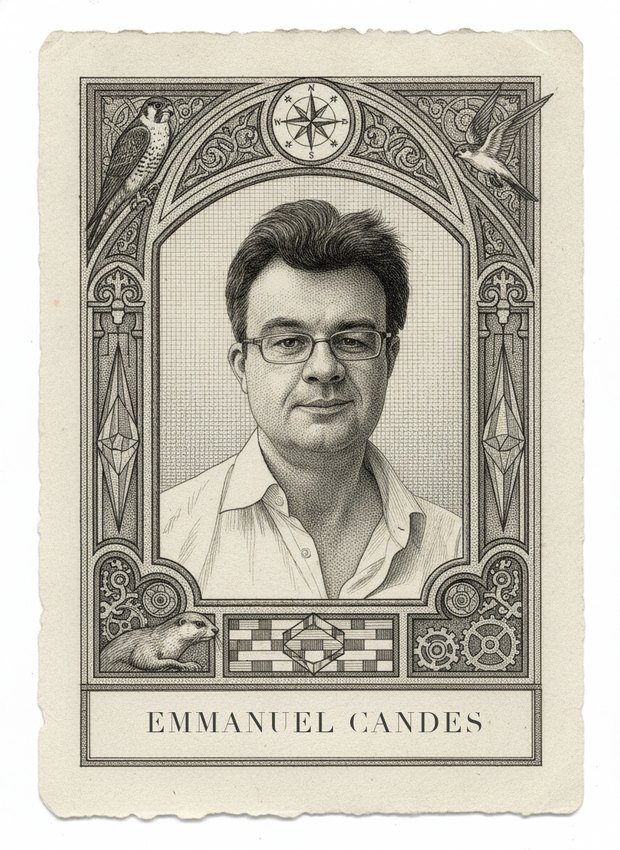
Candes's compressed sensing and matrix completion work, developed with Donoho and Tao from the mid-2000s, addresses recovering sparse or low-rank structure from limited measurements using convex optimization, a structurally related but methodologically distant cousin of the classical power-and-sample-size calculation this problem requires. His later work on knockoffs for variable selection touches sample-efficiency questions more directly. But his primary technical contributions center on high-dimensional signal recovery rather than the classical Neyman-Pearson hypothesis-testing framework this problem's planning-meeting scenario specifically requires the student to apply, keeping the direct relevance to this specific classical Neyman-Pearson framing modest despite real thematic adjacency in high-dimensional, sparse-recovery settings that classical Neyman-Pearson theory did not originally anticipate or address.
Battle #81 · 8/10/2026, 11:36:35 AM · this result is deterministic: the same two personas on this problem always resolve the same way.