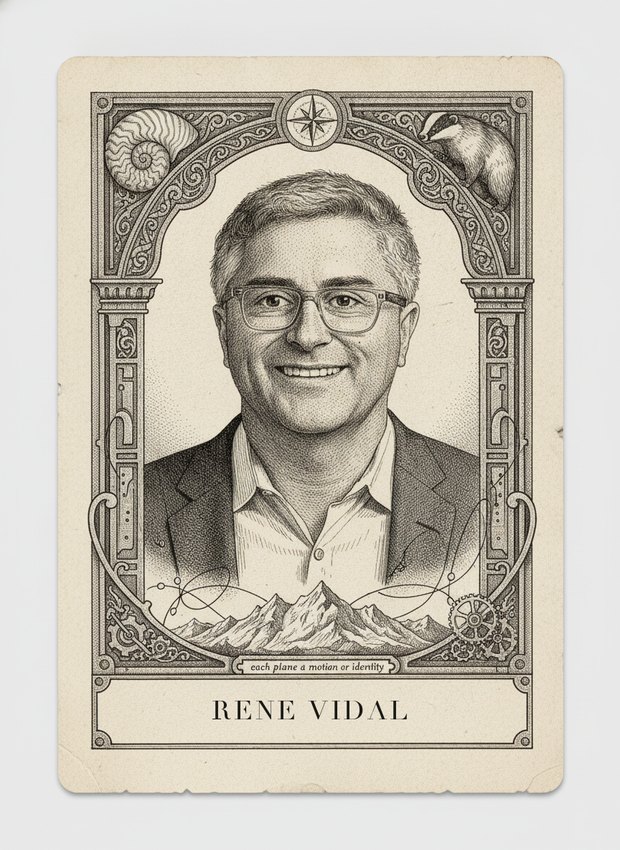
Rene Vidal
Generalized PCA; subspace clustering; geometry of vision
Played by Chris
Strongest on
Battles
In the mind map
The same ideas, as concepts rather than history — in John's ML knowledge map.
Life and career
Point a camera at a street scene and you get a swarm of tracked feature points, all mixed together — some on a bus, some on a pedestrian, some on the stationary building behind them. Nothing labels which point belongs to which object. But the mathematics is not as hopeless as it looks: under the standard affine camera model, the trajectories of points on a single rigidly moving body span a low-dimensional linear subspace. The scene is therefore not one cloud of points, it is a *union of subspaces*, and the segmentation problem becomes an algebraic one. Rene Vidal has built a career on that observation and its many descendants.
Vidal was born in Chile and took his undergraduate degree in electrical engineering there before coming to the University of California, Berkeley for doctoral work in the early 2000s. He worked with Shankar Sastry, in a group whose intellectual signature was the application of serious geometry and control theory to problems in vision and robotics — a distinctly Berkeley combination that shaped everything that followed. His dissertation asked how to fit multiple models to data simultaneously without knowing in advance which datum belongs to which model, and the answer he developed was algebraic rather than iterative.
He joined Johns Hopkins, where he spent most of his career, holding appointments in biomedical engineering and the Center for Imaging Science and becoming the founding director of the university's data science institute. That institutional position tells you something about his range: the same subspace machinery that segments motion in video also applies to medical imaging, to gene expression data, and to the analysis of surgical technique from instrument kinematics — a line of work his group pursued with real clinical collaborators. In recent years he moved to the University of Pennsylvania, continuing to work at the intersection of mathematics, imaging, and machine learning.
The later phase of his career has been marked by a turn toward the theory of deep learning. Having spent two decades proving when a geometric method provably recovers the right answer, he became interested in why highly non-convex neural network training so often succeeds anyway — contributing to the literature on conditions under which local minima of factorized, positively homogeneous objectives are global. It is a characteristic move: confronted with a technology that works for reasons nobody can state, his response was to try to state them.
Key contributions
**Generalized Principal Component Analysis.** GPCA, developed with Yi Ma and Shankar Sastry, is the contribution that defines him. The setup: your data lies not on one linear subspace but on a union of several, of possibly different dimensions, and you know neither the subspaces nor which point belongs to which. Classical PCA fits one subspace and fails; iterative approaches like k-subspaces alternate between assignment and fitting and get stuck in local minima depending on initialization.
The GPCA insight is that a union of $n$ subspaces is exactly the zero set of a system of homogeneous polynomials of degree $n$. Embed the data via the Veronese map — all degree-$n$ monomials of the coordinates — and the polynomial coefficients can be estimated *linearly*, from the null space of the embedded data matrix. Then comes the elegant part: the gradient of one of these polynomials evaluated at a data point is normal to the subspace containing that point. So differentiation recovers each point's subspace directly, giving segmentation without any initialization and without any alternating scheme. The framework comes with algebraic conditions on subspace dimensions and sample configuration under which correctness is provable. Vidal, Ma, and Sastry later expanded this into a full book.
**Motion segmentation and multibody geometry.** Vidal carried the algebraic machinery straight into vision. Multibody structure from motion generalizes the epipolar constraint from a single rigid motion to several simultaneous ones, encoding the multiple fundamental matrices as a single higher-degree constraint that can be factored to recover the individual motions. This let a system segment independently moving objects and estimate their 3D motions in one pass over feature trajectories.
**Sparse subspace clustering.** GPCA's weakness was noise sensitivity — polynomial fitting in high degree is fragile. Vidal's answer, with Ehsan Elhamifar, is one of the most-used algorithms in the field. The idea rests on a self-expressiveness property: each point in a union of subspaces can be written as a linear combination of *other points from its own subspace*. So solve, for each point, a sparse regression against all other points with an $\ell_1$ penalty and the constraint that a point not use itself. Under suitable subspace-separation conditions, the resulting sparse coefficients are supported almost entirely within the correct subspace. Assemble those coefficients into an affinity matrix and run spectral clustering. It is convex, it degrades gracefully under noise, and it comes with theoretical guarantees. The parallel low-rank formulation, using a nuclear-norm penalty instead, gives a robust alternative.
**Dynamical and hybrid models.** A related thread treats video sequences as outputs of linear dynamical systems — dynamic textures for flowing water or smoke — and asks how to identify and compare such systems, which requires metrics on the space of dynamical models rather than on the raw frames. He also worked on the identification of hybrid systems, where the data is generated by switching among several linear dynamics with unknown switching times: the same "multiple models, unknown assignment" structure as GPCA, in a control-theoretic setting.
**Theory of deep networks.** More recent work with Benjamin Haeffele and others establishes conditions — involving positive homogeneity of the network map and appropriately structured regularization — under which every local minimum of a factorized non-convex problem is a global minimum, extending intuitions from matrix factorization toward deep architectures.
In battle
Vidal is a sharp specialist, and the numbers are unambiguous: 100 problems, mean 25.9, median 19, with 55 problems at or below 20 — but a ceiling of 97 and four dominant cards. Play him inside his geometry and he is devastating; play him outside it and he contributes almost nothing.
**P072, "The subspaces of moving objects"** (97) is his dissertation described back to him. Multibody motion segmentation from feature trajectories, with a demand for provable correctness conditions rather than iterative initialization, is precisely what GPCA was built to deliver — the Veronese embedding, the linear polynomial estimation, the differentiation step, and the explicit algebraic conditions all appear in the problem statement. The three points withheld reflect the method's genuine noise sensitivity, the flaw that sparse subspace clustering was later invented to fix.
The rest of his dominant band is vision geometry. **P234, "Where did every pixel go?"** (84) is dense motion estimation, where his fluency in the geometry of image motion is directly applicable. **P235, "Rebuild the city from vacation photos"** (84) is large-scale structure from motion — multi-view geometry, his native language even where the specific systems were built by others. **P273, "Cut the image, weight the graph"** (82) is spectral segmentation, which is the second half of sparse subspace clustering: he uses that exact affinity-plus-spectral-clustering pipeline constantly. **P284, "Unroll the swiss roll"** (76) is manifold learning, adjacent to but not identical with his union-of-subspaces framing — he is strong there because low-dimensional structure recovery is his subject, but Isomap is not his paper.
Below the top tier, **P096, "Tensors don't factor like matrices"** (65) rewards his multilinear algebra, **P241, "Depth for a robot on Mars"** (65) is stereo geometry, and **P069, "Edges before objects"** (55) is early vision, where he is competent but historically downstream. His two leading categories, `high-dim` (42.6 over fifteen problems) and `perception` (42.0 over nineteen), define the band where he is worth playing.
The losses are among the most total on the roster, and they are worth studying because they show what a purely geometric toolkit cannot touch. **P249, "The shopping cart that must not vanish"** (4) — a highly available, partition-tolerant distributed store with conflict resolution — has literally no bridge to subspace geometry, and **P248, "The machine that overdosed"** (5), a safety-critical software engineering failure, is the same story. His `systems` average of 16.4 confirms it. **P170, "The message no eavesdropper can read"** (5) is cryptography and **P159, "Is this number prime?"** (6) is computational number theory; his `computability` average of 6.5 is the floor of his card. **P205, "Auction the airwaves"** (6) is mechanism design and **P120, "Play the winner"** (6) is adaptive clinical trial design — economics and statistics respectively, neither anywhere near his record.
The pattern to internalize: Vidal wins when the mess in the data conceals an algebraic structure — a union of subspaces, a multi-view constraint, a low-dimensional manifold. When the difficulty is adversarial, economic, discrete, or about the reliability of a running system, he has nothing to bring, and the game says so bluntly.