It is 1966 at IBM Research, and the customers paying millions for a System/360 are threatening to keep writing assembly forever: the FORTRAN compiler's output runs at half the speed of hand-tuned machine code, and machine time is the most expensive resource in the building. Make the compiler win — analyze data flow across the whole procedure, allocate registers globally, hoist invariants out of loops, and prove each transformation preserves the program's meaning, because an optimizer that miscompiles once is an optimizer no one will ever trust again. High-level languages live or die on this. Get it wrong and programming stays a priesthood of assembly writers, or a silently wrong optimization corrupts a payroll run at a bank that will never know why.

Chose Data-flow analysis to a fixed point — right call.
This is not a hypothetical for Allen; it is her actual desk at IBM Research through the 1960s and 1970s. She joined IBM in 1957 to teach FORTRAN, then moved into compiler research for the Stretch-Harvest project and later led work that founded modern optimizing-compiler theory: representing a program's control flow as a graph, computing global data-flow information across an entire procedure rather than one statement at a time, and using that information to justify transformations like loop-invariant code motion and common-subexpression elimination as provably meaning-preserving. Her 1966 and 1970 papers on program optimization and control-flow analysis are foundational texts of the field this problem describes. She became the first woman to win the Turing Award in 2006, specifically for this body of work.
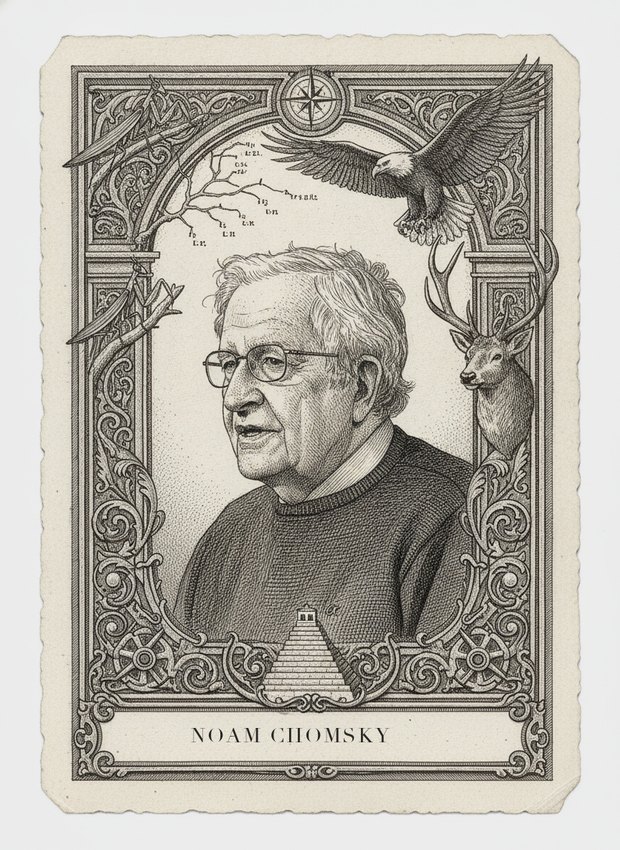
Chomsky's formal-grammar hierarchy, published in the late 1950s, gave compiler builders the mathematical foundation for parsing: representing a programming language's syntax as a context-free grammar that a parser can process systematically rather than through ad hoc pattern matching. Every 1960s compiler project, including the FORTRAN optimizer this problem describes, depended on parsing theory descended directly from his formal-language work. But Chomsky's own research addressed natural language syntax and cognitive linguistics, not compiler optimization, code generation, or the register-allocation and data-flow-analysis machinery this problem's 'optimize the compiler's output' actually demands, so his relevance is foundational parsing theory rather than engagement with the optimization problem itself. Grad students should read his contribution as parsing-theory infrastructure rather than any engagement with the optimization problem this scenario poses.
Battle #82 · 8/10/2026, 11:36:38 AM · this result is deterministic: the same two personas on this problem always resolve the same way.