systems
The compiler that beats the coder
It is 1966 at IBM Research, and the customers paying millions for a System/360 are threatening to keep writing assembly forever: the FORTRAN compiler's output runs at half the speed of hand-tuned machine code, and machine time is the most expensive resource in the building. Make the compiler win — analyze data flow across the whole procedure, allocate registers globally, hoist invariants out of loops, and prove each transformation preserves the program's meaning, because an optimizer that miscompiles once is an optimizer no one will ever trust again. High-level languages live or die on this. Get it wrong and programming stays a priesthood of assembly writers, or a silently wrong optimization corrupts a payroll run at a bank that will never know why.
Who this problem belongs to
The two figures whose methods fit it best, out of 40 in contention.

This is not a hypothetical for Allen; it is her actual desk at IBM Research through the 1960s and 1970s. She joined IBM in 1957 to teach FORTRAN, then moved into compiler research for the Stretch-Harvest project and later led work that founded modern optimizing-compiler theory: representing a program's control flow as a graph, computing global data-flow information across an entire procedure rather than one statement at a time, and using that information to justify transformations like loop-invariant code motion and common-subexpression elimination as provably meaning-preserving. Her 1966 and 1970 papers on program optimization and control-flow analysis are foundational texts of the field this problem describes. She became the first woman to win the Turing Award in 2006, specifically for this body of work.
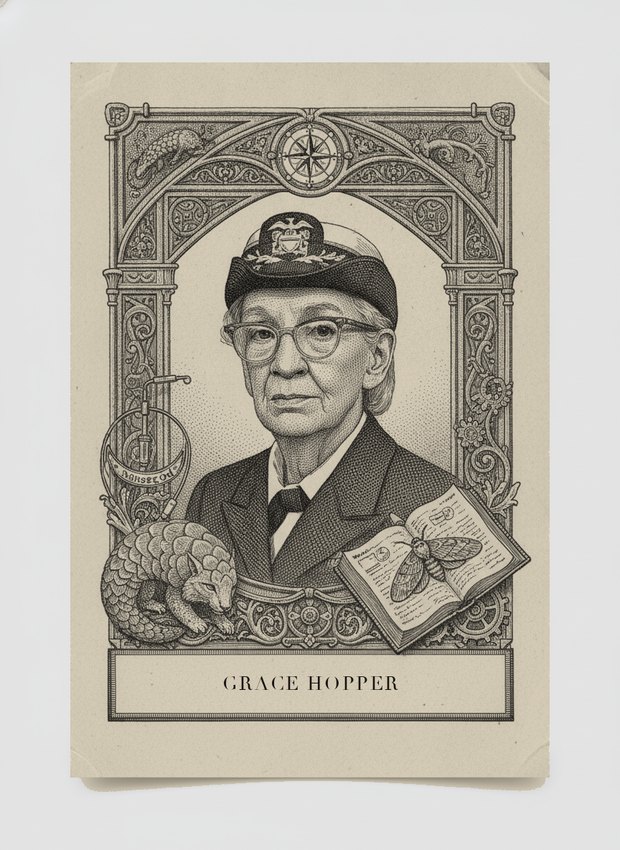
Hopper built the A-0 system in 1952, arguably the first compiler, on the then-radical premise that a program could translate symbolic instructions into machine code automatically, freeing programmers from writing raw machine language by hand. Her subsequent leadership on FLOW-MATIC and COBOL pushed the industry toward machine-independent, high-level programming exactly because she saw, a decade before this problem's 1966 scene, that customers would never trust compiled code unless it worked correctly and reasonably fast. Her famous insistence that 'it's easier to ask forgiveness than permission' reflects the practical, ship-it engineering culture this problem demands. She did not personally develop the global data-flow analysis and register-allocation techniques this specific 1966 optimization challenge requires, which keeps her just below Allen, the person who actually built them.
Fought here
40 figures are scored on this problem. Draw it in a battle to see where you land.