It is 2017 at Google Brain, and machine translation's best models are recurrent networks with a structural disease: they process a sentence one token at a time, so training cannot parallelize along the sequence, and the hardware of the era — massively parallel accelerators — sits half idle. The proposal is surgical: remove recurrence entirely. Design a sequence-transduction architecture where every position attends directly to every other — attention as the only mechanism for moving information — with positional encodings to restore order, and say precisely why it scales: what the parallelism buys in wall-clock training, what the shortened gradient paths buy in learnability. The empirical bar is state-of-the-art translation at a fraction of the training cost. The historical stakes, invisible from 2017: everything after runs on this.

Radford's later GPT work is built directly on top of the transformer this problem asks someone to invent, giving him deep practical fluency with exactly what the architecture enables once built, self-attention, parallel training, positional encodings. He understood viscerally, from using transformers at scale, precisely why removing recurrence mattered for wall-clock training efficiency. But his own major contributions come after the architecture already existed rather than inventing it, and he has no documented authorship role in the original 2017 attention paper itself. A downstream master user of the architecture, not its original designer. Deep fluency as a user is real credibility, even without a claim to the original invention itself.
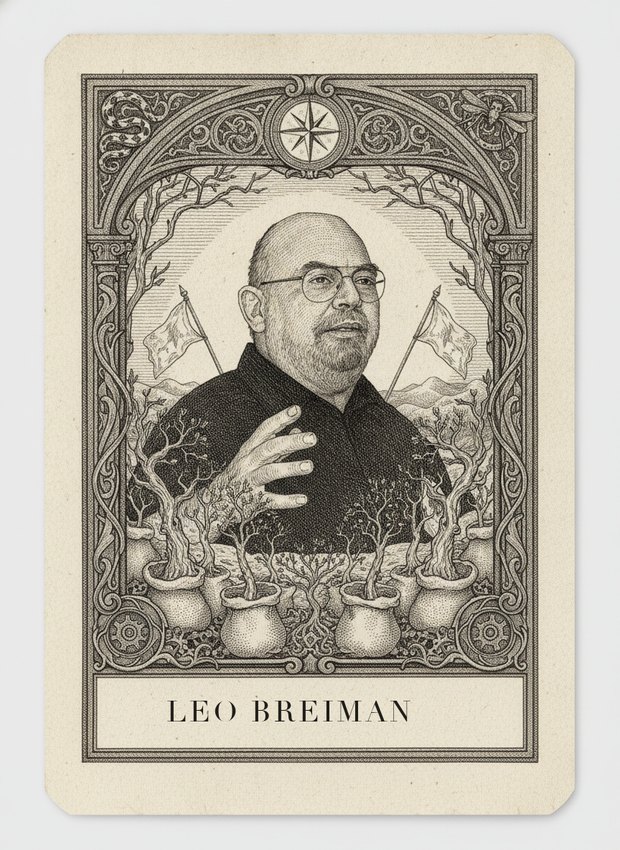
Breiman's CART, bagging, and random forests, along with his influential two-cultures essay favoring predictive accuracy over interpretable theory, show a philosophical alignment with the empirical, benchmark-driven engineering spirit this problem's translation-quality bar embodies. But his signature methods are tree-based ensembles for structured tabular data, not neural sequence architectures, and he has no documented history with recurrence, attention mechanisms, or hardware-aware parallelization. Genuine philosophical kinship, no direct technical overlap with this specific architecture-design problem. Philosophical alignment with empirical rigor does not amount to documented technical authorship of this architecture. His tree-based ensemble methods and neural sequence architectures share almost no concrete machinery. Shared philosophy about prediction over interpretability is not shared technical machinery.
Battle #99 · 8/10/2026, 11:37:49 AM · this result is deterministic: the same two personas on this problem always resolve the same way.