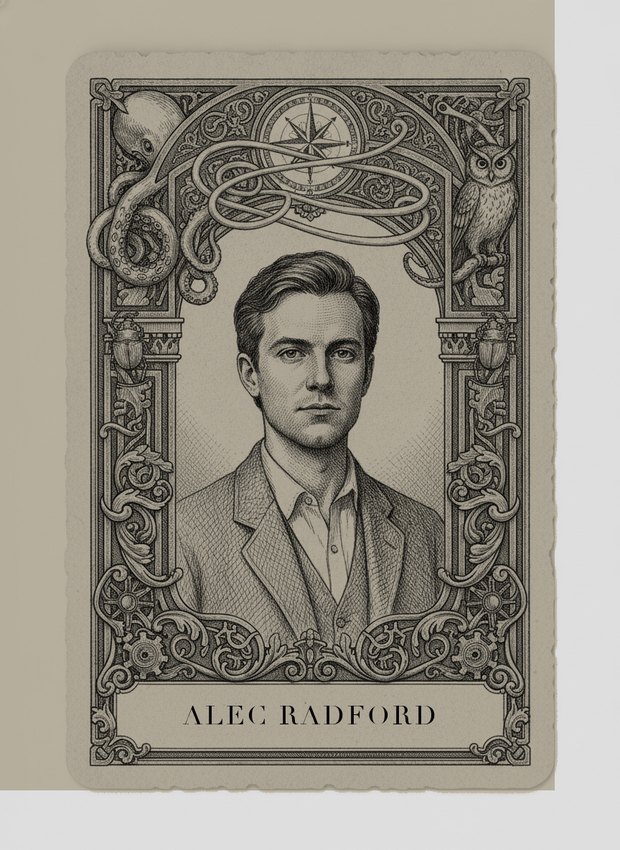
Alec Radford
GPT and CLIP: the language-model lineage
Played by Sam · LinkedIn
Strongest on
Battles
Cut the image into things W Leo Breiman
Attention replaces recurrence L Bernhard Scholkopf
Rebuild the city from vacation photos L Bernhard Scholkopf
Translate Russian by machine
In the mind map
The same ideas, as concepts rather than history — in John's ML knowledge map.
Life and career
If you ranked researchers by the ratio of influence to public profile, Alec Radford would be near the top of the list. He has first-authored a series of papers — DCGAN, GPT, GPT-2, CLIP, Whisper — any one of which would define a career, and he did it without a PhD, without a professorship, and without much appetite for the podium. The pattern in his work is so consistent that it functions as a research philosophy: take an objective simple enough to be almost embarrassing, find a data source large enough to be almost absurd, scale until something the field did not expect falls out, and write it up plainly.
He studied at Franklin W. Olin College of Engineering, a small undergraduate institution built around project-based engineering, and went to work at indico, a Boston machine learning startup, rather than to graduate school. It was from that unglamorous position — a small company, modest compute — that he produced the 2016 DCGAN paper with Luke Metz and Soumith Chintala, which did more to make generative adversarial networks usable than anything since Goodfellow's original.
He joined OpenAI in the organization's early years and stayed for most of a decade. The sequence of what came out of that tenure is the sequence of the modern field. In 2017 came the "sentiment neuron" result: a large character-level LSTM trained only to predict the next character of Amazon reviews turned out to have a single unit whose activation tracked sentiment, and which set a new state of the art on a sentiment benchmark when read out linearly. That paper is the hinge. It is a small, cheap, almost accidental finding, and its implication — that pure unsupervised next-token prediction discovers *semantic* structure nobody supervised for — is the seed of everything OpenAI did next.
In 2018 he led GPT: generative pre-training on unlabeled text, then discriminative fine-tuning on individual tasks. In 2019, GPT-2 removed the fine-tuning and argued that a sufficiently large language model performs tasks zero-shot when they are simply described in the prompt. He was a co-author on GPT-3 in 2020, which pushed that to few-shot in-context learning. In January 2021 he led CLIP, and later that year contributed to the image-generation line; in 2022 he led Whisper, a speech recognition system trained on hundreds of thousands of hours of weakly labeled web audio that matched or beat supervised systems on out-of-distribution benchmarks without fine-tuning on them.
He left OpenAI in late 2024 to pursue independent research. Colleagues have described him, in public and repeatedly, as one of the most effective empirical researchers in the field — which is notable given how rarely he has said so himself.
Key contributions
**DCGAN (2016).** GANs in 2014–15 were famous and nearly unusable: training was unstable, samples were small and blurry, and there was little guidance on architecture. Radford, Metz, and Chintala did the unglamorous work of finding a set of architectural constraints that made convolutional GANs train reliably — replace pooling with strided and fractionally-strided convolutions so the network learns its own up- and down-sampling, use batch normalization in both networks, remove fully connected hidden layers, use ReLU in the generator and LeakyReLU in the discriminator. The paper also demonstrated that the generator's latent space has linear structure: interpolation between latent codes produces smooth semantic transitions, and vector arithmetic on latent codes produces the sort of analogy behavior word embeddings had shown, but for images. For several years afterward, "DCGAN" was the default starting architecture for anyone doing generative image modeling.
**Generative pre-training and the GPT line.** The technical claim of GPT-1 is that a transformer decoder trained with a plain language-modeling objective on a large unlabeled corpus learns representations that transfer, with minimal task-specific architecture, to classification, entailment, similarity, and question answering. GPT-2 made the sharper claim: if the model is large enough and the corpus diverse enough, task-specific fine-tuning is often unnecessary, because tasks appear in natural text and the model learns them as a byproduct of modeling the distribution. The framing to hold onto is the one Radford's work has made canonical — supervised learning is a special case of language modeling, since a labeled example is just a string with a predictable continuation. GPT-2's staged release, motivated by misuse concerns, also set a precedent the field is still arguing about.
**CLIP (2021).** Contrastive Language–Image Pre-training. Two encoders — one for images, one for text — are trained on roughly 400 million web image-caption pairs with a contrastive objective: within a batch of $N$ pairs, maximize cosine similarity for the $N$ matched pairs and minimize it for the $N^2 - N$ mismatched ones, a symmetric cross-entropy over the similarity matrix. The consequence is a shared embedding space, and the consequence of *that* is zero-shot classification: to classify an image into arbitrary categories you have never trained on, embed candidate class names as captions and take the nearest one. CLIP matched fully supervised ImageNet ResNet performance zero-shot, and proved far more robust to distribution shift than models trained on ImageNet directly. It also became the text-conditioning backbone for the diffusion image generators that followed. The paper's own limitations section is unusually candid about the social biases inherited from web-scraped supervision.
**Whisper (2022).** The same recipe applied to speech: enormous weakly supervised multilingual data, a plain encoder-decoder transformer, multitask training (transcription, translation, language identification, timestamping) specified through special tokens in the decoder. The argument is that breadth of weak supervision beats depth of clean supervision for robustness — the model is not fine-tuned on the benchmarks it wins.
In battle
Radford's profile in the matrix is a near-perfect fingerprint of the "scale a simple objective" method: eight dominant cells (80+), a mean of 27.0, a median of only 18, and fifty-four problems at 20 or below. He is a modern-era carrier with essentially nothing to say before about 2012, and a devastating one after.
His top cell is **P243 — Name what you've never trained on** at 98, which is CLIP restated — the matrix's explanation notes that he led the design, ran the zero-shot evaluation the problem describes, and that even the bias-audit the problem demands is in his own paper's limitations section. **P087 — Predict the next word** (97) is GPT and is arguably his strongest claim on the roster, above Vaswani who supplied the architecture, because the *thesis* that next-token prediction is sufficient is his. **P262 — Fluent, confident, and wrong** (96) is high because he built the systems that hallucinate. **P037 — Compress the English novel** (88) is the same claim in information-theoretic clothing. **P075 — The picture that isn't there** (85) is GANs, where he sits just under Goodfellow: Goodfellow invented the game, Radford made it converge. **P071 — Segment anything** (86) and **P224 — The reward is a human preference** (90) place him inside the modern OpenAI toolchain — large weakly supervised vision, and preference-based fine-tuning. **P294 — The model memorized the secrets** (88) is memorization and extraction from web-scale training data, a failure mode his own systems exhibit.
Categories: **fairness** 64.0 and **RL** 57.0 are high but rest on only two problems each; **information** 50.0 and **NLP** 39.9 over eighteen problems are the substantive strengths, with **perception** 30.2 and **classification** 31.3 close behind. The floor is where the lesson is. **Experimental-design** 7.5, **small-sample** 8.5, **systems** 9.0, **testing** 10.5, **regression** 12.6.
His six worst cells are all classical statistics and they are all in the same tradition: **P136 — Counting accidents** (3, Poisson regression), **P143 — The coefficient that flips sign** (3, confounding and Simpson's paradox), **P133 — Why tall fathers have shorter sons** (4, regression to the mean), **P135 — The probability of default** (4, credit scoring and logistic regression), **P137 — The same patients, measured again and again** (4, longitudinal and mixed-effects models), and **P182 — The corner that sparsity loves** (4, the lasso). The matrix's own verdict on P143 is worth quoting in spirit: Radford's work is built on large-scale representation learning from abundant data, and he "would be starting close to scratch on this problem's specific statistical content, however formidable the surrounding general expertise may be."
That is the honest pedagogical point about Radford, and it generalizes to his whole cohort. The method that produced CLIP is *abundance-dependent*. It requires a corpus so large that a simple objective can find structure nobody labeled. Every one of his losses is a problem where the data is small, the sample is precious, the design is fixed in advance, or the difficulty is a causal subtlety in three variables rather than a pattern in four hundred million. Scale has no purchase there.
Practical read: play Radford on anything involving pretraining, transfer, zero-shot generalization, generative modeling, multimodal alignment, or the pathologies of web-scale training data. Do not bring him to a clinical trial, a credit model, or a confounded regression.