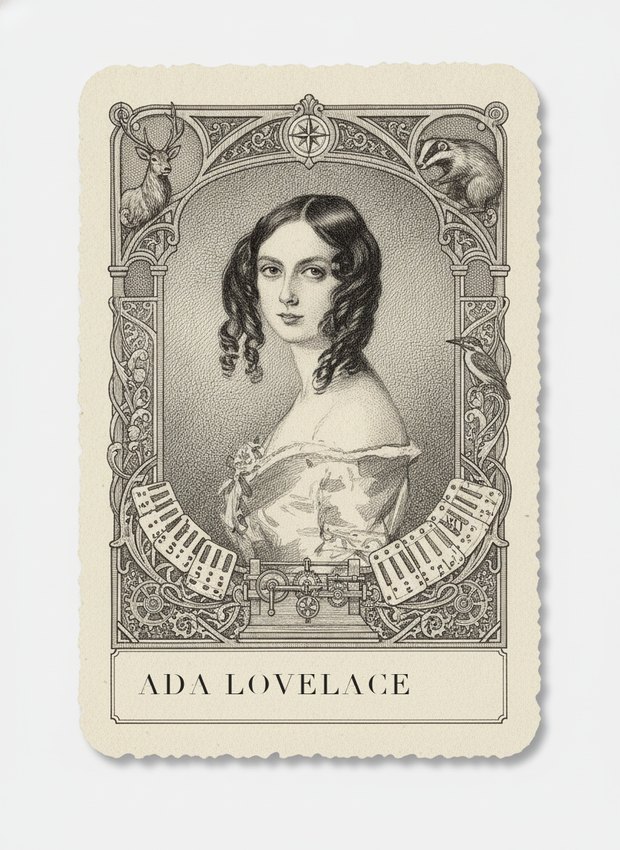
Ada Lovelace
The first programmer; foresaw general-purpose computation beyond number
Strongest on
Life and career
Augusta Ada Byron was born in London in 1815 to Lord Byron and Anne Isabella Milbanke, and her parents separated within weeks of her birth. She never met her father, who left England permanently and died in Greece when she was eight. Her mother — whom Byron had called the "princess of parallelograms," and who had a genuine mathematical education herself — had her daughter tutored intensively in mathematics and logic, on the explicit theory that rigorous study would inoculate her against whatever poetic madness she might have inherited. This is a strange origin for a mathematician and Lovelace was aware of it; she described her own approach as "poetical science," which reads less as a slogan than as an accurate account of what she actually did.
Her tutors were serious people. Mary Somerville, one of the most accomplished scientific writers of the era, was a mentor and family friend, and it was Somerville who introduced her, at seventeen, to Charles Babbage. Later she corresponded with Augustus De Morgan, who taught her advanced mathematics by post and thought highly of her capacity — while also expressing, in a letter to her mother, the era's standard anxiety about whether intense abstract study was safe for a woman. She married William King in 1835, who became Earl of Lovelace three years later, and had three children. Her adult life was chronically shadowed by illness and by treatments — opiates, largely — that were as debilitating as the conditions. She had an interest in gambling systems that ended badly, and a temperament that her correspondence shows as by turns brilliant, grandiose, and self-doubting.
The work she is known for occupies about nine months of 1842–43. The Italian mathematician Luigi Menabrea had published, in French, a paper describing Babbage's Analytical Engine following a lecture Babbage gave in Turin. Lovelace translated it into English. Babbage suggested she add material of her own, and she produced a set of seven notes, labeled A through G, that ran to roughly three times the length of the original paper. They were published in 1843 in *Scientific Memoirs* under the initials "A.A.L." — a woman's full name on a technical paper being a complication she and her circle chose to avoid.
The notes are the entire basis of her reputation and they are enough. She died of cancer in 1852, at thirty-six, the same age at which her father died, and was buried beside him at her request. She had, so far as the record shows, no further mathematical output. Her name resurfaced in the twentieth century through the history of computing; the Ada programming language was named for her in 1980. The question of how much of Note G is hers and how much is Babbage's has been argued at length, and the correspondence between them survives and is worth reading. The broad scholarly position is that the program in Note G is substantially her own work with Babbage correcting an error, and — more importantly — that the *interpretive* content of the notes, the part that actually matters, has no precedent in anything Babbage wrote.
Key contributions
Two things, one famous and one more important.
**Note G: the first published algorithm intended for a machine.** The note contains a table specifying, step by step, the operations, the variables read and written, and the loop structure required for the Analytical Engine to compute Bernoulli numbers. It is not a description of a calculation a person might do; it is a specification of the machine's state and control flow — which columns of the store hold what at each stage, which results are cycled back. It has a loop with a variable index and it distinguishes between the values a quantity takes over the course of execution and the storage location holding it. A modern reader recognizes this as a program, and recognizes the table as something close to a trace. This is why she is conventionally called the first programmer, and while priority claims of that kind are always contestable, the artifact is real and it was published.
**The generality insight.** This is the deeper contribution and the one that separates her from Babbage. Babbage thought of the Engine as a machine for numbers — a device to compute and print tables reliably. Lovelace saw that the numbers were incidental. Her argument in the notes is that if the Engine's operations act on symbols whose relations can be expressed abstractly, then anything whose fundamental relations can be so expressed is computable by the machine. She gives the example of music: if the relations between pitches were represented, the Engine could compose elaborate pieces of any complexity. That is the concept of general-purpose symbol manipulation — the idea that computation is not arithmetic but *formal process*, and that the domain is whatever you can encode. A century later this is the assumption underneath every non-numerical application of computers, which is to say nearly all of them.
**The limits argument.** Lovelace also stated, carefully, that the Engine "has no pretensions to originate anything" — that it can do whatever we know how to order it to perform. Turing took this up directly in 1950 as "Lady Lovelace's objection" and argued against it. It is worth noting what her claim actually is: not that machines are stupid, but that the machine's output is determined by the specification it is given, so the interesting question is what can be specified. This is a claim about the relationship between program and behavior, and it is the same question that formal semantics and computability theory would later make precise. She was thinking about the limits of mechanical procedure eighty years before anyone had the tools to prove anything about them.
What she did not have: any theory of computation, any notion of "all possible programs" as a mathematical object, no quantifiers, no diagonalization, and no machine. The Analytical Engine was never built. Nothing in her notes was ever executed in her lifetime or for a century after.
In battle
Lovelace's numbers are, at first glance, brutal: mean 10.4, median 9, ceiling 45, with ninety-three of a hundred problems at or below 20 and not a single score above 70. She belongs on the roster for what she saw, and the game scores what she could *do*, and the gap between those is exactly her profile.
Her best region is computability, at an average of 27.3 — the highest of any category she carries, and still low in absolute terms. "Will it ever halt?" is her top score at 45, and the reason is precise: she supplies the two prerequisites for stating the halting problem at all, namely a general-purpose programmable machine and the recognition that it manipulates symbols rather than numbers. Her Note G program contains a loop, so the question of whether a computation terminates was implicitly on her desk, and her argument about what a machine can and cannot originate is aimed squarely at the limits of mechanical procedure. What caps her is a century of missing logic. She could understand the question better than anyone before 1900 and could not have produced the 1936 proof. "Prove the program correct" (34) is the same story applied to program verification, and "The language for the job" (25) and "Let the machine find the proof" (22) reach programming-language design and automated deduction on conceptual ancestry alone. "Feed the army for pennies" (28) and "Where to place the sensors" (22) are the outliers where her algorithmic-specification instincts touch an optimization brief without supplying its method. "The equation with no algorithm" (24) is Hilbert's tenth problem — again, the right theme, none of the machinery.
Her losses are total and instructive in their uniformity. "The therapy the trial reversed" (2) — confounding by indication in the Women's Health Initiative — and "The corner that sparsity loves" (2) are her floor: causal epidemiology and convex sparse regression, two branches of applied statistics that did not exist in any recognizable form in 1843. "Counting accidents" (3) is Poisson regression, "Optimize across the datacenter" (3) is distributed consensus optimization, "Fill in the hidden variables" (4) is EM, and "The eigenvalues are lying" (4) is random matrix theory. Her causality average of 4.0 is the lowest number on her sheet, with regression at 6.0 and testing at 6.6. She has no data, no distributions, no estimation, no empirical method whatsoever — her entire output is one theoretical document about a machine that did not exist.
The most telling number is her systems average: 9.7 across eighteen problems, the largest block she carries and among her weakest. Like Babbage, she is scored as an architect of an unbuilt thing being asked about the operation of real ones. Her battle identity is stated exactly right in the profile: she wins on vision, abstraction, and what machines could become, and she loses on empirics and machines that exist. A student who plays her expecting her historical significance to convert into points will lose, and should — the lesson is that seeing something first and being able to do it are different achievements, and this game only scores the second.