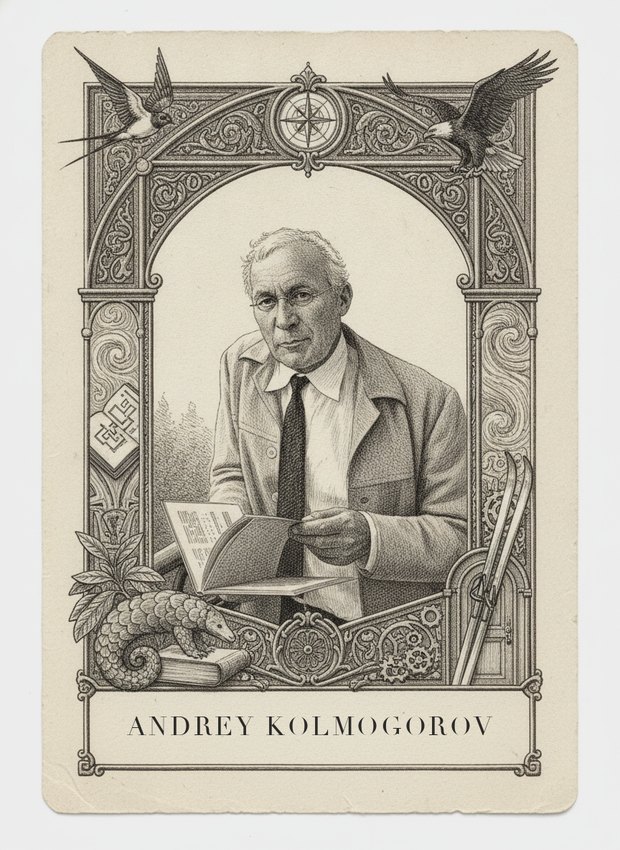
Andrey Kolmogorov
Axioms of probability; complexity; turbulence
Strongest on
In the mind map
The same ideas, as concepts rather than history — in John's ML knowledge map.
Life and career
Andrey Nikolaevich Kolmogorov was born in 1903 in Tambov, in circumstances that would have discouraged most people. His mother died in childbirth and his father, an agronomist, was largely absent and later killed during the Civil War; he was raised by an aunt on a family estate. He arrived at Moscow State University in 1920, initially interested in Russian history — he wrote a study of medieval Novgorod land records that reportedly impressed his professors and was told a historical thesis needed several proofs where in mathematics one would do, a remark he liked to repeat as the reason he switched fields.
He was publishing serious results by nineteen. Under Nikolai Luzin he worked on trigonometric series, and in 1922 constructed a Fourier series that diverges almost everywhere — a startling counterexample that made his name internationally while he was still an undergraduate. He never left Moscow State thereafter, becoming a professor in 1931 and holding chairs there for the rest of his life.
The 1933 monograph *Grundbegriffe der Wahrscheinlichkeitsrechnung* — Foundations of the Theory of Probability, written in German and running to about eighty pages — settled a question that had been open since Hilbert listed it as part of his sixth problem in 1900: what, mathematically, *is* probability? Kolmogorov's answer was that it is measure theory with a normalization condition, and the answer was so complete that the question stopped being interesting. Everything after that is downstream.
His subsequent range is nearly unmatched in the twentieth century. He did fundamental work on Markov processes and the equations governing their transition densities; on stationary processes and prediction, in parallel with Wiener; on the statistical theory of **turbulence**, where his 1941 papers gave the scaling laws for the energy cascade that still bear his name and that engineers use daily; on **dynamical systems**, where his contribution to what became KAM theory addressed the stability of near-integrable Hamiltonian systems and thereby the long-run stability of planetary orbits; on **Hilbert's thirteenth problem**, resolved with his student Vladimir Arnold via the superposition theorem that any continuous multivariate function decomposes into compositions of univariate functions and addition — a result that resurfaces periodically in neural network theory; and on **algorithmic information theory** in the 1960s. He also did applied and military work on artillery fire and on ballistics during the war.
He was an extraordinary teacher, which mattered as much as the research. His students include Arnold, Gelfand, Martin-Löf, Sinai, Prokhorov, and many others; the Moscow school of probability is his creation. He founded a specialized boarding school for mathematically gifted children and taught in it personally, and he cared deeply about mathematical education at every level. He was an avid skier, hiker, and swimmer, and he had a long, close personal and professional partnership with the topologist Pavel Alexandrov, with whom he shared a house outside Moscow. He navigated the Soviet system with mixed compromises — he signed at least one denunciation of Luzin, his own teacher, during the 1936 affair, a fact his biographers do not dispute and cannot fully explain. He died in Moscow in 1987.
Key contributions
**The axioms (1933).** Take a set Ω of outcomes, a σ-algebra F of measurable subsets, and a countably additive measure P with P(Ω) = 1. That is all. Random variables are measurable functions, expectation is the Lebesgue integral, independence is a product condition on measures, and conditional expectation is defined as a Radon–Nikodym derivative — a definition that handles conditioning on events of probability zero, which naive approaches cannot. Convergence theorems, the strong law of large numbers, and martingale theory all become theorems in a well-defined subject rather than heuristics. The **Kolmogorov extension theorem** guarantees that a consistent family of finite-dimensional distributions determines a stochastic process on an infinite-dimensional path space, which is what licenses talking about Brownian motion, Gaussian processes, and continuous-time models at all. The **zero-one law** and the **three-series theorem** are his. For a modern reader the payoff is that every probabilistic model you write — a probabilistic program, a diffusion, a nonparametric Bayesian prior — is guaranteed to name a coherent object because of this framework.
**Kolmogorov complexity (1965).** Having made probability rigorous, Kolmogorov became dissatisfied that the theory said nothing about *individual objects*: a fair coin assigns the same probability to a thousand heads as to any other specific sequence, yet one of those is obviously not random. His answer: define the complexity K(x) of a string as the length of the shortest program that outputs it on a universal Turing machine. The **invariance theorem** shows this is machine-independent up to an additive constant, making the definition meaningful. Randomness becomes **incompressibility** — a string is random if no description of it is shorter than itself — and his student Per Martin-Löf completed the picture in 1966 by characterizing randomness via universal statistical tests. Ray Solomonoff arrived at closely related ideas slightly earlier and independently, which is why the subject is sometimes called Kolmogorov–Solomonoff–Chaitin complexity.
The consequences run through modern learning theory. **Minimum description length** turns model selection into a compression problem: the best model is the one minimizing the combined code length of model plus data given model, a formalization of Occam's razor with a theorem behind it. The connection between compression and prediction, the algorithmic-information view of learning, the incompressibility method in combinatorics, and the intuition that generalization is compression all descend from here. K is uncomputable, which is both the punchline and the practical limitation.
**Kolmogorov–Smirnov test.** A distribution-free goodness-of-fit test based on the supremum distance between empirical and hypothesized CDFs, with a limiting distribution independent of the underlying distribution — one of the most used nonparametric procedures in existence.
**Turbulence and the 5/3 law.** His 1941 analysis of the energy cascade in fully developed turbulence, predicting the inertial-range energy spectrum scaling, is one of the most cited results in fluid mechanics and an exemplar of dimensional and scaling reasoning applied to a problem no one can solve exactly.
In battle
Kolmogorov is the most *evenly* dangerous figure in the early-statistics cohort: mean 47.6, median 47, ten problems above 80, seventeen above 70, and only ten weak. That last number is the remarkable one. Almost everyone else on the roster has thirty to fifty problems where they are essentially useless; Kolmogorov has ten. Foundations transfer.
His dominant region is description length and information. "The shortest description" (98) is Kolmogorov complexity in its original setting — his problem, solved his way, docked two points only because Solomonoff got there independently and slightly earlier. "The shortest description that predicts" (95) is MDL model selection. "Compress without knowing the source" (88) is universal compression, where the algorithmic-information framework supplies the theory. "Concepts from three examples" (86) is extreme small-sample generalization, where the compression-as-learning argument gives a principled account of why a short hypothesis should be preferred. "Which of five models?" (84) is model selection generally. "Does the model fit at all?" (92) is goodness-of-fit — the KS test. "Phase transition at the threshold" (82) is critical phenomena in random structures, where his probabilistic and scaling instincts apply directly. "Feed the army for pennies" (83) is a linear programming problem, and his strength there reflects the sheer breadth of a mathematician who worked in optimization, dynamical systems, and applied military mathematics.
His category profile is unusually flat and unusually high: computability 72.2 across eight problems, information 60.2 across fifteen, NLP 55.0, regression 53.0, RL 50.5, optimization 50.0, causality 49.9, games 49.0. Almost nothing on his sheet is genuinely bad. He is the roster's answer to the question of what pure mathematical foundations buy you.
The weaknesses, being few, are more diagnostic than usual. Three of his six worst problems are about **social and institutional questions rather than mathematics**: "The p-value reckoning" (18) is the replication crisis, a critique of research culture and incentives; "Arrested by a false match" (15) is facial recognition misidentification and its consequences; "Train on the phones, keep the secrets" (15) is federated learning and privacy engineering. His fairness average of 15.0 is his weakest category by a wide margin, and the reason is structural: Kolmogorov's method is to axiomatize and prove, and these problems turn on institutional design, deployment context, and harm — questions with no theorem at the end. The other two failures are **embodied and engineering** problems: "Drive through the intersection" (10) and "Sequence the robot's actions" (8), both requiring real-time perception and planning in a physical world. And his floor, "Ship it to a hundred contributors" (3), is open-source governance, where the profile calls the mismatch honest and total.
The lesson a student should take from his sheet is the inverse of Babbage's. Kolmogorov demonstrates that deep foundational work transfers almost everywhere, because most later fields are built on top of the objects he defined — and that it stops transferring exactly where the question stops being mathematical. Play him on anything about randomness, information, complexity, model selection, or the correctness of a probabilistic formulation. He will hold up in more places than you expect. Just do not send him at problems whose difficulty is human.