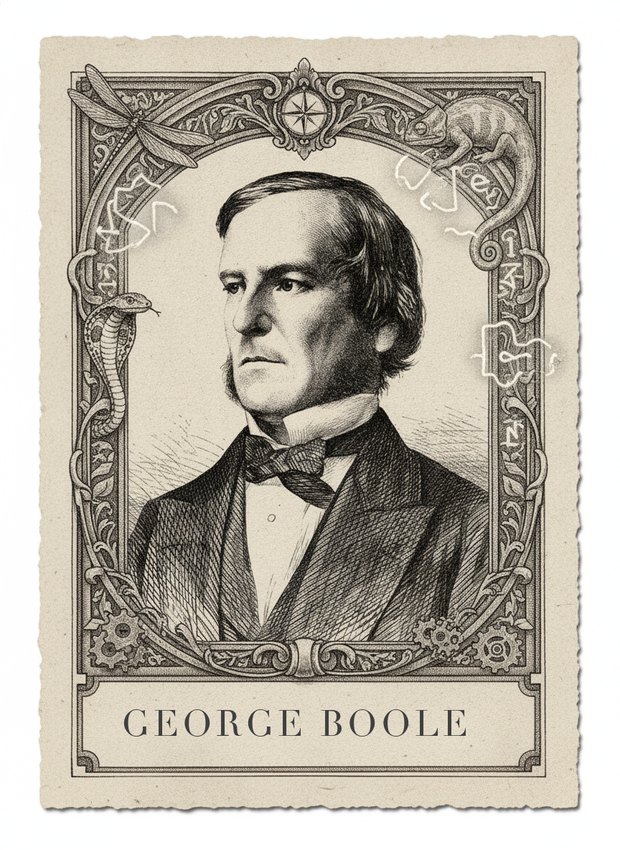
George Boole
Boolean logic underlying all digital computation
Strongest on
In the mind map
The same ideas, as concepts rather than history — in John's ML knowledge map.
Life and career
George Boole had almost none of the advantages that usually precede a permanent place in the history of mathematics. He was born in Lincoln in 1815, the son of a shoemaker whose real passion was optics and instrument-making and whose business failed accordingly. There was no university, no patron, no continental tour. Boole taught himself Latin and Greek as a boy, then taught himself French, German, and Italian in order to read the mathematical literature — Lagrange, Laplace — that English texts did not cover. At sixteen, with the family in financial trouble, he became an assistant schoolmaster to support his parents and siblings. At nineteen he opened his own school in Lincoln. He would run schools for the next decade and a half while producing original mathematics in the hours around them.
The mathematics was good enough to travel. He began publishing in the *Cambridge Mathematical Journal* in the late 1830s, in the then-active area of operator methods for differential equations, and in 1844 the Royal Society awarded him a medal for a memoir on the general method in analysis. He was a working schoolteacher with no degree, publishing in the Society's *Transactions*.
Two books made his name. *The Mathematical Analysis of Logic* (1847), a short pamphlet, was written in a burst partly prompted by a public controversy between the logicians Augustus De Morgan and William Hamilton over the quantification of the predicate. Boole's move was to sidestep the dispute entirely by algebraizing the whole subject. Seven years later he expanded and deepened it into *An Investigation of the Laws of Thought, on Which Are Founded the Mathematical Theories of Logic and Probabilities* (1854), the book he is remembered for and the one whose title states an ambition — that the operations of human reasoning themselves have an algebraic form — considerably larger than the technical result usually credited to him.
In 1849, on the strength of the published work and against the handicap of having no degree, he was appointed the first Professor of Mathematics at the newly founded Queen's College, Cork, in Ireland. He spent the rest of his life there. He married Mary Everest, a mathematically capable woman who later wrote on education and whose uncle George Everest gave the mountain its name; they had five daughters, of whom Alicia Boole Stott became a notable figure in the study of four-dimensional polytopes and Ethel Lilian Voynich became a novelist. He also wrote well-regarded treatises on differential equations and finite differences.
His death was early and pointlessly sad. In 1864 he walked several miles to a lecture in heavy rain, taught in wet clothes, and developed a feverish illness; he died at forty-nine. Boolean algebra spent the following seventy-five years as a curiosity of philosophical logic. It became the substrate of the modern world in 1937, when Claude Shannon's master's thesis observed that the algebra of 0 and 1 describes exactly the behavior of relay switching circuits.
Key contributions
Boole's central act was to notice that logical inference has the same formal structure as algebraic manipulation, and to build a calculus in which propositions are objects you compute with.
**Logic as algebra.** In his system, symbols stand for classes (the class of white things, the class of sheep), multiplication `xy` is intersection, addition is union, and `1 - x` is complement. Universal statements become equations: "all X are Y" is `x(1-y) = 0`. The distinguishing law is *idempotence* — `x² = x` — which has exactly two solutions, 0 and 1, and this is where Boole gets his famous observation that the algebra of logic is ordinary algebra restricted to a domain of two values. Once you have that, syllogistic inference becomes equation-solving and elimination: you write down your premises as equations, eliminate the variables you don't care about, and read off the conclusion. Deduction becomes a mechanical procedure rather than a matter of recognizing valid figures from a memorized list.
The system as Boole left it is not quite the Boolean algebra a computer scientist learns. He was working with something closer to numerical algebra with a constraint, and his treatment of addition (originally for disjoint classes) and of division was awkward and later cleaned up — by Jevons, Peirce, and Schröder — into the inclusive, complemented lattice structure now standard. The distributive laws, the complement laws, and De Morgan's duality all sit in this tradition.
**Why it matters for computation.** The payoff for a graduate audience is worth stating explicitly. Boolean algebra is the reason a physical device can perform inference. Every logic gate, every branch predicate in a program, every SAT instance, every binary decision diagram, every predicate pushed down into a query plan is Boolean algebra running on hardware. The propositional layer of first-order logic, and therefore of automated theorem proving, SMT solving, model checking, and formal verification, is Boole's calculus with quantifiers added on top by Frege and Peirce a generation later. And the canonical NP-complete problem is *Boolean* satisfiability — the complexity-theoretic center of gravity sits in his structure.
**Probability as an extension of logic.** The second half of *Laws of Thought* attempts something more ambitious and less successful: extending the algebra to handle probabilities, so that reasoning with uncertain propositions falls out of the same machinery. His method for bounding the probability of a compound event from the probabilities of its constituents — what are now sometimes called Boole's inequalities, including the union bound — is a real and durable contribution, and the general project anticipates modern probabilistic logic. But he had no notion of conditional independence, no graphical structure, and no calculus for updating on evidence, so the uncertainty half of the book never achieved what the deductive half did.
What Boole did not have: quantifiers, a theory of models, any machine, diagonalization, or any concept that some questions might be undecidable. He built the layer everything else stands on and could not himself climb it.
In battle
Boole's profile is a study in narrowness. Mean 15.4, median 12, and seventy-eight of his hundred problems at or below 20 — but with one score of 84 and a strong tail in a single region. He is nearly useless outside a well-defined corridor and genuinely formidable inside it.
That corridor is symbolic logic and computability. "Will it ever halt?" is his best problem at 84, and the profile's explanation is precise about why: the halting problem is a statement inside symbolic logic *about* symbolic logic, and Boole built the first working calculus in which propositions are computable objects — the step that made Hilbert's *Entscheidungsproblem* even formulable. He is discounted for missing eighty years of subsequent logic (he has no quantifiers, no machine model, no diagonalization) but he is aimed at exactly the right layer. "The grammar beneath the sentence" (75) reaches formal grammar and syntactic structure, which explains his top category average of 41.5 in NLP; his instinct that language has an algebra underneath it is directly ancestral. "The truth it cannot prove" (58) is Gödel incompleteness, "Let the machine find the proof" (55) is automated theorem proving, "Three machines, one class" (42) is machine-model equivalence, "Every interesting property is undecidable" (34) is Rice's theorem, and "The problem all others reduce to" (32) is Cook–Levin — SAT, which is his algebra, and where he scores lower than a student might guess because the problem demands a reduction argument and a complexity framework rather than the algebra itself. "Weight of evidence at Bletchley" (32) is his best showing outside pure logic and comes from the probability half of *Laws of Thought*. His computability average of 33.3 across fifteen problems is the only category where he is consistently competitive.
Everything continuous defeats him, and the floor is very low. "Optimize across the datacenter" (2) is distributed convex optimization; "Fill in the hidden variables" (3) is EM; "Five hundred stocks, one year of days" (3) is high-dimensional covariance estimation; "Unroll the swiss roll" (3) is manifold learning; "Test the many with the blood of few" (3) is group testing and compressed sensing; "The interpolator that should have failed" (3) is the benign-overfitting question in modern learning theory. His classification average is 3.0 — the lowest single category number he carries — with perception at 6.0, RL at 7.0, optimization at 7.7, and high-dimensional at 7.9.
The pattern is a clean statement of his battle identity: Boole operates in a **discrete, exact, two-valued register**, and every one of his failures is a problem stated in a **continuous, approximate, probabilistic** one. A gradient does not exist in his mathematics. Neither does a distribution over parameters, a variance, or a notion of "close enough." Even group testing — which is combinatorial and looks superficially like his territory — defeats him, because the modern formulation is a sparse-recovery problem with statistical guarantees rather than a deduction.
Play Boole on decidability, logic, formal languages, verification, and satisfiability, and expect a real fight from him there against opponents who arrived eighty years later. Play him on anything with a real number in it and watch him score in single digits. The gap is the most legible illustration on the roster of the split between the symbolic and statistical traditions in computing — a split that starts with him, and that the field spent the twentieth century failing to close.