computability
The truth it cannot prove
It is 1931 in Vienna, and the great project of the age is to put all of mathematics on a complete, mechanical, self-certifying foundation — a formal system that can prove every truth and its own freedom from contradiction. Take any such system rich enough to describe arithmetic and settle its fate: construct a statement true but unprovable within it, and show that no consistent system of this strength can prove its own consistency. The argument must be airtight, because it ends a program the era's greatest mathematicians staked their careers on. Get it wrong and either mathematics chases a completeness that cannot exist, or a real limit goes unrecognized — this draws the outer wall inside which all mechanical proof must live.
Who this problem belongs to
The two figures whose methods fit it best, out of 35 in contention.
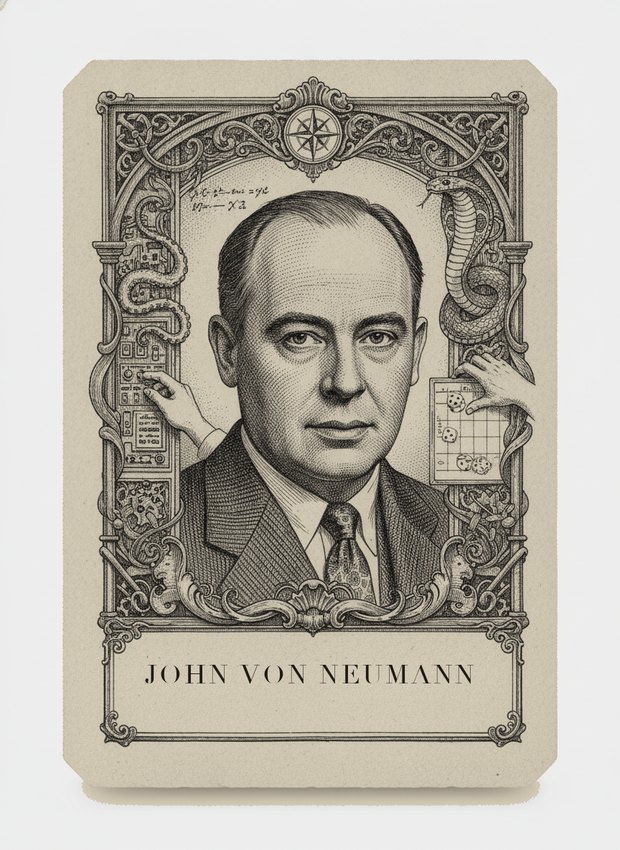
Von Neumann was in the audience at the 1930 Konigsberg conference when Godel first mentioned incompleteness in a roundtable remark, and he was the only person present who immediately grasped its force. Within weeks he had independently derived the second incompleteness theorem — that a consistent system cannot prove its own consistency — and wrote to Godel, only to learn Godel had already found it and was submitting it for publication; von Neumann graciously withdrew and became one of incompleteness's earliest and most forceful advocates. His command of formal logic, set theory, and the Hilbert program's ambitions from the inside makes him the closest thing on this roster to a primary witness. He is not the theorem's author, which is the only reason this is not higher.
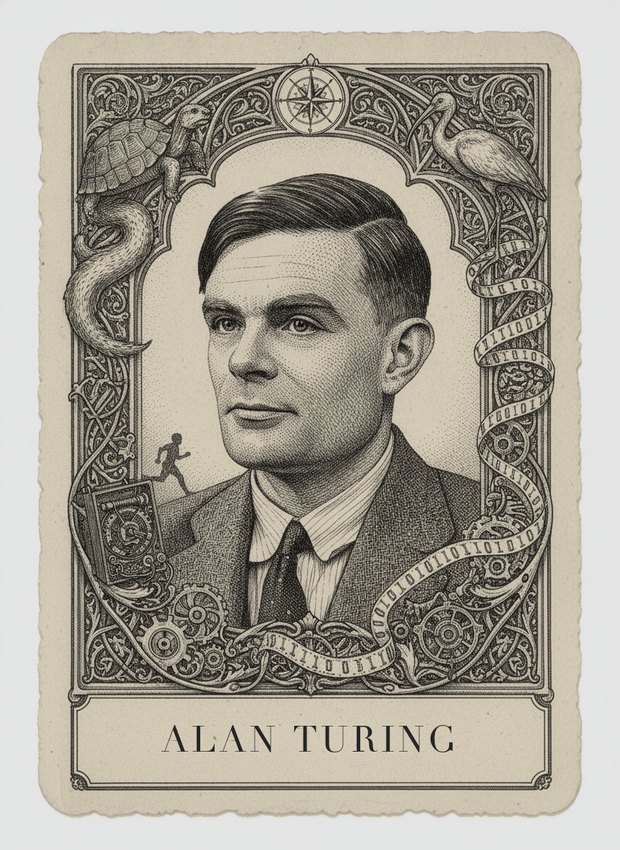
Turing's 1936 paper 'On Computable Numbers' is the direct computational sibling of Godel's result: he defines the universal machine, proves the halting problem undecidable by a diagonal argument structurally parallel to Godel's self-referential sentence, and shows the Entscheidungsproblem has no algorithmic solution. Turing had studied Godel's 1931 paper closely at Cambridge and reframed 'provable in a formal system' as 'computable by a machine,' giving incompleteness a mechanical, constructive face that a mathematician like Hilbert could not dismiss as a logician's trick. He arrives five years after 1931, so he inherits rather than originates the result, but no one on this roster translates the theorem into an equally rigorous, independent impossibility proof. His diagonalization technique could reconstruct Godel's argument from first principles.
In the mind map
The same ideas, as concepts rather than history — in John's ML knowledge map.
35 figures are scored on this problem. Draw it in a battle to see where you land.