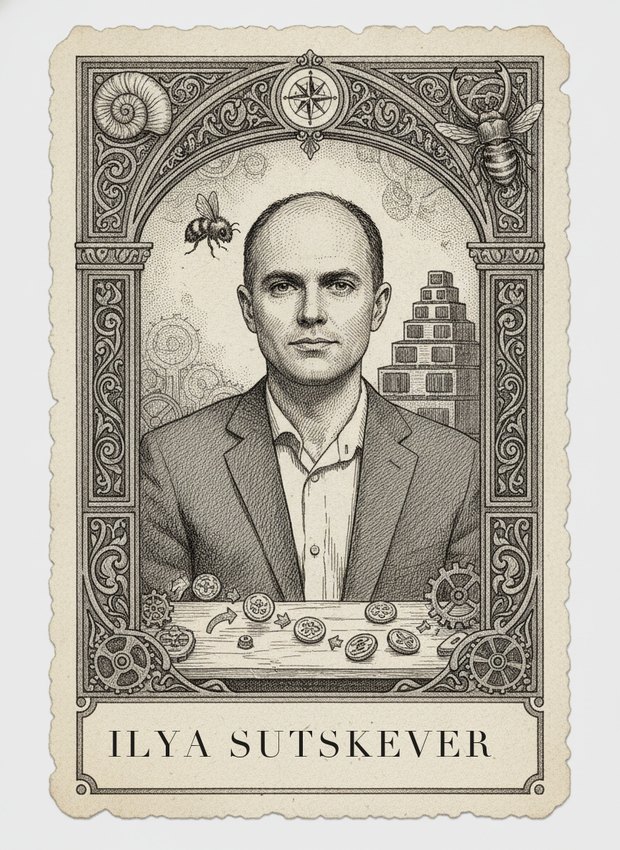
Ilya Sutskever
Seq2seq; scaling hypothesis; AlexNet co-author
Played by Kakit Ho · LinkedIn
Strongest on
In the mind map
The same ideas, as concepts rather than history — in John's ML knowledge map.
Life and career
Three times in a decade, Ilya Sutskever was a co-author on a paper that made the previous consensus look silly. That is an unusual hit rate, and it is not luck; it is the compounding return on a single conviction he held earlier and more literally than almost anyone — that large neural networks trained on large data with large compute would keep getting better, and that most of the field's cleverness was a substitute for compute it did not have.
He was born in 1986 in Nizhny Novgorod, in the Soviet Union, and his family emigrated to Israel when he was about five. He grew up in Jerusalem, and at sixteen the family moved again, to Toronto. He did his undergraduate, master's, and doctoral work at the University of Toronto, where he became a student of Geoffrey Hinton at a moment when being a neural network researcher was a slightly eccentric career choice. Toronto in the late 2000s was one of a handful of places — with Montreal and NYU — keeping the connectionist program alive through what practitioners now call the second AI winter, and Sutskever's early published work reflects that milieu: restricted Boltzmann machines, recurrent networks, and the optimization tricks needed to train them at all.
In 2012 he, Alex Krizhevsky, and Hinton entered the ImageNet Large Scale Visual Recognition Challenge with a deep convolutional network trained on two consumer GPUs. AlexNet won by a margin that was not incremental — the top-5 error dropped by roughly ten percentage points against a field of hand-engineered feature pipelines — and the computer vision community reorganized itself around the result within about eighteen months. The three of them formed a company, DNNresearch, which Google acquired in 2013, and Sutskever joined Google Brain.
At Google he was a co-author on several of the load-bearing papers of the mid-2010s: the word2vec follow-up on negative sampling and phrase representations, the dropout paper, an influential empirical study with James Martens and Hinton on how much initialization and momentum actually matter for training deep and recurrent nets, and the early demonstration with Christian Szegedy and colleagues that neural networks have adversarial examples. In 2014, with Oriol Vinyals and Quoc Le, he published "Sequence to Sequence Learning with Neural Networks," which showed that an LSTM could read a source sentence into a fixed vector and a second LSTM could decode a translation out of it, end to end, with no alignment model, no phrase table, and no linguistic pipeline.
In 2015 he left to co-found OpenAI, where he served as chief scientist through the GPT era. He was on the board during the November 2023 events in which Sam Altman was briefly removed as CEO and then reinstated; Sutskever subsequently stated publicly that he regretted his participation. The internal details of that episode are not public and are not worth speculating about. He left OpenAI in 2024 and co-founded Safe Superintelligence Inc., a research company organized around a single stated objective and, unusually, no intermediate product line.
Key contributions
**AlexNet (2012).** With Krizhevsky and Hinton. The architectural ingredients — ReLU activations, dropout, overlapping max pooling, data augmentation, and a two-GPU model-parallel implementation — were individually not all new, but the combination trained a network far deeper than convention allowed on a dataset far larger than convention used, and the result was a discontinuity in benchmark performance. The paper's real content for a graduate reader is an existence proof about capacity: the prevailing wisdom was that a model with sixty million parameters would overfit a million images, and the paper demonstrated that with the right regularization and enough augmentation it does not, and that the learned first-layer filters look like Gabor filters and color blobs whether you asked for them or not.
**Sequence to sequence learning (2014).** The idea is almost aggressively simple. Encode a variable-length input sequence with an RNN, take the final hidden state as a fixed-dimensional summary, and decode a variable-length output sequence from it with a second RNN, training the whole thing by maximum likelihood on paired data. It made machine translation a *learning* problem rather than a pipeline-engineering problem, and it generalized instantly — the same template gave image captioning, parsing, and dialogue. The paper is also honest about its own bottleneck: quality degraded on long sentences because every bit of meaning had to survive compression into a single vector. That named limitation is what attention mechanisms, and then the transformer, were built to remove. Sutskever's group both created the architecture and diagnosed the flaw that superseded it, which is about as clean a piece of scientific work as the era produced.
**Optimization and regularization for deep nets.** Less glamorous and heavily cited: the empirical demonstration (with Martens, Dahl, and Hinton) that careful initialization plus Nesterov-style momentum lets plain SGD train deep and recurrent networks that were widely believed to require second-order methods; and co-authorship of the dropout paper, which reframed a regularizer as approximate model averaging over an exponential ensemble of subnetworks.
**Adversarial examples.** As a co-author on "Intriguing Properties of Neural Networks" (2013), he was part of the group that found that imperceptible, deliberately chosen perturbations flip a classifier's prediction with high confidence — an early and durable result about the geometry of learned decision boundaries in high dimensions.
**The scaling thesis.** Harder to cite and arguably more consequential than any single paper: the position, held and acted on at OpenAI well before the evidence was overwhelming, that loss improves predictably with model size, data, and compute, and that capabilities emerge from that curve rather than from architectural insight. Next-token prediction on enough text, in this view, is not a toy objective but a sufficient one — compression of a corpus forces the learning of whatever structure generated it.
In battle
Sutskever is one of the highest-variance carriers in the game and one of the most rewarding to play correctly. Across 102 problems his mean is 32.2 with a median of 24, but he has fourteen dominant cells (80+) alongside forty-nine at 20 or below. When the problem is deep-learning-shaped, he is nearly unbeatable; when it is not, he is close to dead weight.
His strongest cell is **P260 — The sentence in a single vector** at 98, and there is nothing to interpret: it is his own 2014 paper, down to the fixed-vector bottleneck the problem asks about. **P148 — A thousand categories** (97) and **P233 — A thousand categories, one bet** (95) are ImageNet, likewise literal. **P087 — Predict the next word** (95) and **P037 — Compress the English novel** (85) are the scaling thesis stated as problems — the equivalence between language modeling and compression is exactly the frame he has argued from for a decade. **P152 — The pixel you cannot see** (92) is adversarial examples, on which he is an actual co-author. **P081 — Train across a thousand GPUs** (90) rewards the engineering half of his career, from AlexNet's two-GPU split forward. **P262 — Fluent, confident, and wrong** (86) catches him on the hallucination question — high, though notably below the ethics carriers who own the critique rather than the system.
His category profile is instructive. **NLP** (44.5 over sixteen problems) and **perception** (36.5 over sixteen) are his broad bases; **RL** (59.2), **games** (58.0), **systems** (51.0), and **information** (52.5) are strong but thin, only a few problems each. The number students should stare at is **optimization: 15.1**. Sutskever has real, cited optimization work — momentum, initialization, Hessian-free training of RNNs — and the game still scores him near the floor, because the problem set's optimization category is mostly classical convex programming, relaxation, and combinatorial rounding. His optimization knowledge is about making one specific non-convex thing train; it does not transfer to a simplex tableau.
The losses are a coherent list of everything the scaling thesis does not help with. **P151 — Three species of iris** (3) is the canonical case: Fisher's 1936 discriminant on 150 flowers, four features, closed form. More data and more parameters solve nothing there, and the matrix says so bluntly. **P136 — Counting accidents** (4) is Poisson regression; **P143 — The coefficient that flips sign** (5) is confounding and Simpson's paradox; **P145 — Just look at the neighbors** (5) is nearest neighbors; **P285 — Test the many with the blood of few** (5) is group testing; **P180 — Relax, then round** (5) is LP relaxation. His **small-sample** average is 8.0 and his **high-dim** average 12.7 — the two regimes where you cannot buy your way out with compute. A carrier whose entire method is "make it bigger" has no move when $n = 150$ and the estimator has a closed form.
Practical read: Sutskever is a hammer of unusual quality. Play him on sequence modeling, large-scale vision, language modeling, distributed training, and anything whose intended answer is *train a bigger network on more data*. Do not play him on classical inference, small samples, causal identification, or discrete optimization — the matrix will not give him partial credit for being smart.