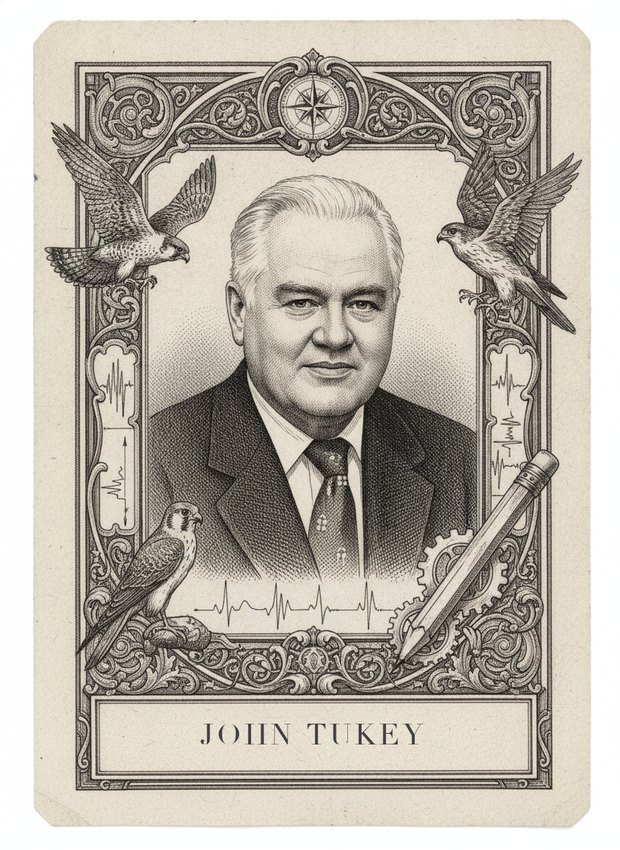
John Tukey
Exploratory data analysis; FFT; coined 'bit' and 'software'
Strongest on
In the mind map
The same ideas, as concepts rather than history — in John's ML knowledge map.
Life and career
John Wilder Tukey named the bit and named software, co-invented the algorithm that makes digital signal processing possible, and spent his career insisting that statisticians were doing the job backward — that the first task is to look at the data, not to test a hypothesis about it.
He was born in New Bedford, Massachusetts in 1915, an only child, and was educated at home by his parents, both teachers, on a deliberate plan to keep him out of a conventional classroom. He entered Brown University and took degrees in chemistry, then went to Princeton for a doctorate — also nominally in chemistry, which he abandoned for mathematics within a year. His 1939 thesis was in **topology**, on the general theory of convergence and on what is now sometimes called the Tukey lemma in set theory. He joined the Princeton faculty immediately.
The war moved him. He worked at the Fire Control Research Office in Princeton on problems of gunnery, rangefinding, and the analysis of experimental data, and he later said this was where he became a statistician — the encounter with real, messy, urgently needed analysis did what no course could. After the war he took an unusual dual appointment that he held for decades: professor at Princeton, where he founded the statistics department in 1965, and simultaneously a member of technical staff (later associate executive director) at **Bell Labs**. Bell gave him signal processing, telephone traffic, and an endless supply of hard data problems; Princeton gave him students.
His public service was extensive and consequential. He worked on the 1950 Kinsey report methodology, criticizing its sampling. He chaired or served on committees on air quality, on the effects of nuclear testing, on the census undercount, and on the Presidential Science Advisory Committee. He was involved in the development of election-night vote projection for NBC. He served on a National Research Council committee that examined the Kinsey data and on numerous others where a statistician was needed to tell a government something it did not want to hear.
His vocabulary is everywhere. He introduced **"bit"** in print — crediting the coinage to a compression of "binary digit" in conversation at Bell Labs — in Shannon's 1948 paper's acknowledgment of him, and he is credited with the first published use of **"software"** in its computing sense in 1958. He also coined "boxplot," "stem-and-leaf," "trimean," "linear," "jackknife," "data analysis" as a name for a discipline, and a great deal more; he had a genuine and slightly eccentric gift for naming.
Colleagues describe a man who thought out loud, wrote in an idiosyncratic dense style that many found difficult, gave answers that took years to fully unpack, and was almost always right. He retired from Princeton in 1985 and from Bell in the same period, and died in New Brunswick in 2000.
Key contributions
**Exploratory data analysis.** Tukey's 1962 paper "The Future of Data Analysis" and his 1977 book *Exploratory Data Analysis* argued a position that was heretical at the time and is orthodoxy now: statistics had over-invested in confirmatory inference — testing pre-specified hypotheses with optimality guarantees — and under-invested in the prior activity of finding out what is in the data. He argued that data analysis is a science in its own right, judged by whether it produces understanding rather than by whether it optimizes a criterion, and that approximate answers to the right question beat exact answers to the wrong one.
The tools he built for this are ones you use constantly. The **box plot** displays median, quartiles, and outliers with a fence rule (1.5 times the interquartile range) that flags points for attention without deleting them. The **stem-and-leaf display** keeps the digits visible while showing the distribution. **Five-number summaries**, **resistant smoothers** (running medians, the 3RSSH family), **re-expression** (choosing a transformation by what makes structure visible), and residual plotting as a routine habit are all his. The through-line is *resistance*: methods whose conclusions do not swing wildly when a few points are wrong, because in real data a few points are always wrong.
**Robust statistics.** Tukey's 1960 paper on contaminated distributions is one of the founding documents of robustness. He showed that if even a small fraction of your data comes from a heavy-tailed contaminating distribution, the sample mean's efficiency advantage over more resistant estimators evaporates entirely — a devastating result for the standard normal-theory apparatus. Trimmed means, Winsorization, and the **biweight** loss function are his; Huber's formal minimax theory followed and complemented this.
**Multiple comparisons.** The **Tukey honestly significant difference** procedure (circulated 1953) solved the problem that an ANOVA can declare an overall effect without identifying which pairs of treatments differ. HSD uses the studentized range distribution to set one critical value covering all pairwise comparisons simultaneously, controlling the family-wise error rate across the whole set of contrasts rather than letting it inflate comparison by comparison. He also introduced the one-degree-of-freedom test for non-additivity and worked extensively on simultaneous inference — a subject he essentially created and returned to throughout his life.
**The fast Fourier transform.** With James Cooley in 1965, Tukey published the divide-and-conquer algorithm computing the discrete Fourier transform in O(n log n) rather than O(n²), by recursively splitting the transform into even- and odd-indexed subtransforms. Gauss had an equivalent idea in unpublished notes a century and a half earlier and various partial versions existed, but the Cooley–Tukey paper is the one that changed the world. The motivating application was seismic detection of Soviet nuclear tests. Essentially all digital signal processing, spectral analysis, convolution, and a great deal of numerical linear algebra depends on it.
**The jackknife and resampling.** Tukey developed and named the jackknife — systematically deleting one observation at a time and using the resulting pseudo-values to estimate bias and variance — building on Quenouille's bias-correction idea. It is the direct precursor of Efron's bootstrap and of the whole computational-inference tradition.
**Spectral analysis and time series.** With Blackman he wrote the standard treatment of power-spectrum estimation from finite records, including the windowing and smoothing methods (the Tukey window among them) that made spectral estimation practical.
In battle
Tukey's profile is broad and unusually free of catastrophic holes: mean 43.3, median 40, seven problems above 80, eleven above 70, and only thirteen weak — the second-lowest weakness count in the early-statistics cohort after Kolmogorov. He is a generalist who dominates a specific, recognizable region.
That region is **messy data and multiplicity**. "Which pairs really differ?" (98) is his HSD procedure, dated in the game to 1953 for the precise reason that it is the year he circulated it. "One test or twenty?" (95) and "Twenty thousand tests at once" (78) are the multiple-comparisons problem at two very different scales — the second reaching into modern high-throughput multiplicity (FDR territory) where his simultaneous-inference framing is the foundation others built on. "Regression with lies in it" (93) is robust regression against contaminated data, and "When the bell curve won't hold" (93) is exactly his 1960 contaminated-normal argument. "The bootstrap when theory fails" (88) is the jackknife's descendant, and he gets the score for having built the resampling idea Efron formalized. "Thirty percent chance of rain" (92) is forecast verification and calibration — a data-display and honest-communication problem, which is his temperament exactly. "Who wrote the disputed papers?" (88) is the Federalist authorship study, where Mosteller was his frequent collaborator and where the work is fundamentally careful exploratory analysis of feature distributions before any model. His categories: testing 62.4 across fifteen problems, small-sample 54.0, systems 53.0, NLP 49.0, regression 46.8.
The systems average of 53.0 is worth noting as a genuine advantage over every other statistician on this part of the roster, and it is not an accident. Tukey was at Bell Labs, he co-invented the FFT, and he named software. He is the rare classical statistician with real computational standing.
His losses are more interesting than most because they are not era gaps. "Solve the game, completely" (15) is game-theoretic solution of a combinatorial game — his lowest-value category is games at 13.5, and the reason is that exhaustive combinatorial solution admits no exploratory approximation, which is the only thing he offers. "Calculus for a jagged path" (13) is Itô calculus, where the requirement is a rigorous continuous-time construction; Tukey's instincts were resolutely finite and empirical. "The grandmaster's intuition" (12) is expert pattern recognition and chunking, "Tensors don't factor like matrices" (12) is multilinear algebra and tensor decomposition, "Choose the first hundred believers" (12) is a strategy and diffusion-of-innovation problem, and "The sentence in a single vector" (10) is neural sequence-to-sequence encoding — his floor, where the profile allows him only general methodological virtue and no technical bearing.
The unifying reason he loses is his own stated methodology. Tukey's power comes from refusing to commit to a formal model and instead extracting structure from the data by resistant, approximate, visual means. That refusal is a liability exactly where the problem *demands* a formal object — a proof, a decomposition, an architecture, an exact solution. The profile's summary line is precise and slightly funny: he wins whenever the data is messy and the question vague, and loses formal optimality contests he would have refused to enter anyway. Play him on outliers, multiplicity, diagnostics, calibration, spectral analysis, and any problem where the first honest step is to look at the data. Do not send him at anything that needs a theorem.