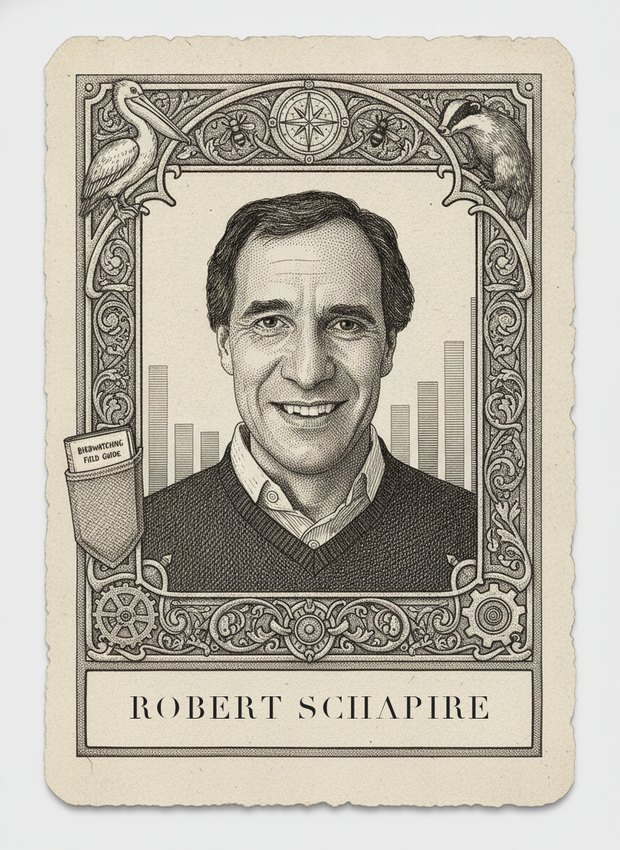
Robert Schapire
Boosting: weak learners made strong
Strongest on
In the mind map
The same ideas, as concepts rather than history — in John's ML knowledge map.
Life and career
In 1988 Michael Kearns and Leslie Valiant posed a question that sounded almost like a riddle. Suppose you have a learning algorithm that is only slightly better than a coin flip — it gets 51% accuracy on any distribution you hand it. Is that useless, or can it somehow be leveraged into a learner of arbitrary accuracy? Most people's intuition said the two notions of learnability were plainly different. Robert Schapire, then a graduate student at MIT, proved they were the same thing.
The paper, *The Strength of Weak Learnability*, appeared in 1990 and did not merely answer the question; it answered it *constructively*, exhibiting a recursive procedure that takes a weak learner as a subroutine and manufactures a strong one. That construction, unwieldy as it was in its original form, is the ancestor of every boosting algorithm since, and it made Schapire's career before it had properly started.
He did his doctorate at MIT under Ronald Rivest, in a theory environment where the standard for an answer was a proof, not an experiment. From there he went to Bell Labs and then AT&T Labs — the same extraordinary 1990s concentration of learning researchers that produced the SVM, convolutional networks, and modern online learning — where he began the long collaboration with Yoav Freund that produced AdaBoost. The pairing worked because their instincts were complementary: Freund arrived from Haussler's group with boost-by-majority and the drifting-games machinery; Schapire had the equivalence theorem and a relentless attention to what a bound actually says.
In the early 2000s he moved to Princeton as a professor of computer science, where he taught, advised a long line of students, and broadened considerably. One of the more charming threads of his career belongs to this period: with Steven Phillips and Miroslav Dudík he developed the maximum-entropy approach to species distribution modeling, and the resulting Maxent software became a workhorse of ecology and conservation biology — used by field biologists worldwide to estimate where a species can live from scattered presence-only observations. Schapire is a serious birder, and this is one of the rare cases where a theorist's hobby and research program visibly converged.
He later joined Microsoft Research in New York City, where his work turned toward contextual bandits — the problem of learning to make decisions from partial feedback, which is where online learning meets the practical business of choosing what to show a user. With Alekh Agarwal, Miroslav Dudík, John Langford, and Lihong Li he produced algorithms that achieve the optimal regret rate while remaining computationally practical, reducing the bandit problem to repeated calls to an ordinary supervised learner.
He and Freund received the Gödel Prize in 2003 and the Kanellakis Theory and Practice Award for AdaBoost, and in 2012 they published *Boosting: Foundations and Algorithms*, a book that is unusual in that it presents an algorithm from five genuinely different theoretical vantage points and takes all five seriously.
Key contributions
**The weak-to-strong equivalence.** In the PAC framework, a *strong* learner achieves error at most ε with probability at least 1−δ for any ε and δ, in time polynomial in the relevant parameters. A *weak* learner only achieves error slightly below 1/2. Schapire's theorem: a concept class is weakly PAC-learnable if and only if it is strongly PAC-learnable. The proof is a filtering construction — train a first hypothesis, train a second on a distribution where the first is right half the time, train a third on the examples where the first two disagree, take the majority — recursed to the required depth. It is not the algorithm anyone runs, but it settles the question and it shows where the leverage comes from: forcing the weak learner onto distributions where the existing ensemble is uninformative.
**AdaBoost.** With Freund, the practical realization. Maintain a weight over training examples; call the weak learner; measure its weighted error εₜ; give its hypothesis weight αₜ = ½ln((1−εₜ)/εₜ); multiply the weights of misclassified points up by e^{αₜ} and the rest down; repeat; output the sign of the weighted vote. The key word is *adaptive*: the algorithm does not need to know the weak learner's edge in advance, because it reads the realized error each round and sets the step accordingly. Training error is provably bounded by a product of terms each strictly less than one whenever the round beats chance, so it decays exponentially. In practice AdaBoost with decision stumps was, for years, a method that was nearly impossible to beat without substantial effort.
Later work with Yoram Singer generalized it in the directions practitioners needed: **confidence-rated predictions**, where weak hypotheses output a real-valued confidence rather than a bare label, and multiclass and multi-label extensions, including BoosTexter for text categorization.
**Margins.** The theoretical scandal — test error continuing to fall long after training error hits zero — was addressed by Schapire, Freund, Bartlett, and Lee in 1998. The bound they proved does not depend on the number of boosting rounds at all. It depends on the *margin distribution*: for each training example, the normalized weighted vote in favor of the correct label. Boosting continues to push this distribution rightward after the training error is exhausted, and the generalization bound tightens as it does. Leo Breiman and others contested the explanation, arguing that margin-maximizing variants did not always perform best; Schapire defended and refined it for years, and the refined version — bounds on the whole margin distribution rather than the minimum margin — held up. This debate is one of the more instructive arguments in the field's history and a direct ancestor of the modern interpolation literature.
**Boosting as a game.** With Freund, the observation that boosting is repeated play of a zero-sum game between a booster choosing distributions and a weak learner choosing hypotheses, with multiplicative-weights dynamics converging to the minimax value. This yields an independent proof of the minimax theorem, and it explains the algorithm rather than merely bounding it.
**Maximum entropy species distribution modeling.** Given only locations where a species has been observed and environmental covariates over a region, estimate the species' distribution. The maximum-entropy formulation picks the distribution of maximum entropy subject to matching the observed feature averages, with regularization to handle sampling error — and Schapire's group supplied both the algorithm and the analysis of what the regularized version is actually estimating. It is a case study in a theorist producing something a field biologist can download and use.
**Contextual bandits.** At Microsoft, algorithms that make the exploration-exploitation problem with side information both statistically optimal and computationally tractable, by reducing it to a small number of calls to an off-the-shelf cost-sensitive classifier.
In battle
Schapire's numbers are a specialist's: mean 28.8, median 20, fifty-one problems at 20 or below — and one problem at 99.
**P026 — A committee of weak learners** is that problem, and it is the highest score he could plausibly receive. The game's reasoning is that all three layers belong to him: the theorem (his 1990 solo result), the algorithm (AdaBoost, with Freund), and the explanation (margins, with Freund, Bartlett, and Lee). Freund scores 97 on the same problem and Bartlett 91; the ordering exactly tracks who owns which layer. If you have Schapire and this problem comes up, play it and stop thinking.
His strong band is the neighborhood boosting opened up. **P032 — What can be learned at all?** at 76 is PAC learnability itself — his `computability` score of 42.5, high for a machine learning figure, comes entirely from the fact that his formative work *was* learning theory in the computational sense. **P023 — The line between two clouds** (74) and **P070 — Find every face** (74, the Viola-Jones cascade) are margin classification applied. **P029 — The tilted scan** (73), **P150 — Learn from the stream, one at a time** (72, online learning and Hedge), **P028 — Which examples deserve labels?** (70), and **P258 — The inbox under siege** (69, BoosTexter-style text categorization) complete it. `classification` at 46.6 is his only large-sample category above 40.
Now the honest part. Schapire's battle identity — "wins on provable ensemble guarantees; loses to gradient boosting's engineering descendants at industrial scale" — names the real limitation. XGBoost and LightGBM are the algorithms people actually run, and their advantages are engineering ones: second-order approximations, regularized tree growth, sparsity-aware splitting, cache-efficient implementation. Schapire's contribution is upstream of all of it, but the game scores era-appropriate fit, and on a problem framed around industrial-scale tabular learning he is not the person who solved it.
His true floor is statistical. **P143 — The coefficient that flips sign** (5), **P141 — Why least squares, exactly?** (8), **P142 — Predict the ore grade underground** (6), and **P212 — Sample from the impossible posterior** (6) put him at the bottom: `causality` at 6.5 and `regression` at 19.2 are strikingly low for someone of his stature, and the reason is that PAC learning and classical statistical modeling are genuinely different traditions with different objects. Confounding, Gauss-Markov, kriging, and MCMC are simply not in his toolkit. **P217 — How high must the dike be?** (7) is extreme-value theory, **P246 — Small tools, loosely joined** (6) is Unix design, and `systems` at 9.0 is a floor he shares with most of the statisticians on the roster.
The lesson for a player: Schapire is a near-lock on one problem and a plausible pick on maybe a dozen more. Everywhere else, the fact that he is one of the most decorated theorists in machine learning buys him nothing, and the game is deliberate about that.