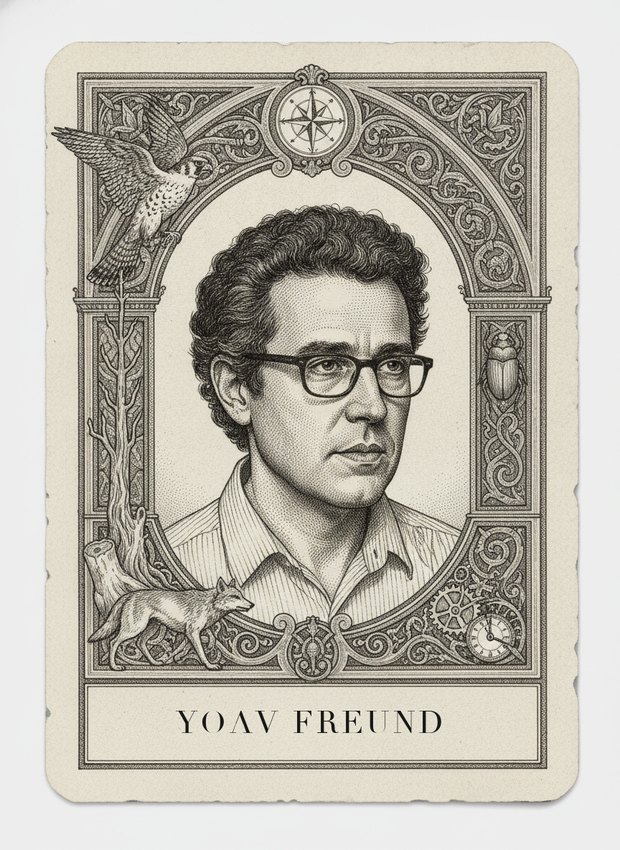
Yoav Freund
AdaBoost (with Schapire)
Strongest on
In the mind map
The same ideas, as concepts rather than history — in John's ML knowledge map.
Life and career
Yoav Freund belongs to the small group of researchers who took an abstract question from computational learning theory and turned it into an algorithm that people who had never heard of PAC learning ran on their data every day. The question was whether a learner only slightly better than guessing can be amplified into an arbitrarily accurate one. The answer, worked out by Freund and Robert Schapire across the first half of the 1990s, was yes, and the algorithm they built to prove it — AdaBoost — became one of the most consequential pieces of machine learning ever written down.
Freund did his doctoral work at the University of California, Santa Cruz, in David Haussler's group, which in the late 1980s and early 1990s was one of the two or three places on earth where computational learning theory was being done seriously. Santa Cruz gave him the habits that mark all his later work: define the learning problem precisely, state a guarantee, prove it, and only then ask whether the algorithm is any good in practice. His thesis-era work on **boost-by-majority** predates AdaBoost and is in some ways the more mathematically beautiful construction, analyzed through a framework of drifting games in which the booster and an adversarial weak learner play out a sequence of moves toward a boundary.
He then joined the research organization at Bell Labs, later AT&T Labs, in the period when it held an extraordinary concentration of learning researchers — Vapnik, Cortes, LeCun, Schapire, and others in adjacent offices, with real problems (handwriting, speech, fraud, text) and real data. It was there, working with Schapire, that boost-by-majority became AdaBoost, and there that the algorithm got tested against the hardest benchmarks then available.
In the early 2000s Freund moved to the University of California, San Diego, where he has been a professor of computer science and engineering, later also affiliated with UCSD's data science institute. His work at San Diego broadened: online learning, nearest-neighbor search and randomized space-partitioning data structures with Sanjoy Dasgupta, applications ranging from neuroscience to environmental sensing, and continued deepening of the boosting theory.
He and Schapire received the Gödel Prize in 2003 and the Kanellakis Theory and Practice Award for AdaBoost — a rare pair of honors that together say exactly the right thing about the work: it was a theorem, and it was a tool.
Key contributions
**Boosting.** The setup: a weak learner is any algorithm that, on any distribution over the training set, returns a hypothesis with error at most 1/2 − γ for some small edge γ. Schapire's 1990 result established that such a learner can be converted into one with arbitrarily small error. Freund's boost-by-majority gave a construction that was optimal in a precise sense, but had a practical defect: you had to know γ in advance, and you had to know it correctly.
AdaBoost, developed jointly and published in the mid-1990s, removed that requirement, and the way it removed it is the whole trick. On each round you train a weak learner on the current weighting of the data, measure the error it actually achieves, and *set that round's hypothesis weight from the observed error rather than from an assumed edge*. Misclassified examples get their weights multiplied up; correctly classified examples get multiplied down; the final classifier is a weighted vote. Because the weights adapt to the weak learner's realized performance, AdaBoost is parameter-free in the way that matters, and its training error provably decays exponentially in the number of rounds so long as each round beats chance at all.
**The framing paper: online allocation and Hedge.** The 1997 paper that presented AdaBoost most influentially framed it as a special case of something more general: a decision-theoretic online allocation problem, in which a gambler distributes wealth across experts, observes losses, and reweights multiplicatively. That algorithm, Hedge, is the multiplicative-weights method in its cleanest form, and the reduction from boosting to online allocation is the reason the two literatures have been intertwined ever since. Regret bounds for Hedge translate into generalization statements for boosting and vice versa.
**Margins.** The empirical scandal of AdaBoost was that test error kept *decreasing* after training error hit zero, which no version of Occam's razor could explain. The resolution, in the 1998 paper by Schapire, Freund, Bartlett, and Lee, was that the right quantity is not the training error but the distribution of *margins* — the signed, normalized confidence of the vote on each training example. Boosting keeps pushing the margin distribution rightward long after every example is on the correct side, and the generalization bound depends on the margin distribution and the complexity of the weak-learner class, not on the number of rounds. This was a genuine advance in how the field thought about capacity, and it fed directly into the later theory of the interpolation regime.
**Boosting as a game.** Freund and Schapire also showed that boosting is an instance of repeated play of a two-person zero-sum game between the booster (choosing distributions) and the weak learner (choosing hypotheses), with the multiplicative-weights dynamics converging to the minimax equilibrium. This gives an independent proof of the von Neumann minimax theorem and is probably the deepest single lens on why the construction works at all.
**Active learning.** With Seung, Shamir, and Tishby, Freund analyzed **query by committee**: maintain a committee of hypotheses consistent with the data so far, and request a label only when the committee disagrees. The paper proved that under suitable conditions this yields exponential savings in label complexity over passive learning. It is one of the founding results of active learning theory and remains one of the few with a clean rate.
**Large-margin perceptrons and randomized data structures.** His voted perceptron work with Schapire showed that a simple online algorithm, run with averaging or voting over its intermediate hypotheses, achieves large-margin behavior competitive with kernel machines at a fraction of the cost. Later, with Dasgupta, he worked on random-projection trees and related structures that adapt to the intrinsic dimension of data rather than its ambient dimension.
In battle
Freund is a specialist, and the numbers say so with unusual force: mean 24.9, median 18, and fifty-eight problems where he scores 20 or below. But his ceiling is enormous, and there is one problem in the game that is simply his.
**P026 — A committee of weak learners** at 97 is that problem. The game marks him a hair below Schapire, and it is right to: the original weak-learnability equivalence theorem was Schapire's solo result, and Freund arrived to the collaboration with boost-by-majority in hand. Everything after that — AdaBoost itself, the margins explanation, the game-theoretic reading — is joint. If you play Freund here you are essentially guaranteed a top-two result, but you cannot beat his co-author on it.
**P028 — Which examples deserve labels?** at 88 is his second dominant problem and the one players consistently miss. Query by committee is his paper; active learning is not an adjacent interest but a founding contribution. Note that this is the same problem Robert Nowak and Sayan Mukherjee also score well on, so expect contested play there.
His remaining strong band is the applied edge of boosting. **P070 — Find every face** (76) is Viola-Jones territory, a cascade of boosted stumps over simple rectangular features — probably the most visible industrial deployment AdaBoost ever had, and the reason `perception` is not lower for him than it is. **P023 — The line between two clouds** (72) and **P029 — The tilted scan** (72) are margin-based linear classification. **P150 — Learn from the stream, one at a time** (68) is online learning, which for Freund is not a side interest but the frame in which he understood boosting in the first place. **P146 — The tree you can read** (65) reflects the fact that boosting's weak learners were usually decision stumps and small trees. **P186 — Where to place the sensors** (64) draws on the active-sensing side of his later applied work.
`classification` at 45.9 across seventeen problems is his only category above 35, and that is the whole story. Everything else — `causality` at 9.0, `systems` at 7.0, `games` at 11.0, `networks` at 16.5, `nlp` at 17.5 — is well below the roster's middle.
The losses are worth studying because they show where a pure classification theorist has nothing to offer. **P143 — The coefficient that flips sign** (5) is his floor: Simpson's paradox, confounding, and errors-in-variables are a completely separate statistical tradition, and boosting's rigorous pedigree buys no transfer at all. **P137 — The same patients, measured again and again** (6) is longitudinal and mixed-effects modeling, which is Gelman's home ground and not remotely Freund's. **P079 — The language for the job** (6) is programming-language design, **P198 — Program chess before the computer exists** (8) is game-tree search, **P185 — Optimize across the datacenter** (8) is systems scheduling, and **P217 — How high must the dike be?** (7) is extreme-value theory, where the entire difficulty is the tail behavior of rare events rather than a decision boundary.
There is one further weakness a careful player should anticipate, because it is also the honest limitation of the method. Freund's battle identity is "wins by reweighting toward hard examples round after round; loses when label noise turns that focus into obsession." That is a real property of AdaBoost with exponential loss: mislabeled points get their weights driven up round after round, and the algorithm eventually devotes the whole committee to fitting the corruption. On any problem whose central difficulty is heavy label noise or outlier contamination rather than a hard-but-clean boundary, do not expect the margin machinery to save him.