small-sample
Estimate the tank total
It is 1943, and Allied intelligence has captured five German tanks bearing sequential serial numbers — and commanders need to know how many the Reich is really building, because inflated spy estimates and cautious ones diverge by thousands of machines. From five numbers you must estimate total production, and every assumption you make will be interrogated by people planning an invasion. Field agents guess tens of thousands; the serial numbers may say otherwise. Build an estimator, defend its logic, and quantify how wrong it could be. Overestimate and the offensive is delayed for a phantom army; underestimate and men land against armor no one warned them about. Five data points decide operational reality.
Who this problem belongs to
The two figures whose methods fit it best, out of 41 in contention.
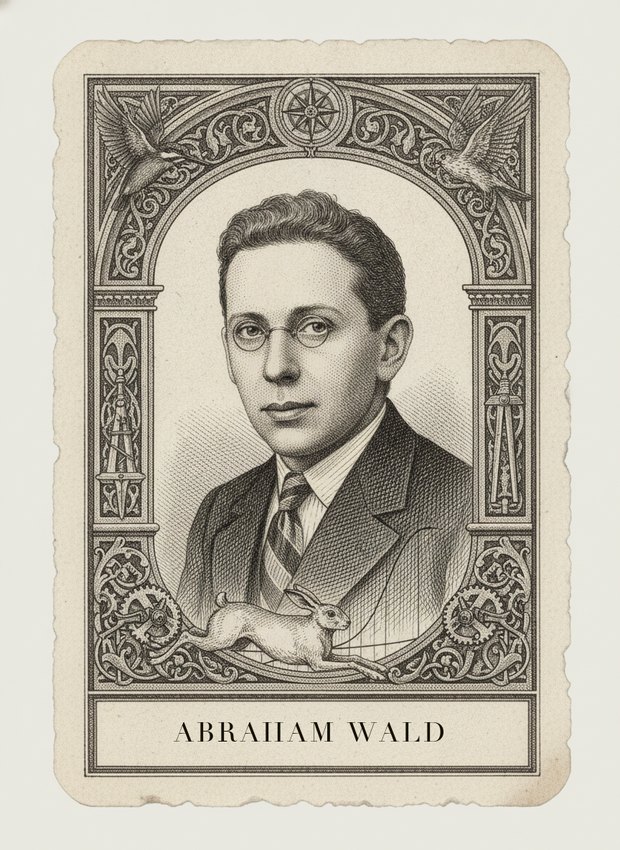
In 1943 Wald was doing precisely this kind of work at Columbia's Statistical Research Group, advising the U.S. military — his survivorship-bias memoranda on aircraft damage date from these years, and they show exactly the habit this problem demands: asking what the sampling mechanism hides. His 1939 reformulation of estimation as decision-making under loss translates 'overestimate delays the offensive, underestimate kills men' directly into an asymmetric loss function, and his sequential analysis, built for wartime munitions inspection, is a machine for extracting defensible conclusions from tiny samples with quantified error. The serial-number estimator itself is an exercise in sufficiency and order statistics, squarely within his mathematics. No one on this list better matches the year, the client, and the technique simultaneously.
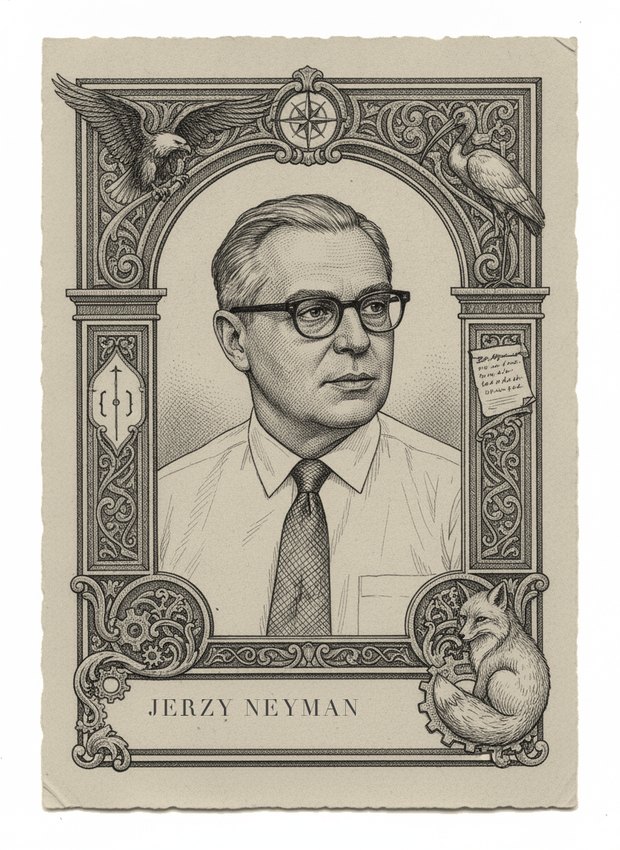
The canonical frequentist treatment of the German tank problem is a Neyman-style analysis: the sample maximum is the natural statistic, and the interval that 'quantifies how wrong it could be' is exactly the confidence-interval framework he published in 1937 — a pre-data coverage guarantee that an invasion planner can audit without accepting anyone's prior. His 1934 paper on survey sampling had already formalized inference about finite populations from partial samples, which is literally what a fleet of serially numbered tanks is. Neyman would state the sampling assumption (captures behave like random draws from 1..N), derive the estimator, and attach an interval whose error rate is a theorem. His toolkit was fully mature by 1943, and he spent the war consulting on military statistics. The fit is nearly exact.
In the mind map
The same ideas, as concepts rather than history — in John's ML knowledge map.
41 figures are scored on this problem. Draw it in a battle to see where you land.