information
Bet with information theory
It is the 1950s, and a gambler with a private wire — side information about horse races arriving just before the odds close — wants to know how fast a fortune can grow. You bet repeatedly on races with known odds, reinvesting your bankroll each time, and you have information the market lacks. Determine how to allocate your wealth across bets to maximize the long-run exponential growth rate — and discover that the achievable edge is measured precisely by the mutual information between your side data and the outcome. Betting and information theory are the same mathematics. Get it wrong and you over-bet and go broke in a bad run, or under-bet and leave exponential growth on the table — the log-optimal rule is the knife-edge between ruin and timidity.
Who this problem belongs to
The two figures whose methods fit it best, out of 30 in contention.
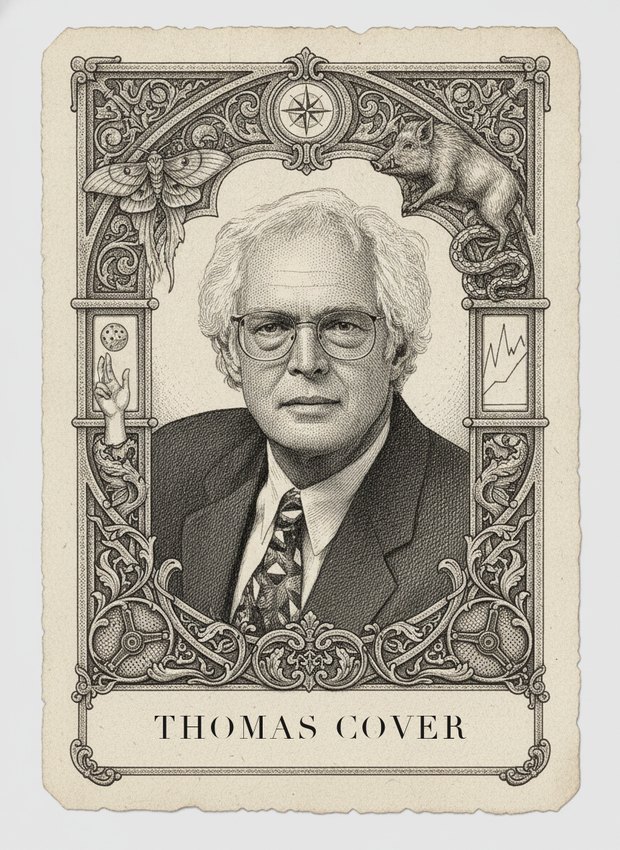
This problem is Cover's home game to a degree matched by no other pairing in the batch. The horse-race market is the running example of the gambling chapter of Cover and Thomas, which proves precisely the assertion in the problem statement: the increase in optimal doubling rate from side information equals the mutual information between the side data and the outcome — stated and proved as a theorem, with the log-optimal proportional-betting rule derived alongside and its dominance established. He then pushed the program beyond known distributions with universal portfolios (1991), achieving asymptotically the growth of the best constant-rebalanced portfolio chosen in hindsight, and with universal gambling schemes tied to data compression. He taught this material at Stanford for three decades; the problem could be lifted verbatim from his exercises. If the game has a designed winner, it is him.
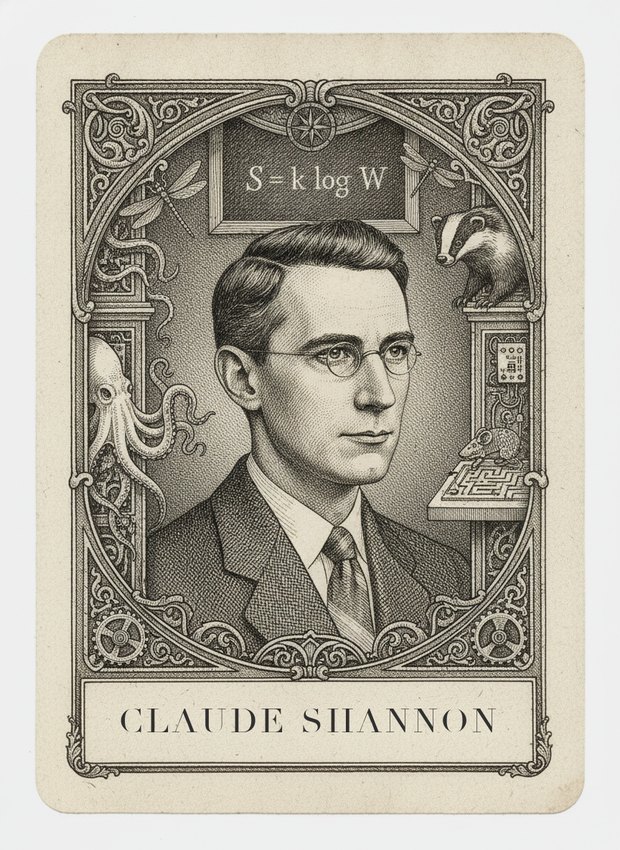
Kelly's 1956 paper was written down the hall from Shannon at Bell Labs and is framed, in its very title, as a new interpretation of Shannon's information rate: the gambler's achievable exponential growth from side information equals the mutual information of Shannon's 1948 theory, so the conceptual core of this problem is Shannon's own construction wearing a green eyeshade. He also lived the application: in the early 1960s he and Ed Thorp built a wearable device to predict roulette, and his later MIT years included well-attended lectures touching investment mathematics. The channel-with-side-information formalism, the logarithmic measure, the coding-theorem style of argument — all his. He ranks a notch below Cover only because Cover spent decades extending the program (universal portfolios, the full horse-race market theory) that Shannon founded but did not systematically develop for gambling himself.
In the mind map
The same ideas, as concepts rather than history — in John's ML knowledge map.
30 figures are scored on this problem. Draw it in a battle to see where you land.