testing
Signal or just noise?
It is the 1940s, and a radar operator's dilemma is being turned into mathematics: a blip on the screen is either a returning aircraft or a fluctuation of noise, and you must choose a decision rule that, for a fixed tolerable rate of false alarms, catches the most real targets possible. The claim to prove is sharp — that comparing the likelihood of the two hypotheses, and thresholding that ratio, is not merely a good rule but the most powerful one there is. Derive it, and defend why no other test detects more at the same false-alarm rate. Get it wrong and you either flood the operator with false alarms until the screen is ignored, or set the threshold so high that real bombers cross it unseen.
Who this problem belongs to
The two figures whose methods fit it best, out of 45 in contention.

This problem is the Neyman-Pearson lemma itself, published with Egon Pearson in 1933 while Neyman was building the modern hypothesis-testing framework and, later, the Berkeley statistics department. Neyman's entire contribution was formalizing the radar operator's dilemma in exact mathematical terms: fix the false-alarm rate (Type I error, size alpha), then maximize the probability of detection (power) over all tests at that size. The lemma proves the likelihood-ratio test achieves this maximum, using a direct comparison argument between any two tests of equal size that shows any deviation from the likelihood-ratio rule can only lose power. There is no closer historical match in this entire roster; this is not an analogy to Neyman's toolkit, it is Neyman's toolkit, applied to the exact problem he solved to found the field of power-optimal hypothesis testing.
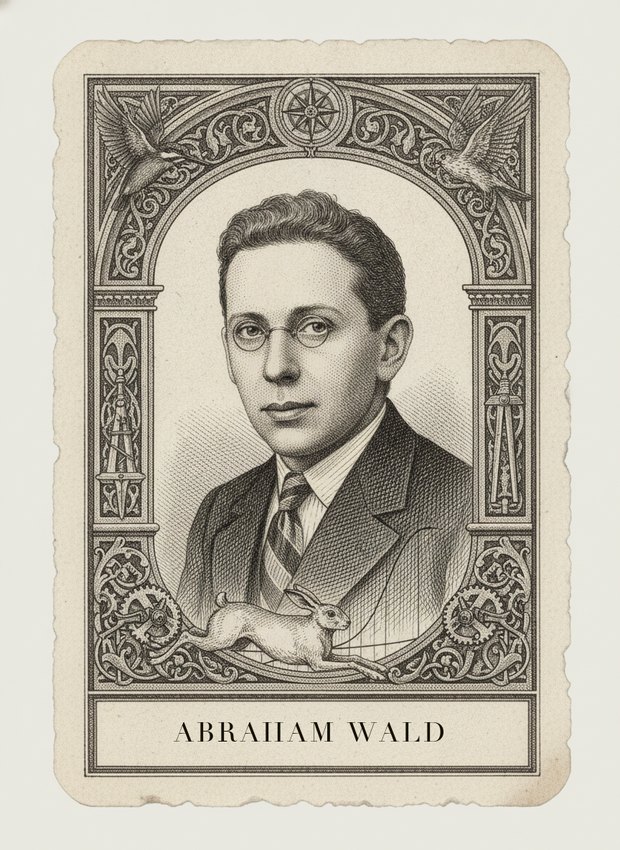
Wald was Neyman's contemporary at Columbia and Berkeley-adjacent statistics circles, and he generalized fixed-sample hypothesis testing into sequential analysis and statistical decision theory during WWII, where his Statistical Research Group evaluated exactly these detection and screening tradeoffs (aircraft losses, bomber vulnerability) under operational constraints. His sequential probability ratio test extends the Neyman-Pearson likelihood-ratio statistic to a streaming radar-blip setting, thresholding a running likelihood ratio against two boundaries to decide 'signal,' 'noise,' or 'keep watching' while controlling both error rates, and his general decision theory (loss functions, admissibility, minimax risk) supplies the language for justifying why likelihood-ratio-based rules are optimal. Wald's WWII-era operations research context makes his toolkit almost as directly on-point as Neyman's own, differing mainly in extending fixed-sample optimality to the sequential, real-time detection setting radar actually demands.
In the mind map
The same ideas, as concepts rather than history — in John's ML knowledge map.
45 figures are scored on this problem. Draw it in a battle to see where you land.