regression
Regression when the outcome is censored
It is 1972, and a study of a cancer therapy must relate survival time to patient covariates — but many patients are still alive when the study ends, so their true survival times are unknown, only known to exceed some value. Throwing those censored patients out biases everything; pretending they died at last contact biases it the other way. Model the effect of covariates on the hazard of dying without assuming a shape for the baseline survival curve, estimating the coefficients from the order in which events occur. Get it wrong and a treatment's benefit is mismeasured because the longest survivors — the very successes — were discarded as incomplete, and the semiparametric trick of leaving the baseline unspecified is what makes honest survival regression possible.
Who this problem belongs to
The two figures whose methods fit it best, out of 51 in contention.
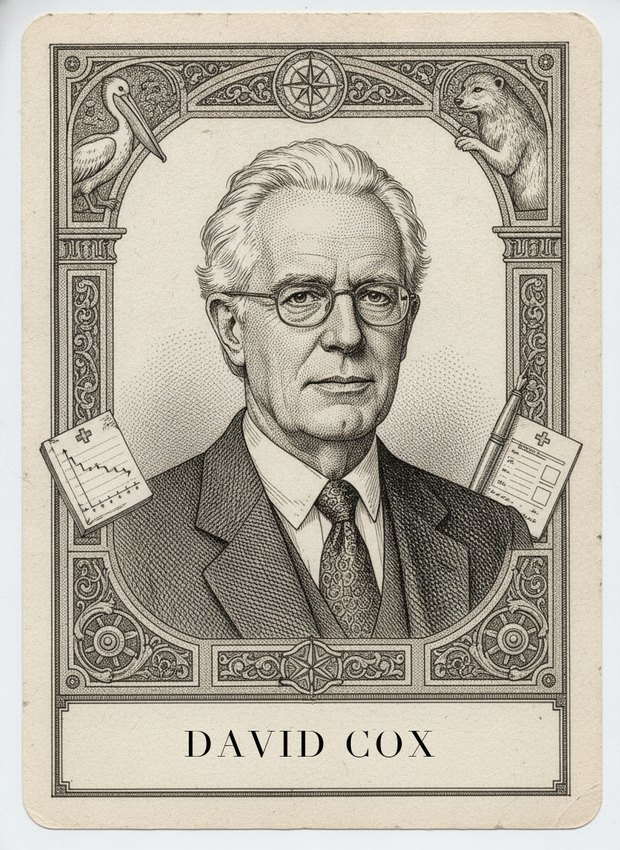
This problem is not an analogy to Cox's career, it is his career. His 1972 paper 'Regression Models and Life-Tables,' presented to the Royal Statistical Society, invented exactly the method this problem describes: relate covariates to the hazard of an event without specifying the baseline hazard's shape, estimating coefficients from the order in which failures occur via the partial likelihood, so censored survivors contribute information without requiring a guess at their unobserved death times. Working in Britain in the early 1970s on medical and industrial failure-time data, he built the semiparametric trick — leaving the baseline unspecified — that is the entire intellectual crux of this problem. The proportional-hazards assumption itself bears his name. No other figure on this roster originated this method; everyone else is applying, extending, or critiquing what Cox built.
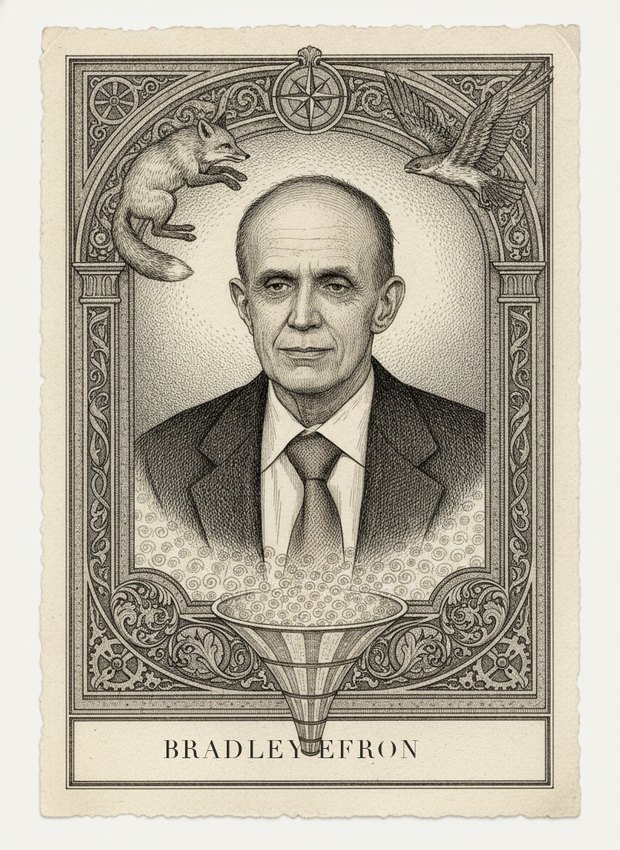
Efron's 1977 paper on the efficiency of Cox's partial likelihood proved, using martingale and information-theoretic arguments, that the semiparametric method loses remarkably little compared to a hypothetical fully parametric model — a foundational justification for trusting the exact approach this problem calls for. His broader work on the bootstrap, developed in 1979, was quickly extended by others to resample censored survival data and the Kaplan-Meier curve itself, giving censored-data inference a second load-bearing pillar beyond Cox's own machinery. He was a close contemporary of Cox and worked the same medical-statistics terrain at Stanford. He scores just below Cox because he rigorously justified and extended the method rather than inventing the proportional-hazards regression itself.
In the mind map
The same ideas, as concepts rather than history — in John's ML knowledge map.
51 figures are scored on this problem. Draw it in a battle to see where you land.