information
The optimal codebook
It is 1951 at MIT, and a graduate student is offered a choice: take the final exam, or solve an open problem about building the most efficient code. He takes the problem. Given the frequencies of symbols in a message, assign each a binary codeword so that no codeword is a prefix of another and the expected length is provably minimal — not merely good, but the shortest such code that exists. The trick is to build it bottom up, repeatedly merging the two least frequent symbols. Prove it optimal, not just clever. Get it wrong and every stored file and transmitted message carries needless bits at planetary scale, or you settle for a heuristic that looks fine and quietly wastes a few percent, forever.
Who this problem belongs to
The two figures whose methods fit it best, out of 42 in contention.
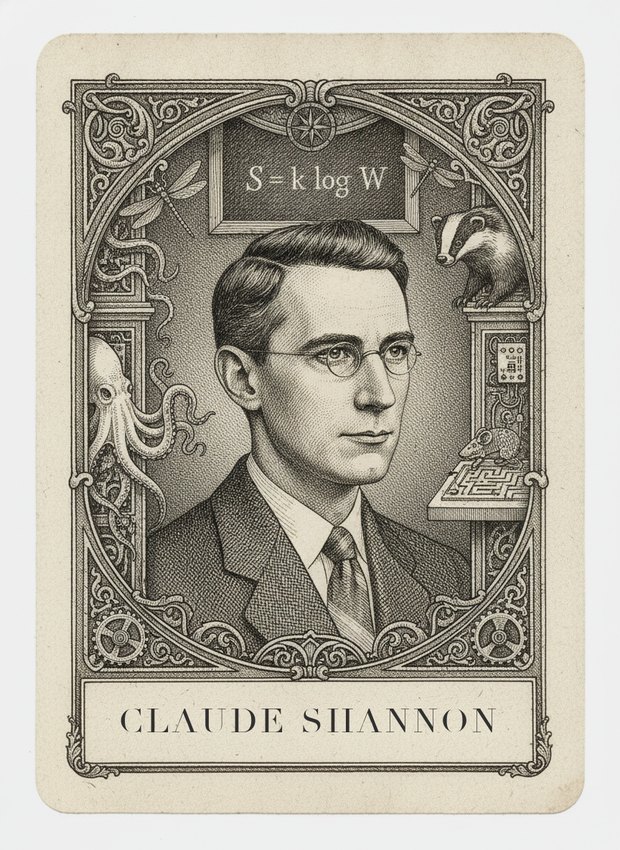
This problem is Shannon's own intellectual territory laid bare: his 1948 paper 'A Mathematical Theory of Communication' established entropy as the fundamental limit on compression and posed exactly the question of how close a real, hand-computable code can get to that limit. David Huffman's 1951 construction, produced as an MIT graduate student choosing an open problem over a final exam under Robert Fano, directly answers a question Shannon's own framework raised and that Shannon-Fano coding had only partially solved. Shannon did not personally invent the specific bottom-up merging algorithm, that credit belonging to Huffman, but every concept the problem requires — entropy, expected code length, prefix-free codes, optimality relative to a known distribution — is Shannon's own invention, making him the deepest possible fit.
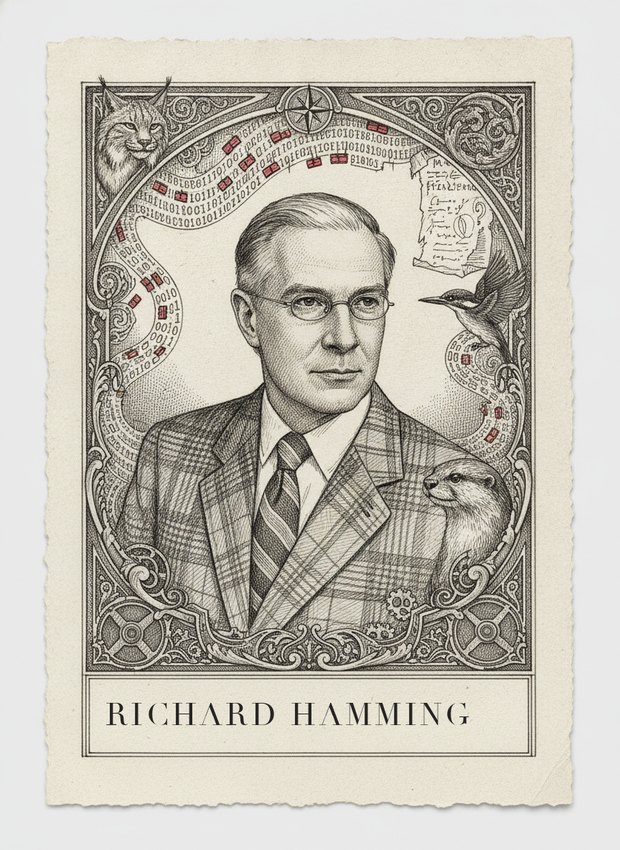
Hamming's career at Bell Labs, overlapping directly with Shannon's and running through exactly the same 1940s and 1950s period that produced this problem, was devoted to the mathematics of efficient, reliable representation of information — his 1950 error-correcting codes address a closely related question about redundancy and structure in symbol encoding. His deep, practical fluency with entropy, symbol probabilities, and the combinatorics of binary codes gives him genuine, professional-grade proximity to the Huffman construction's mathematical apparatus, even though his own celebrated contribution addresses error correction rather than expected-length minimization. Working in the same institutional and intellectual environment as this problem's 1951 setting, Hamming is an outstanding, historically grounded fit. His own celebrated coding contribution addresses a closely related but formally distinct question about error correction.
In the mind map
The same ideas, as concepts rather than history — in John's ML knowledge map.
42 figures are scored on this problem. Draw it in a battle to see where you land.