search
Search deep on a shoestring of memory
It is the era when the best-guided search algorithms hit a wall that is not time but memory: the frontier they must remember grows exponentially, and the machine runs out of storage long before it runs out of patience. On the hardest puzzles, the elegant best-first search cannot fit its own frontier in RAM. Redesign the search to spend time instead of space — deepen exploration in bounded iterations that each keep only a single path in memory, re-searching shallow layers rather than storing the whole frontier, while still returning provably optimal solutions under an admissible heuristic. Get it wrong and you exhaust memory and crash on solvable ones, or throw away the heuristic and wander blindly — memory-bounded search is what lets deep, informed search run on finite hardware.
Who this problem belongs to
The two figures whose methods fit it best, out of 64 in contention.
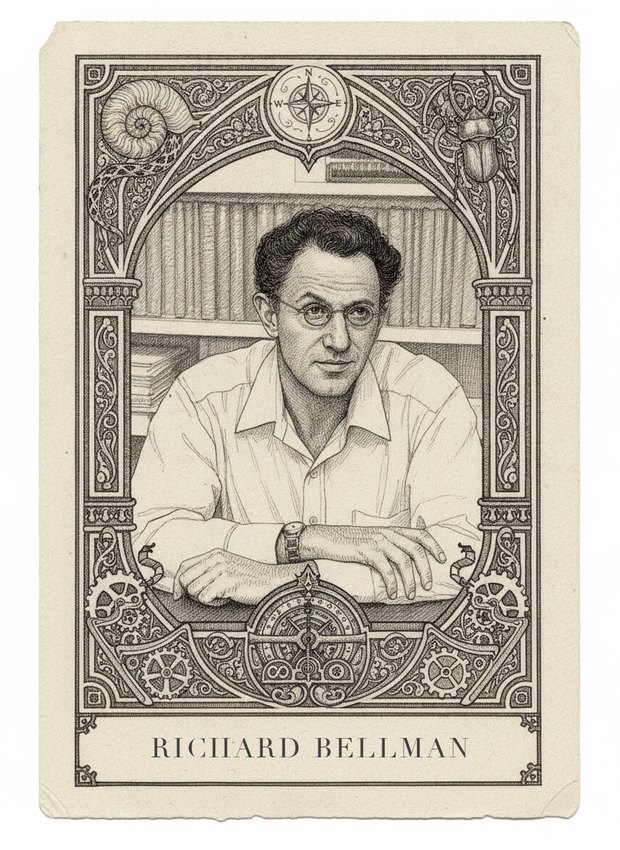
Bellman's dynamic programming and his 'curse of dimensionality' name precisely why the best-first search frontier this problem describes grows exponentially and cannot fit in memory: each additional layer of a search tree multiplies the number of states that must be remembered if stored explicitly. His broader recursive-decomposition philosophy, solve a problem by relating it to smaller subproblems rather than storing every intermediate result, is the direct conceptual ancestor of trading time for space: re-derive a value when needed rather than cache it forever. His own dynamic-programming formulation typically assumes memory is available for a table, the opposite tradeoff IDA*-style memory-bounded search makes, which is the main reason his score, while strong, does not reach the very top of this card.
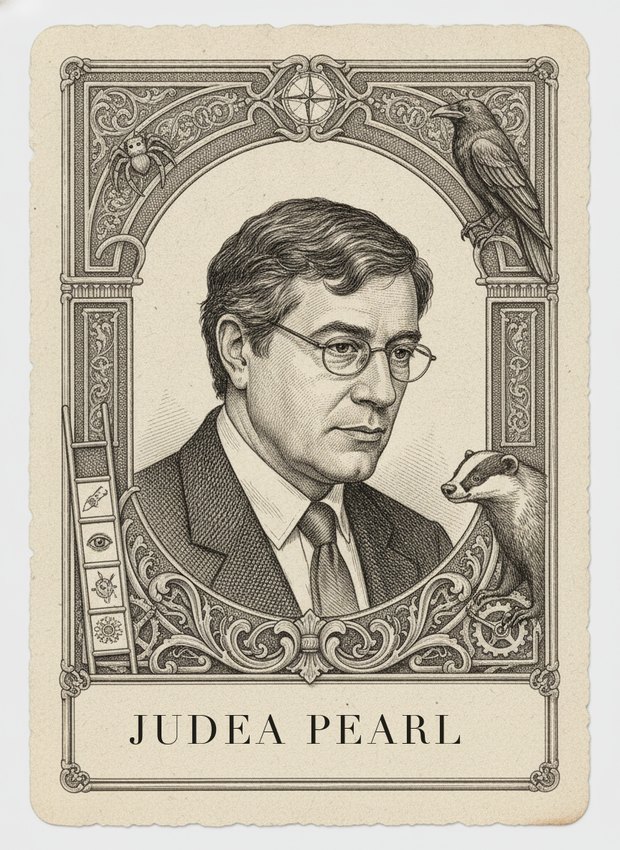
Pearl's Heuristics: Intelligent Search Strategies for Computer Problem Solving (1984) is the definitive systematic treatment of admissible heuristic search, and his analysis of A*'s memory requirements, the exponentially growing frontier this problem's 'cannot fit its own frontier in RAM' describes, directly motivated the memory-bounded search variants (IDA*, developed by his student-adjacent lineage of researchers) that solve exactly this problem. His rigorous treatment of what a heuristic must guarantee (admissibility) to preserve optimality under any search strategy, including memory-bounded ones, is the theoretical bedrock this problem's 'still returning provably optimal solutions' requirement rests on. He did not personally invent IDA* itself (Korf, 1985), which is the only reason his score is not higher.
In the mind map
The same ideas, as concepts rather than history — in John's ML knowledge map.
64 figures are scored on this problem. Draw it in a battle to see where you land.