games
The exchange with no prices
It is 2004, and thousands of kidney patients have a willing donor whose organ their body will reject — while across town, another mismatched pair faces the mirror problem. Money is illegal here; the market must clear without prices. Design the exchange: find cycles and chains of compatible swaps in the graph of incompatible pairs, decide how long a chain surgery logistics can tolerate, and make truth-telling about compatibility the hospitals' best strategy — because a hospital that hides its easy matches to game the pool condemns strangers elsewhere. The optimization is combinatorial, the incentives are the hard part, and the stakes are exact: every improvement in the matching algorithm is measured in transplants that otherwise do not happen.
Who this problem belongs to
The two figures whose methods fit it best, out of 53 in contention.
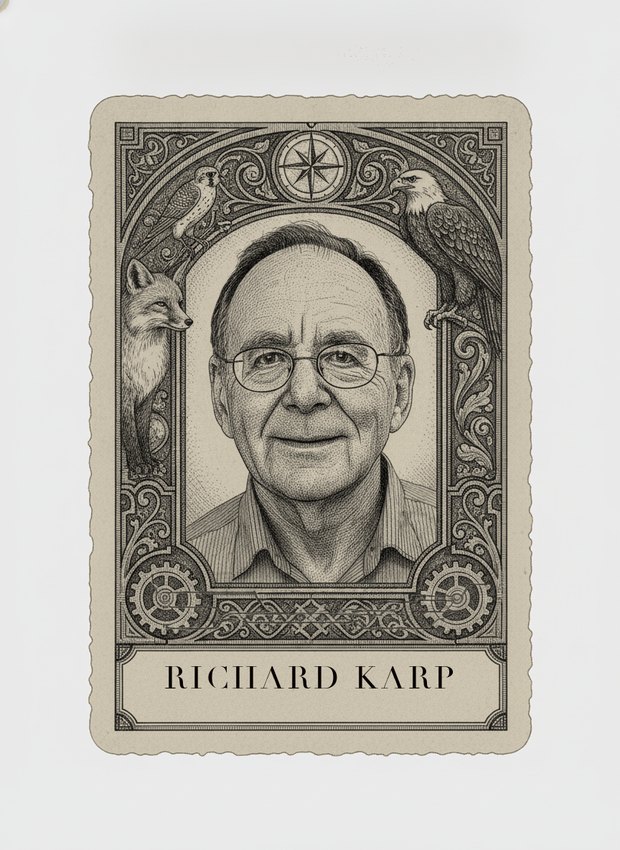
Karp's career-defining work on combinatorial optimization and graph algorithms, including his 1972 classification of NP-complete problems and his foundational contributions to matching theory, is close to the literal mathematics of the kidney-exchange problem: finding cycles and chains of compatible swaps in a graph of incompatible donor-patient pairs is exactly the kind of combinatorial matching problem his career addressed, and the practical algorithms used by real kidney-exchange programs descend directly from the efficient-matching tradition he helped found. His interest in what makes large combinatorial problems tractable is directly on point for deciding, at national scale, which chains are computationally and logistically feasible to execute. Karp did not work on kidney exchange or incentive-compatible hospital participation specifically, which keeps this shy of a perfect score, but the graph-matching core is squarely his terrain.
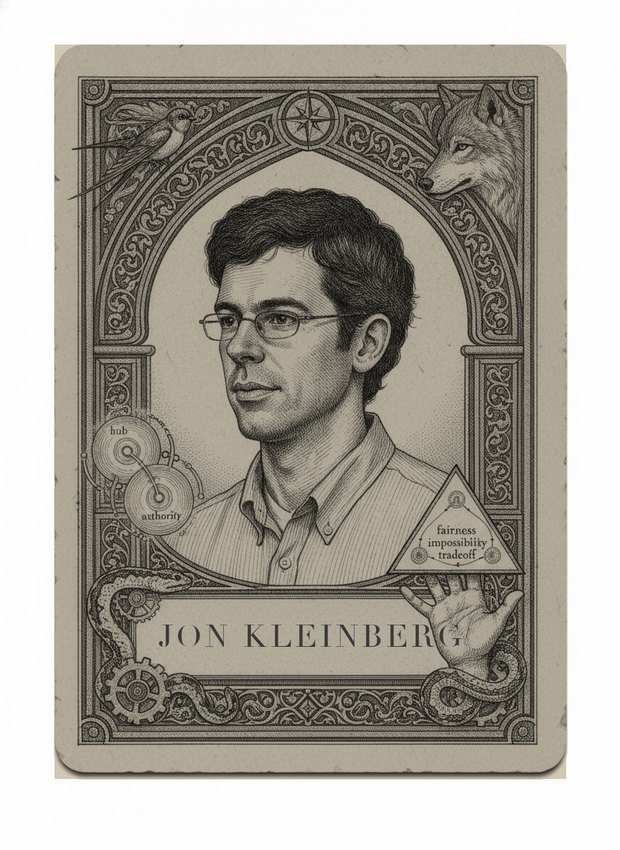
Kleinberg's research in algorithmic game theory and network structure addresses precisely the two-part challenge the kidney exchange poses: finding good matches in a combinatorially complex compatibility graph, and designing the mechanism so that hospitals cannot profitably game the pool by hiding easy matches. His work treating strategic behavior as a computational object, asking not just what a good matching is but how to make truthful participation the dominant strategy for self-interested institutions, is exactly the incentive-compatibility problem central to real kidney-exchange design. Kleinberg did not build or run an actual kidney-exchange program himself, and the specific surgical-logistics constraints on chain length sit outside his published research, but the combined graph-matching-plus-incentive-design framing is close to his own signature research territory.
In the mind map
The same ideas, as concepts rather than history — in John's ML knowledge map.
53 figures are scored on this problem. Draw it in a battle to see where you land.