causality
Calculus for a jagged path
It is 1944 in wartime Japan, and a young mathematician working in near-total isolation is confronting a scandal at the foundation of probability: Brownian motion is continuous everywhere and differentiable nowhere, so the ordinary calculus — the chain rule itself — fails on exactly the random paths that physics and finance need most. Build the calculus that works: define integration against a process of unbounded variation, derive the correction term that replaces the chain rule, and make stochastic differential equations a rigorous object rather than a physicist's shorthand. Get it wrong and diffusion, filtering, and every model of noisy dynamics stays heuristic; get it right and — decades on — option markets, control theory, and sampling algorithms all run on this arithmetic.
Who this problem belongs to
The two figures whose methods fit it best, out of 60 in contention.
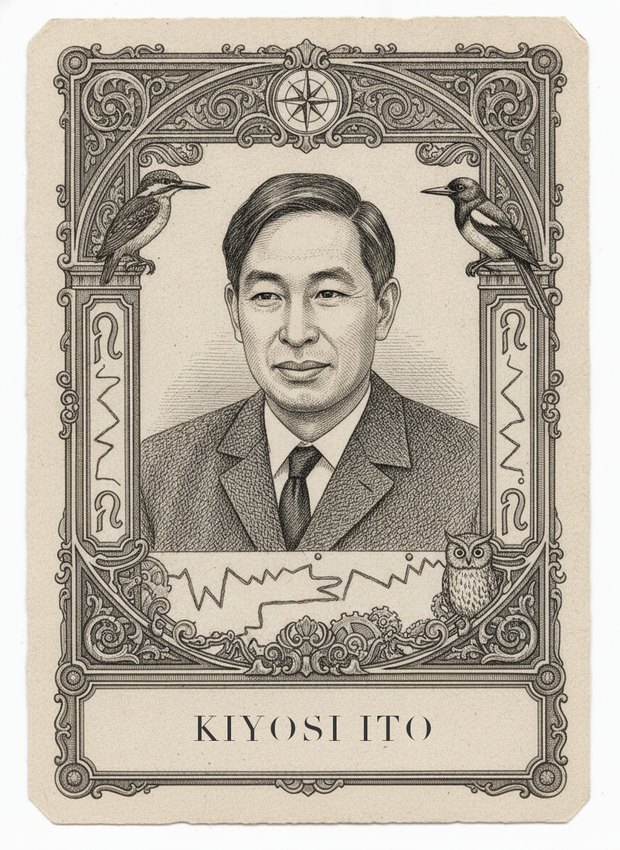
Ito is the problem. Working in near-total isolation in wartime Japan, publishing his foundational papers in 1942 and 1944 while cut off from the international mathematical community, he confronted directly the scandal the problem describes: Brownian motion is continuous everywhere and differentiable nowhere, so ordinary calculus fails on exactly the paths that physics and probability needed most. His solution, defining an integral against Brownian motion and deriving the correction term, now called Ito's lemma, that replaces the ordinary chain rule, is precisely the rigorous stochastic calculus the problem asks be built. Decades later this arithmetic underlies option pricing, control theory, and sampling algorithms exactly as the problem describes. This is not a transferable skill applied to the case; it is the actual historical event, which is why the score sits at the absolute ceiling.
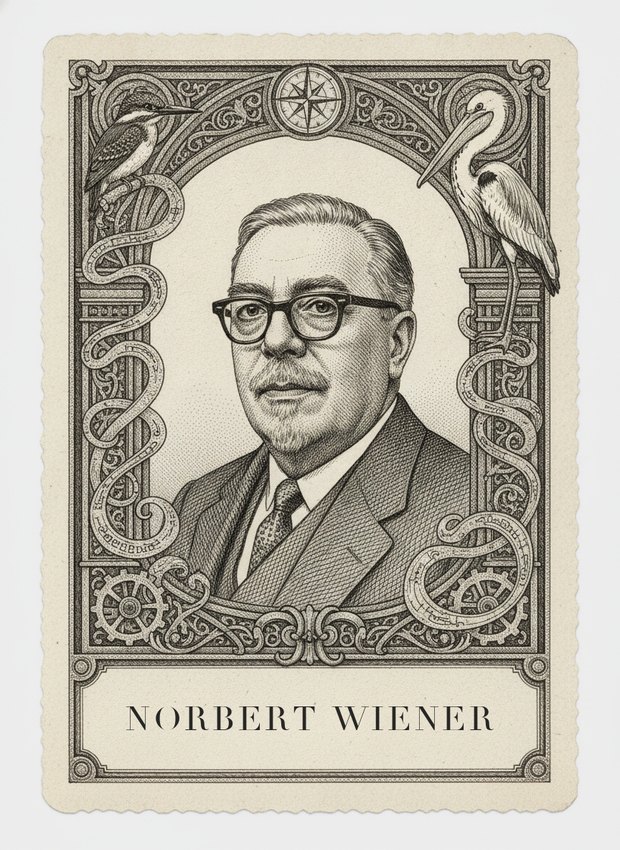
Wiener's rigorous 1920s mathematical construction of Brownian motion, what is now called the Wiener process, gave probability theory the first fully rigorous continuous-time stochastic object with the jagged, nowhere-differentiable sample paths the problem describes, work that directly preceded and made possible Ito's later calculus built on top of it. His subsequent work on cybernetics and optimal filtering in continuous time, developed through the 1940s, applied exactly this kind of continuous stochastic-process reasoning to real engineering problems of noisy signal estimation. But Wiener himself did not build the differential calculus, the chain-rule correction term, needed to manipulate functions of his process; that specific missing piece was Ito's 1944 contribution, working independently and largely unaware of Wiener's parallel Western developments, which is why Wiener sits just below Ito despite supplying the essential underlying object.
In the mind map
The same ideas, as concepts rather than history — in John's ML knowledge map.
60 figures are scored on this problem. Draw it in a battle to see where you land.